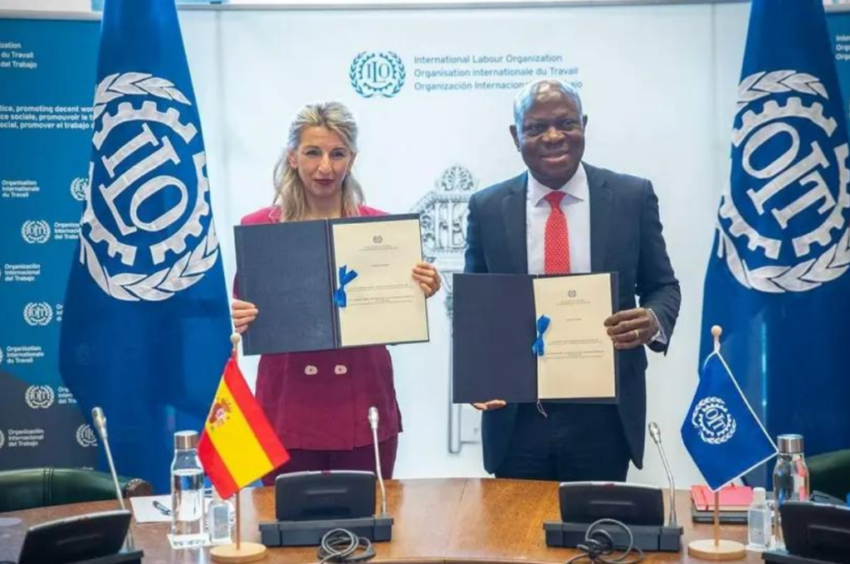
The re-election of Togolese leader Gilbert Houngbo as Director-General of the International Labour Organization (ILO) in November 2026 marked a turning point for the UN agency, but not without controversy. His uncontested victory followed the last-minute withdrawal of Spanish Labour Minister Yolanda Díaz, who accused the outgoing administration of mismanagement, financial crisis, and weakened social dialogue within the organization.
From rivalry to withdrawal: the unexpected shift in ILO’s election
Gilbert Houngbo’s second term at the ILO was secured after Yolanda Díaz unexpectedly abandoned her candidacy just days before the vote. Initially seen as his main challenger, Díaz’s decision left Houngbo as the sole candidate, raising questions about the organization’s electoral process and governance legitimacy.
In a public statement, Díaz framed her withdrawal as a gesture to preserve unity within the global labour movement. However, she did not shy away from criticising the ILO’s financial mismanagement, which she described as one of the most severe crises in the organization’s history. Her remarks underscored deep divisions not just over leadership, but over the very future of worker rights worldwide.
The financial strain: a growing burden on workers
At the heart of Díaz’s criticism was the ILO’s financial crisis, exacerbated by delayed and unpaid contributions from key member states, particularly the United States. The deficit forced the organization to implement drastic cost-cutting measures, including staff reductions and restructuring plans that critics argue disproportionately impact workers.
The outgoing administration defended its approach, citing the need for fiscal responsibility. Yet Díaz contended that these measures weakened the ILO’s core mission of promoting social justice and decent work. The controversy intensified when staff unions within the ILO raised concerns over consultation failures and the erosion of social dialogue—ironic for an agency charged with defending labour rights on a global scale.
“The workers of the ILO deserve the social dialogue they advocate for others,” Díaz stated, highlighting a paradox where the institution tasked with protecting labour rights faces internal strife and declining morale among its own employees.
Divided labour movement: why Yolanda Díaz stepped aside
Díaz’s withdrawal was not merely a response to financial mismanagement; it reflected broader tensions within the international labour movement. The International Trade Union Confederation (ITUC) had already endorsed Houngbo, a decision Díaz criticised as misaligned with the sentiments of many workers. She also questioned the process behind the endorsement, warning that it risked further fracturing the labour movement.
Her decision followed that of Peruvian candidate Javier González-Olaechea, whose exit left the field open for Houngbo. By stepping aside, Díaz sought to prevent long-term divisions among unions, framing her move as an act of solidarity. Yet her criticism of the process cast a shadow over Houngbo’s legitimacy, even in the absence of electoral competition.
Houngbo’s new mandate: navigating a minefield of challenges
A fragile mandate in a time of crisis
While Houngbo’s re-election guarantees continuity, the circumstances surrounding his victory leave little room for complacency. The financial instability, staff unrest, and strained relations with labour partners pose immediate threats to the ILO’s credibility and effectiveness. Without electoral opposition to legitimise his mandate, the burden falls on his administration to restore confidence.
The new term demands more than just policy adjustments; it requires tangible proof that the ILO can address its crises without diluting its founding principles of social justice and tripartite dialogue. For workers and employers alike, the next five years will be a test of whether the organization can reclaim its role as a beacon for fair labour practices.
What’s next for the global labour landscape?
The fallout from this election extends beyond the ILO’s headquarters in Geneva. Workers’ rights advocates worldwide are watching closely, as the organization’s ability to recover from its financial and reputational slump will influence labour policies across continents. Whether Houngbo’s leadership can bridge internal divides—or whether Díaz’s warnings were prescient—remains to be seen.
The stakes are high. The ILO’s mission is indispensable in an era where global supply chains, remote work, and economic disparities strain labour standards. For the millions of workers it purports to represent, the next five years may determine whether the organization can transform its struggles into strength—or succumb to the very crises it was designed to combat.