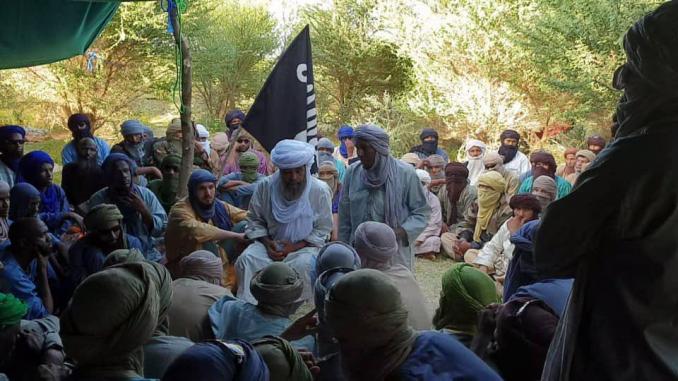
The Group for the Support of Islam and Muslims (JNIM), an Al-Qaeda-linked jihadist faction, is rapidly expanding its influence across Mali, with military operations intensifying despite counter-terrorism efforts led by national forces and international allies. Ambushes on patrols, coordinated attacks on military outposts, and systematic pressure on key transport routes reveal the group’s growing operational reach.
Regional spillover: when terror spreads beyond Mali
Though the crisis originated in Mali, it now threatens neighboring countries across the Sahel. The escalation alarms regional governments and international observers alike. Weak governance, severe economic crises, and porous borders create fertile ground for jihadist groups to thrive. Mali’s instability risks metastasizing into a broader regional emergency.
A shift from mobility to territorial control
Recent attacks in five villages near Bandiagara—claimed by the JNIM—highlight a deliberate strategy of territorial consolidation. Unlike purely mobile insurgent tactics, this faction now exploits local conflicts, weak state presence, and community grievances to embed itself in rural areas. It imposes shadow governance: arbitrating disputes, regulating movement, and imposing informal tax systems. Where the state falters, the JNIM seeks to replace it.
This shift explains why purely military responses often fail. Even when operations reclaim territory, absent restored governance—administrative, judicial, or economic—the gains remain fragile and temporary.
Military sovereignty vs. persistent violence in Mali
Since the withdrawal of French forces and the growing partnership with Russian private military contractors, Bamako has prioritized military independence. Authorities frame this as a break from Western security dependence. Yet on the ground, violence continues unabated, and armed groups retain high mobility.
Accusations of human rights abuses involving Malian troops and allied foreign forces have surfaced from multiple international organizations. Bamako consistently denies these claims, accusing foreign actors of orchestrating destabilization campaigns. This polarization further shrinks the space for political mediation.
The Sahel’s widening geopolitical chessboard
The Sahel is increasingly a battleground for global influence. Russia, Turkey, Gulf states, Western powers, and regional actors all vie for strategic footholds. In this fragmented landscape, jihadist groups exploit state rivalries, border closures, and the collapse of regional cooperation.
The gravest risk is the normalization of chronic insecurity. Vast areas now exist in a precarious balance—neither fully controlled by the state nor by armed factions. As uncertainty looms over the future of foreign mercenary support, including the potential withdrawal of Africa Corps units from conflict zones, the question lingers: how far will the violence escalate?
Mourad Ighil