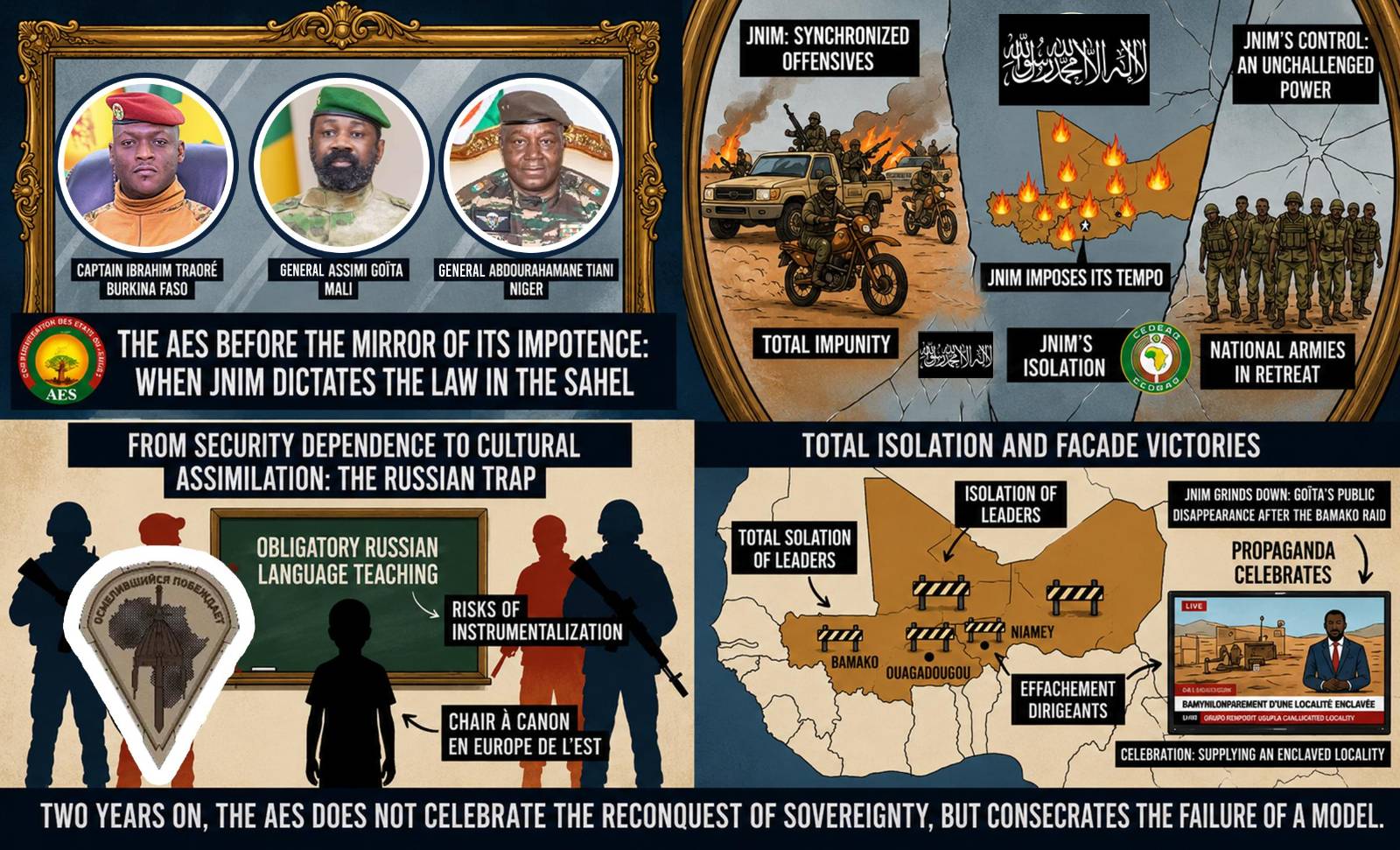
The once-bold Alliance of Sahel States (AES) is now showing cracks in its armour. Despite the rousing speeches of Mali, Burkina Faso, and Niger’s military leaders about reclaiming sovereignty, the harsh truth on the ground tells a different story. The only force maintaining real coordination, dictating the pace of operations, and striking at will across the region is the Group for the Support of Islam and Muslims (JNIM).
Political ineptitude and hollow bravado from these military regimes are no match for the JNIM’s devastating efficiency. The group orchestrates large-scale, synchronized offensives that target multiple strategic areas at once, overwhelming even well-equipped national armies. Neither the supposed intelligence-sharing agreements within the AES nor the full geopolitical alignment with Moscow have managed to stem the tide of losses.
From security reliance to cultural assimilation: the Russian trap
Faced with this reality, Captain Ibrahim Traoré and his counterparts have turned to Russia for salvation. But this partnership has evolved far beyond mere military support or the deployment of former Wagner mercenaries, now rebranded as the Africa Corps. A recent decision to introduce the Russian language into Burkina Faso’s school curriculum starting next term signals a major ideological shift. Marketed as a bold move toward cultural decolonization, this policy instead sets the stage for deeper psychological and structural control over the nation’s youth.
The implications of this linguistic shift go beyond simple education reform. By embedding Russian into the school system, the regime is laying the groundwork for a future generation that is ideologically and practically aligned with Moscow. There are growing concerns that this strategy could serve as a pipeline for sending young Burkinabè to Russia under the guise of education or training—only to be exploited in future conflicts far removed from the Sahel. In a world increasingly divided by global tensions, the fear is real: that these Sahelian youths could become expendable pawns or human shields in wars not of their making, all to repay Russia for its military backing.
Total isolation and hollow victories
While these cultural and military shifts unfold, the JNIM continues its relentless campaign. By crippling the three regimes, the armed group has pushed their leaders into a state of near-total isolation. In Mali, the prolonged absence of Assimi Goïta from public life—particularly after the deadly Bamako raid that reportedly killed the Defence Minister—stands as a stark example of this isolation.
The bitter truth is undeniable: while terrorists steadily carve out more territory, the military leaderships of these nations are drowning in political absurdity. Today, their official propaganda channels celebrate minor logistical achievements or token defensive responses as major victories. This only underscores their deep-seated powerlessness.
As the AES marks its second anniversary, it is not celebrating a triumphant reclaiming of sovereignty but rather the collapse of a failed model. By mistaking war propaganda for military strategy and swapping one foreign dependency for cultural and military subjugation to Moscow, the juntas have handed the JNIM the reins. The Sahel has not won its freedom; it has merely traded one set of masters for another—and its youth will bear the heaviest cost.