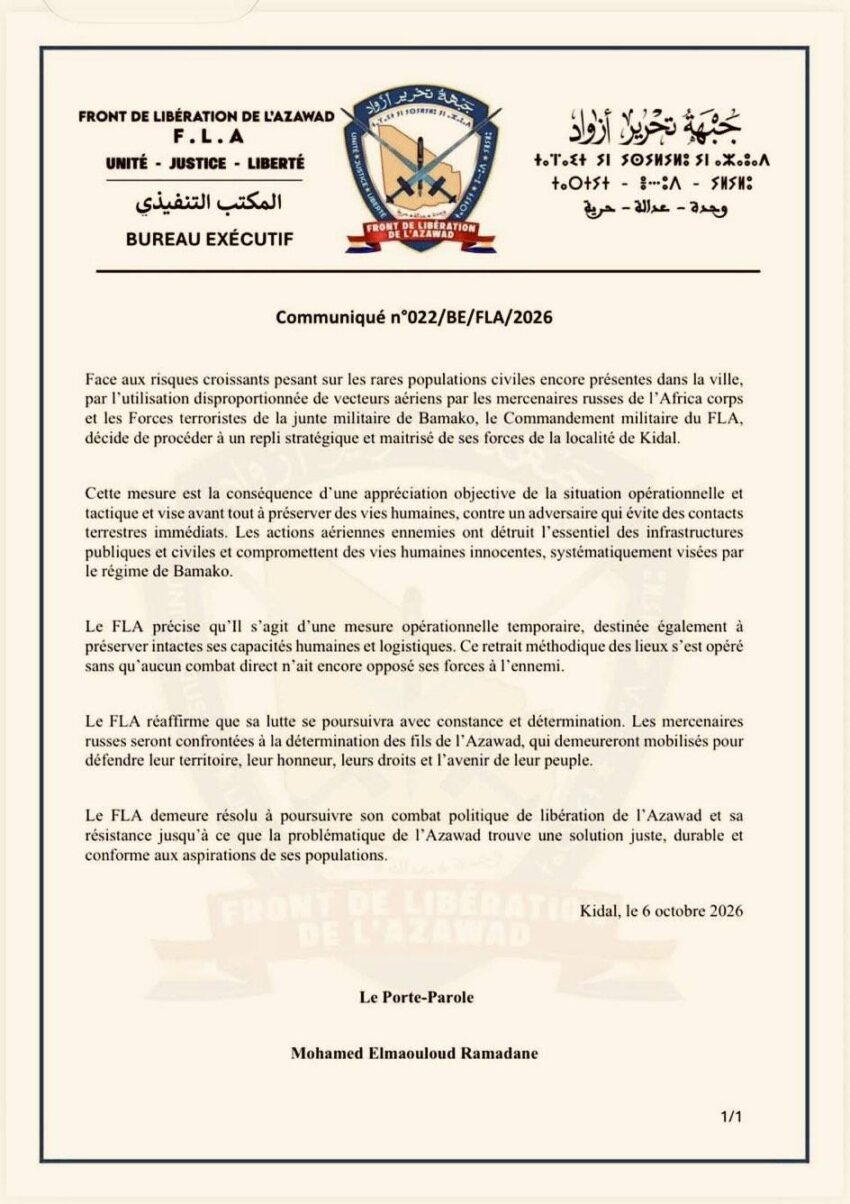
The announcement landed like a thunderclap in northern Mali: the Front de libération de l’Azawad (FLA) says it has withdrawn its forces from Kidal, framing the move as a “controlled strategic pullback.” The separatist movement insists its fighters left the town without a direct ground battle and that the decision is only temporary. Yet the fallout has been immediate — in Bamako, in the desert camps of the Azawad, and far beyond Mali’s borders. Allies, analysts and ordinary citizens are all asking the same question: what does this withdrawal actually mean for the next phase of the war?
Reactions have been swift and sharply divided. Supporters of the independence movement read the pullout as proof of disciplined military planning, not surrender. Officials in Bamako, by contrast, have been far more guarded, wary of handing their adversaries a political victory by commenting too quickly. Among civilians in the north, the mood is a mixture of exhaustion and apprehension — few believe the departure of FLA fighters from Kidal will bring calm.
Why Kidal still matters more than any other town
Kidal has never been an ordinary city in this conflict. Perched in Mali’s far north, it has served for decades as a cradle of Tuareg rebellion. For Bamako and for the independence movements alike, holding the town carries military weight — but also deep political and symbolic value.
Government forces retook Kidal in November 2023 with backing from Russian units then operating under the Wagner banner. The transitional authorities hailed the recapture as a landmark step toward restoring Mali’s territorial integrity. Independence groups had left the town ahead of the government advance, explaining even then that they wanted to shield their fighters from overwhelming firepower.
Nearly three years later, the balance of power flipped. In April 2026, the FLA claimed it had retaken Kidal at the end of a coordinated offensive spanning several regions of Mali. Elements of Africa Corps — the structure that replaced Wagner in Russia’s Mali deployment — left the town under escort. At least 400 Russian paramilitaries were evacuated from Kidal toward Tessalit.
A familiar playbook: the strategic pullback
Against that backdrop, the FLA’s latest announcement deserves careful reading. The movement presents its exit as a military decision aimed at avoiding a direct confrontation and preserving its fighting capacity.
There is nothing new about this logic in the Azawad conflict. For independence groups, abandoning a position temporarily has never meant giving up territorial ambitions. The Malian desert offers fighters enormous strategic depth: mobile units, intimate knowledge of the terrain, and the ability to disperse before reappearing on key axes.
The phrase “strategic pullback” was already in use after government forces retook Kidal in 2023. At the time, independence fighters said they wanted to avoid further losses in the face of airstrikes and the advance of government and Russian forces. The context today is different: the FLA has seized the initiative across several zones in the north. Its withdrawal from Kidal, if confirmed as described, may reflect a desire to keep its forces intact rather than a classic military defeat.
What past offensives have cost
The recent history of the conflict shows how expensive battles around Kidal and the Algerian border can be.
In May 2014, the Malian army launched an offensive to retake Kidal from Tuareg groups. The fighting swung in the rebels’ favor. Casualty figures were fiercely disputed: Malian authorities spoke of roughly 20 soldiers killed and 30 wounded, while the MNLA cited higher numbers. A later MINUSMA report confirmed at least 33 Malian force members and eight civilians killed, while stressing that the overall toll remained uncertain. That battle still matters for understanding the military trauma attached to Kidal. A decade later, the town’s recapture in November 2023 carried enormous symbolic weight for Bamako.
Tinzaouatène: the 2024 setback that still haunts
The most spectacular precedent remains Tinzaouatène, near the Algerian border, in July 2024.
A column of Malian soldiers and Russian Wagner fighters was caught in fierce clashes with Tuareg armed groups. The fighting, worsened by a sandstorm, caused heavy losses. Wagner acknowledged significant casualties, and subsequent research identified several Russian fighters killed or missing.
The CSP, the coalition from which the FLA emerged, claimed the deaths of 84 Wagner fighters and 47 Malian soldiers — 131 in total. Those figures were never officially confirmed by Bamako or Moscow and should be treated as a rebel claim. The Malian army initially reported a far lighter toll of two soldiers killed and ten wounded, before its general staff acknowledged “a significant number” of losses without giving a figure. The battle stands as one of the most serious reverses for the Russian presence in Mali.
From Wagner to Africa Corps: the same hard problem
The gradual replacement of Wagner by Africa Corps has not removed the difficulties facing Bamako’s Russian partners. Fighting in the north shows that technological superiority and heavy equipment do not always decide the outcome in a Sahelian environment where mobility, local intelligence and terrain knowledge are decisive.
Africa Corps’ withdrawal from Kidal in April 2026 was already a highly symbolic setback. Months later, Russian and Malian forces kept battling to hold strategic positions in the region. At Anéfis, government forces regained control of the town in July 2026 after several days of fighting with independence fighters. The balance of power remains extremely fluid.
The debate ahead: a pause or a new chapter?
The FLA’s announcement should ultimately be read against this long sequence of offensives and retreats. In northern Mali, a town can change hands without the war being truly decided.
For the FLA, preserving fighters, logistics and civilian populations may be a strategic priority. For Malian forces and their Russian allies, any loss of ground remains vulnerable to political exploitation by their adversaries.
Kidal is therefore far more than a military objective. It embodies the historic heart of the Azawad claim and stands as one of the key symbols of the confrontation between Bamako’s central power and Tuareg independence movements. If the announced withdrawal is indeed temporary, the essential question now is where the FLA intends to concentrate its forces — and whether a new offensive is being prepared. In a conflict where “strategic pullbacks” have often preceded fresh battles, the departure from Kidal may look less like an ending than another stage of the war.