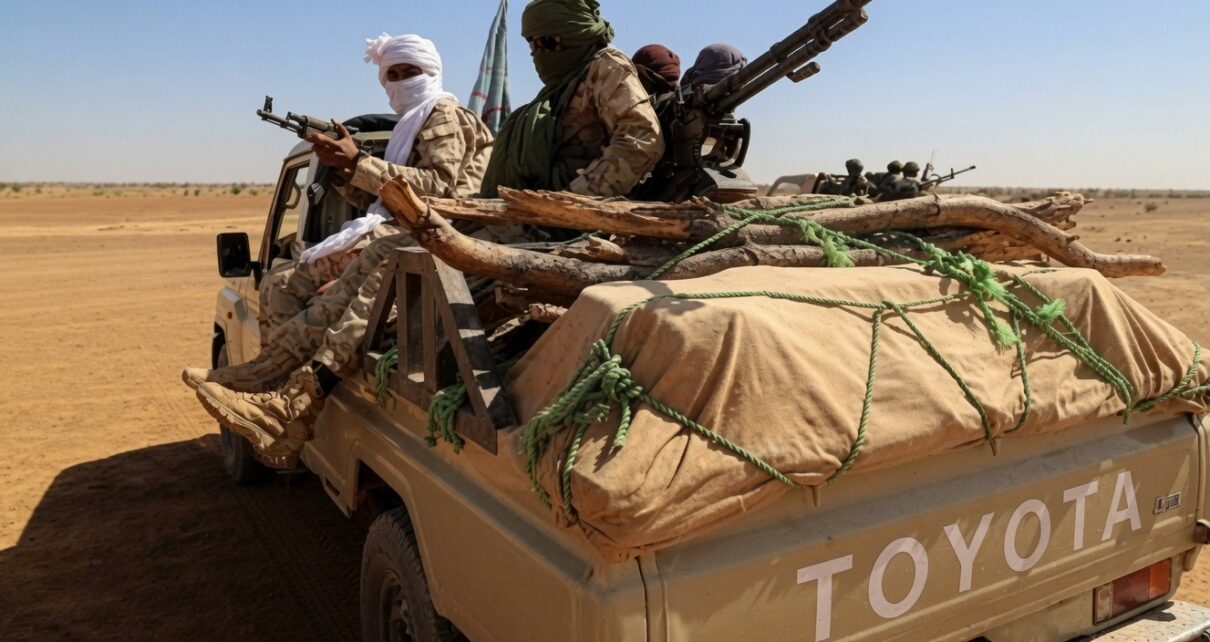
A deadly ambush on a Russian paramilitary convoy in central Mali has reignited public debate over the role of Africa Corps, the force that replaced Wagner in the Sahel. The attack, claimed by the al-Qaeda-linked JNIM, has left communities questioning what comes next for security in the region.
How the ambush unfolded near Niono
The assault took place on 28 September 2026 in the late morning, when a military column carrying members of Africa Corps was targeted between the villages of Tiemaba and Wewo, north of Niono in the Ségou region. The incident resulted in both human and material losses for the Russian contingent.
Niono: a long-standing jihadist stronghold
The area around Niono has for years been known as a key zone of influence for Katiba Macina, a major component of JNIM, the jihadist alliance affiliated with al-Qaeda in the Islamic Maghreb (AQMI).
Local and security sources indicate that the convoy was composed almost entirely of Russian fighters — a departure from the usual patrols in which Africa Corps units operate alongside Malian Armed Forces (FAMA).
Casualty claims and the aftermath
In a statement released shortly after the attack, JNIM claimed responsibility, saying it had killed or wounded at least seven members of the Russian contingent and seized a significant amount of military equipment before withdrawing. Several local sources in the region reported at least four Russian fighters killed in the clashes.
Neither the Malian General Staff nor Africa Corps officials have issued an official toll for this specific incident. However, the Malian army announced the following day that it had carried out several targeted airstrikes in nearby areas, including near Dioura, against identified terrorist positions.
Reactions and the road ahead
The ambush has prompted fresh scrutiny of Africa Corps’ operational methods and its integration with Malian forces. Analysts and local observers are asking whether the convoy’s exclusively Russian composition signals a shift in strategy — and whether such attacks will push the Kremlin to reinforce or rethink its presence in the Sahel.
For residents in the Niono area, the immediate concern is what the fallout means for their daily safety. With jihadist groups demonstrating their ability to strike convoys deep in government-held territory, the debate over the effectiveness of foreign paramilitary support is likely to intensify in the weeks ahead.