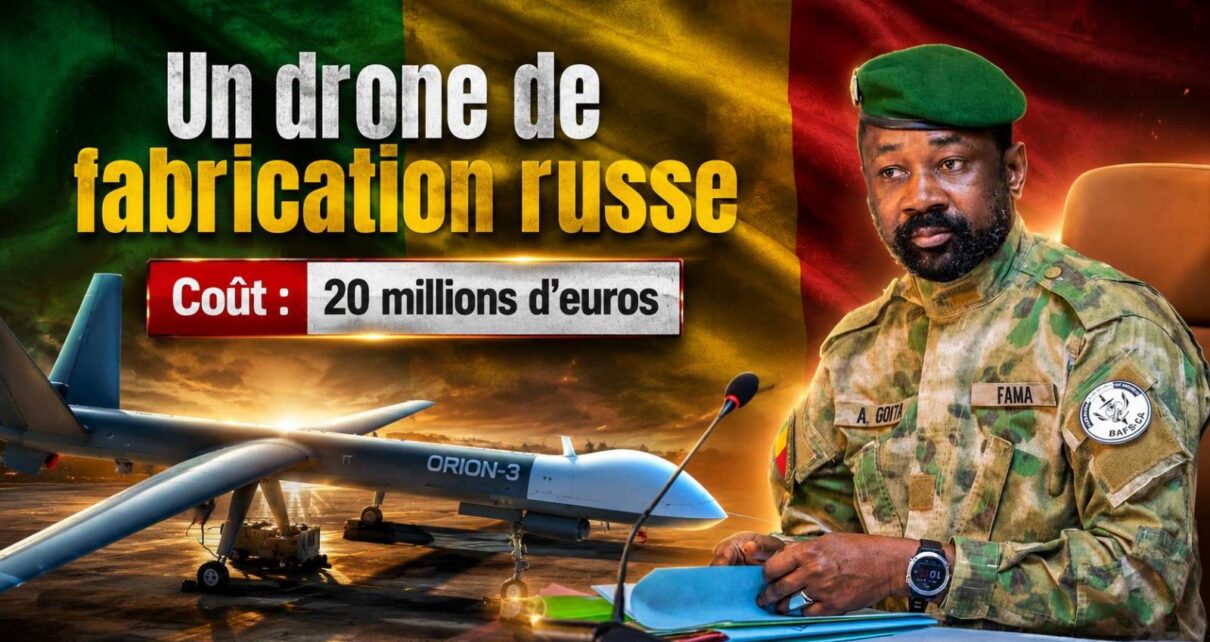
In its drive to strengthen aerial capabilities, Bamako has taken delivery of a Russian-made Orion reconnaissance and attack drone. While transition authorities celebrate this as another step toward reclaiming territory, the single, highly expensive acquisition raises sharp questions among military experts. Between technical unsuitability for asymmetric warfare and the potential financial drain, the real impact of this aircraft on the ground remains unproven.
A new acquisition under Bamako’s partnership with Moscow
The fleet of the Malian armed forces (FAMa) has a new addition. It is now official: an Orion drone, a flagship of Russian aerospace technology, has been delivered to Bamako. This MALE (Medium Altitude Long Endurance) aircraft is designed for extended surveillance and precision strikes. It joins equipment already supplied by the Russian partner in recent years.
For supporters of the current military strategy, this delivery symbolizes the growing strength of the Malian army and its determination to break free from former Western oversight. The Orion is presented as a tool capable of monitoring the country’s vast desert expanses. However, behind the triumphant official communiqués, the realities on the ground and the specific characteristics of this machine demand a far more nuanced analysis.
The Orion paradox: a noisy giant in an invisible war
The first challenge of this acquisition lies in the very nature of the Malian conflict. FAMa do not face a conventional army but mobile, scattered, and highly adaptable terrorist groups—the essence of asymmetric warfare. Yet the Orion drone suffers a major flaw for such operations: its high acoustic signature.
The Orion is loud—very loud. This noise footprint makes it easily detectable by ear long before it reaches its target zone. For terrorist fighters accustomed to blending into the terrain and using cover, this acoustic warning gives them time to scatter or camouflage themselves.
Moreover, the illusion of total impunity in the air is dangerous. Armed groups operating in northern and central Mali have proven they retain and acquire anti-aircraft capabilities capable of threatening low- and medium-altitude aircraft. Such a heavy, detectable platform becomes a prime target. The risk of seeing this single drone quickly downed by man-portable air-defense systems (MANPADS) or concentrated fire is particularly high.
Twenty million euros for a single unit: investment or waste?
The financial cost of the operation sparks sharp debate among economic and military observers. The unit price of the Orion drone approaches 20 million euros (over 13 billion CFA francs). In Mali’s current economic context, marked by budget constraints and pressing social needs, such a sum raises deep questions.
Spending so many resources on a single drone strikes many analysts as a poor investment, if not a waste of public funds. For the same amount, Mali could have acquired an entire fleet of lighter, quieter, and more easily deployable tactical drones. By focusing on a “showcase” piece of equipment, Bamako appears to have prioritized political prestige over tactical effectiveness.
The impossible gift of ubiquity: one drone vs a vast territory
Mali is a large country, and many regions remain beyond effective state control, suffering under terrorist groups. From the far reaches of Taoudénit to the forests of the Kayes region, the threat is diffuse.
Here the mathematical limit of this purchase becomes glaring: a single drone cannot cover all regions. Despite its endurance, the Orion does not have the gift of ubiquity. If it is overflying the Gao region, the Tombouctou or Mopti regions remain blind. One machine cannot ensure continuous air patrol (a noria). As soon as the aircraft lands for maintenance or refueling, the Malian skies become empty again, leaving enemy movements unchecked.
The hidden cost trap: complex maintenance and infrastructure
The purchase of the aircraft is just the tip of the iceberg. Operating a drone of the Orion class requires heavy logistics and ongoing, astronomical expenses that add to the purchase price.
Developing ground infrastructure is the first material challenge: sophisticated control stations, climate-controlled shelters to protect sensitive electronics from Sahelian heat, and suitable landing strips are essential. Added to this are the recurring costs of inputs, notably special fuel, spare parts imported exclusively from Russia, and guided munitions needed to make the aircraft operational. Finally, maintenance and technical expertise weigh heavily on the national budget, as Malian technicians still need training, which means keeping costly Russian instructors and subcontractors on the ground.
Without a continuous financial flow to meet these needs and keep the system running at all times, this 20-million-euro drone risks remaining permanently grounded in a hangar, turning into a mere expensive technological wreck.
The delivery of the Orion drone highlights visible efforts to over-equip FAMa but also exposes the limits of a centralized acquisition strategy focused on prestige tools. Facing a terrorist threat defined by mobility and surprise, introducing a single heavy, noisy, and excessively expensive aircraft looks like an ill-suited response. For lasting security in Mali, the army needs less expensive symbols and more of a multitude of agile, discreet, and economically sustainable means over the long term.