Bamako’s junta faces a strategic void
Mali has transcended being merely a nation in distress; it now stands as a critical flashpoint for the entire Sahel region. The convergence of jihadist groups, Tuareg separatist militias, ethnic rivalries, economic collapse, and increasing military reliance on Moscow is transforming Mali’s inherent state fragility into an overt regional crisis.
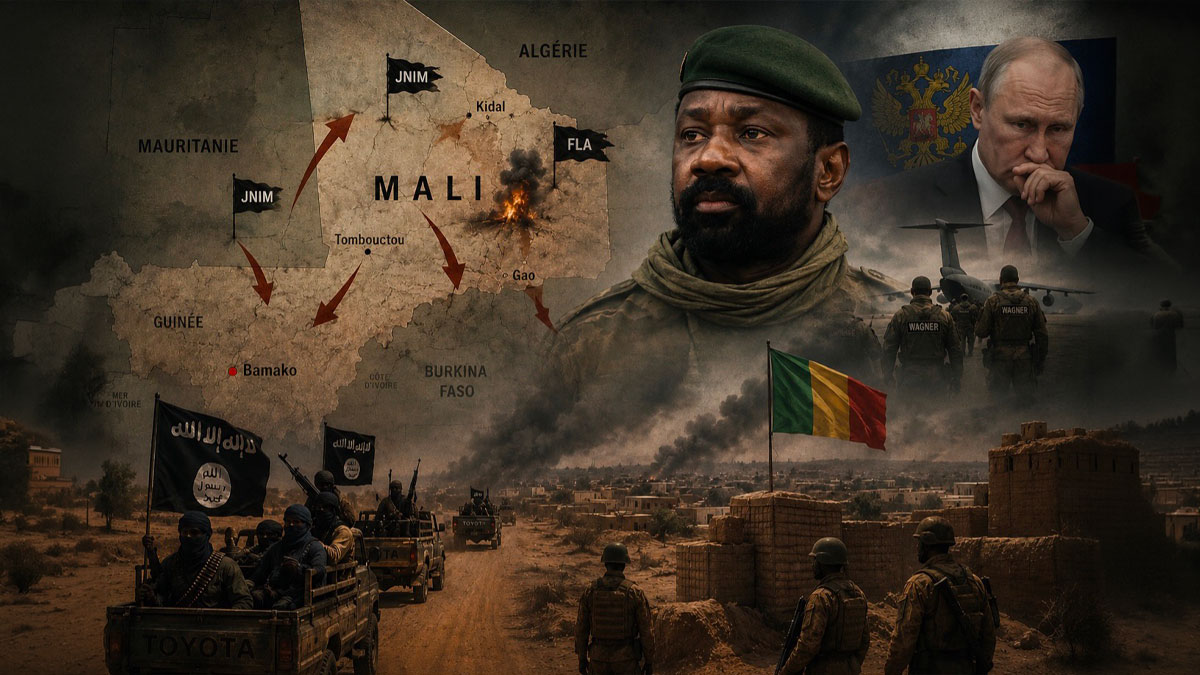
A significant offensive launched on April 25, 2026, reportedly a coordinated effort between the JNIM, an Al-Qaeda-affiliated jihadist entity, and the FLA, representing Azawad’s separatist aspirations, marks a new phase. This is no longer about isolated skirmishes in the desert North but a mounting pressure on urban centers, military installations, logistical arteries, and the core nodes of governmental power. The emerging picture is one of a state reduced to a series of fortified enclaves, increasingly isolated from each other and predominantly focused on defending the few remaining controlled areas.
The junta led by Assimi Goïta had pledged to fully reclaim national territory, expel French influence, restore national sovereignty, and forge a new strategic alignment with Russia. However, this promise now risks being exposed as a politically potent symbolic gesture, yet operationally tenuous. While expelling the French proved feasible, replacing their extensive networks for intelligence, logistics, air support, regional cooperation, and local knowledge has proven to be an entirely different challenge.
The strategic misstep: severing agreements without the strength to conquer
The abrogation of the Algiers Accords, signed in 2015 with various Azawad factions, represented a pivotal moment. These agreements, though imperfect, contentious, and often unenforced, nonetheless served as a political bulwark against a full-scale resumption of conflict in the North. When the junta declared them obsolete in January 2024, it chose a clear path: replacing political mediation with military might, and political management of Mali’s pluralism with military reconquest.
The inherent flaw in this strategy is that a military reconquest demands a disciplined army, robust intelligence, air power, logistical capabilities, a sustained presence, local consent, and administrative continuity. Bamako possesses insufficient quantities of any of these essential tools. Instead, the central authority wields a militarized regime, a potent sovereignist rhetoric, an internal repressive apparatus, and a Russian ally useful for regime protection but not necessarily capable of stabilizing a vast, fragmented nation rife with illicit trafficking, insurgencies, and historical grievances.
This reveals a fundamental misunderstanding. True sovereignty is not merely proclaiming independence from external command. It is the concrete capacity to govern territory, population, borders, economy, and security. If a state asserts its sovereignty but fails to control its roads, schools, markets, mines, customs, and barracks, that sovereignty becomes an empty declaration.
Jihadists and separatists: a tactical alliance, not a shared vision
The operational convergence between the JNIM and the FLA should not be misinterpreted as an ideological merger. Jihadists aim to impose an armed, transnational Islamist order, predicated on delegitimizing the national state. In contrast, Azawad’s Tuareg separatists pursue a territorial, identity-based, and political agenda, linked to demands for autonomy or independence in the northern regions.
Yet, in warfare, a shared ultimate goal is not always necessary. Sometimes, it suffices to share an immediate adversary. Currently, that adversary is Bamako, along with the Russian support system bolstering the junta. The simultaneous nature of attacks serves to overwhelm the Malian armed forces, compelling them to disperse units, reinforcements, helicopters, fuel, convoys, and intelligence. When an already strained army must shuttle between multiple fronts, the problem extends beyond military logistics; it becomes psychological. Every barracks fears being the next target. Every governor questions the capital’s ability to provide genuine relief. Every ally reevaluates the benefit of continued engagement.
This is the crucial point: the conflict in Mali is not won merely by capturing a city. It is won by eroding residual trust in the state. If civil servants flee, if soldiers waver, if local leaders negotiate with armed groups, if merchants pay for protection, and if the populace perceives Bamako as distant and ineffectual, then the state recedes even where its flags officially fly.
Military assessment: Malian army caught between garrison duty and attrition
The Malian Armed Forces face a structural dilemma: they must defend an immense territory with limited resources, insufficient personnel, vulnerable supply lines, and a highly mobile adversary. Jihadist and rebel groups do not need to maintain permanent control over every town. They can strike, withdraw, blockade roads, encircle convoys, isolate outposts, disrupt commerce, threaten officials, levy taxes on villages, and impose an intermittent form of sovereignty.
In contrast, the regular army must hold positions, protect civilians, resupply bases, and demonstrate continuity. This is the classic paradox of counter-insurgency: the state power needs to be ubiquitous; the insurgency can choose its points of appearance. When the state fails to guarantee security, the population does not necessarily support rebels out of ideological conviction. They often endure them, fear them, but ultimately adapt to the power they perceive as most immediate.
Any confirmed strike against a sensitive base like Kati, coupled with reports of casualties or injuries among key security figures, would carry immense significance. Such events would indicate that the crisis no longer affects only the peripheries but has breached the internal security of the power’s core. In such scenarios, the capital may not fall immediately, but it begins to live under a siege of suspicion.
The Russian limitation: protecting the regime does not mean pacifying the country
Russia’s presence in Mali was presented as an alternative to France and the West. However, the outcomes appear increasingly ambiguous. Moscow has offered political protection, training, advisors, armed personnel, coercive capacity, and a highly effective anti-Western narrative. It provided the junta with a lexicon: sovereignty, order, counter-terrorism, and an end to French neocolonialism.
Yet, on the ground, true stabilization demands far more. It requires local intelligence, tribal agreements, development initiatives, effective administration, justice, border control, management of communal conflicts, and political reconciliation. Paramilitaries can win skirmishes, but they cannot rebuild a state. They can intimidate, but they cannot govern. They can protect palaces, but they cannot integrate hostile peripheries.
Furthermore, Russia is already engaged in a protracted and costly war in Ukraine. Its military, logistical, and financial resources are finite. The African project was initially conceived as a low-cost operation: political influence, access to resources, security contracts, and global propaganda. But when the theater devolves into a war of attrition, costs escalate. Moscow must then prioritize where to invest its energies.
Mali could thus transform from a showcase of Russian penetration in Africa into a strategic quagmire. Replacing the French flag with the Russian flag in public squares is one thing; preventing jihadists, separatists, and criminal networks from hollowing out the state from within is another.
Economic scenarios: gold, illicit trade, and state survival
Mali’s economy is precarious, heavily reliant on gold, agriculture, foreign aid, informal flows, and the state’s ability to control at least its primary revenues. When security collapses, it’s not just public order that crumbles; it’s also the state’s fiscal foundation.
Gold mines, including artisanal and informal operations, become contested zones. Whoever controls a mine controls money, weapons, labor, protection, and loyalties. Armed groups tax, extort, traffic, protect, or plunder. The state loses revenue and must spend more on warfare. This creates a perfect vicious circle: less security yields fewer resources; fewer resources lead to less security.
Trans-Saharan routes also hold decisive value. They are not merely conduits for smuggling; they are vital economic arteries for communities that depend on trade, transport, livestock, fuel, foodstuffs, and both legal and illegal commerce. When Bamako loses control of these routes, it forfeits its ability to influence the daily lives of its populations. And where the state no longer reaches, someone else steps in: the jihadist, the trafficker, the local chief, the rebel commander.
From a geoeconomic perspective, Mali’s situation extends beyond its borders. Destabilization could impact Niger, Burkina Faso, Mauritania, Algeria, Senegal, Guinea, and Côte d’Ivoire. The Sahel represents a strategic depth, not a collection of isolated crises. Borders are porous, communities span official lines, and illicit trade disregards maps. A collapse in Bamako would generate far-reaching shockwaves across the region, impacting nations like Burkina Faso and Niger.
The Alliance of Sahel States and sovereignty without means
Mali, Niger, and Burkina Faso have crafted a new political narrative: disengagement from the Western orbit, rupture with France, critique of the traditional regional order, pursuit of new partners, and reclamation of sovereignty. However, the challenge lies in this proclaimed sovereignty emerging from weak states with armies under pressure, fragile economies, militarized institutions, and expanding jihadist threats.
The Alliance of Sahel States (AES) can function as a political and symbolic bloc. It can coordinate declarations, foster solidarity among juntas, and amplify anti-Western rhetoric. But can it genuinely guarantee effective mutual assistance when all its members are vulnerable? Can it stabilize Mali if Niger and Burkina Faso must also protect their capitals, mines, borders, and convoys?
A structural threshold becomes apparent here: an alliance of fragilities does not automatically generate strength. It can lead to shared isolation. It can amplify propaganda. But if resources, training, legitimacy, intelligence, and administrative capacity are lacking, the outcome risks being a confederation of emergencies.
The geopolitical dimension: France departs, the vacuum persists
France’s withdrawal from Mali symbolized the end of an era. Paris paid the price for its errors, ambiguities, perceived arrogance, operational limitations, political misunderstandings, and the deep-seated rejection by a significant portion of Sahelian public opinion. France was increasingly seen as a neocolonial power, unable to defeat jihadism and too closely tied to local elites.
However, French failure does not automatically translate into Russian success. This is a mistake made by many juntas and commentators. Anti-French sentiment can help capture public spaces and achieve temporary consensus. It is insufficient to build security. Anti-Westernism can be a political resource, but it is not a stabilization strategy.
Russia has occupied the space vacated by France, but it has not resolved the fundamental issue: how to govern the Sahel? With what institutions? With what pact between the center and the peripheries? With what economic model? With what balance between ethnic groups, clans, pastoral communities, cities, and rural areas? With what relationship between security and development?
If these questions remain unanswered, any external power will eventually become mired. France experienced this. Russia now risks discovering it.
Three scenarios for Mali’s future
The first scenario envisions a tripartite civil war. Bamako would retain control of the capital and some urban centers, the JNIM would control or influence vast rural areas, and the FLA would consolidate its presence in the North and in regions claimed by Azawad. The country would remain formally united but substantially fragmented. This is the most probable outcome if no single actor can prevail and if the crisis continues to exhaust all parties.
The second scenario involves the internal collapse of the junta. Military defeats, leadership losses, discontent within the armed forces, and the perception of Russian ineffectiveness could generate fractures within the military apparatus. In a system born from coups d’état, another coup always remains a possibility. A new faction might attempt to salvage the regime by sacrificing certain figures from the old guard.
The third scenario is one of de facto secession. Not necessarily immediately proclaimed or recognized, but practiced on the ground. The North could become an area permanently beyond Bamako’s control, governed by an unstable combination of Tuareg forces, local groups, jihadists, illicit networks, and external powers. This would resemble a Sahelian Somalia, with residual institutions and shattered sovereignty.
The risk for Europe
Europe often observes Mali with detachment, as if it were a distant problem. This is a mistake. The Sahel profoundly impacts migration flows, terrorism, raw materials, illicit trafficking, Russian influence, the security of the Mediterranean, the stability of West Africa, and global competition with China, Russia, Turkey, and Gulf monarchies.
A fragmented Mali means more operational space for jihadist groups, more criminal routes, increased pressure on West African coastal nations, and greater instability radiating towards the Mediterranean. It also signifies a diminished European capacity to exert influence in a region from which it has been progressively expelled politically, morally, and militarily.
Europe is paying for two errors: consistently viewing the Sahel as an external security issue, and subsequently losing credibility without constructing a genuine political alternative. Discussions focused too heavily on terrorism, migration, military missions, and training. Too little attention was paid to state-building, justice, corruption, rural economies, communal conflicts, demographics, water, education, employment, and legitimacy.
Mali as a universal lesson
Mali starkly reveals a brutal truth: merely changing external protectors is insufficient to save a state. The French failed to stabilize it. The Russians appear to be failing as well. The junta used sovereignty as a rallying cry, but real sovereignty demands capacities that cannot be bought with propaganda.
A state does not always perish with the capture of its capital. Sometimes, it dies earlier, when it can no longer protect its roads, when schools close, when villages pay taxes to armed groups, when convoys only move under escort, when soldiers lose faith in orders, when external allies withdraw or demand too much, and when the population ceases to expect anything from the state.
Mali is nearing this critical threshold. This does not mean it will cross it tomorrow, nor does it mean Bamako will fall. However, the process of disintegration is now undeniable. The crisis is no longer peripheral; it is central. It no longer concerns only the North; it concerns the very idea of the Malian state.
And here, the circle closes. The junta aimed to demonstrate that military force, backed by Russia and freed from Western constraints, would rebuild national unity. Instead, it is demonstrating that without a political framework, force consumes itself. Without legitimacy, sovereignty becomes a mere slogan. Without administrative capacity, military victory is fleeting. Without a pact with the peripheries, the center becomes a besieged fortress.
Mali is not just an African front. It is a mirror reflecting global disorder: competing external powers, fragile states, hybrid wars, criminal economies, jihadism, sovereignist propaganda, mineral resources, and abandoned populations. In this mirror, the failures of many actors are reflected: France, Russia, military juntas, regional organizations, Europe, and an international order far more adept at commenting on crises than at preventing them.