As summer 2026 unfolds, Morocco has deployed an unprecedented diplomatic chessboard to advance its claim over Western Sahara, a territory it has administered since Spain’s 1975 withdrawal. The strategy combines symbolic gestures toward Washington with calculated pressure on Madrid, revealing Rabat’s nuanced approach to international relations.
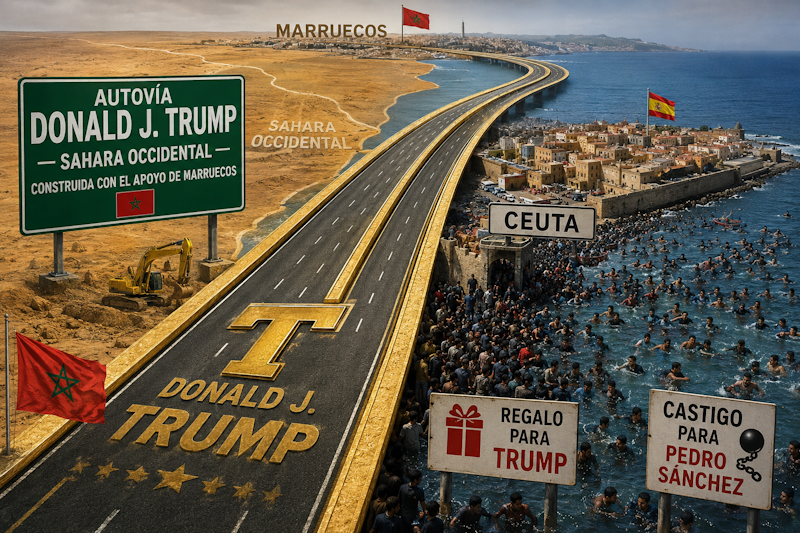
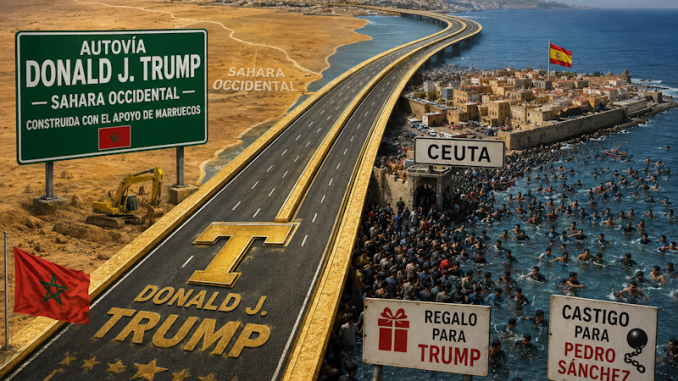
At the heart of this maneuver lies an 1,055-kilometer highway, stretching from Tiznit to Dakhla, which Morocco has named after Donald J. Trump. The move, announced by King Mohammed VI, serves as a public acknowledgment of the former U.S. president’s 2020 decision to recognize Moroccan sovereignty over Western Sahara. The monarch described the infrastructure as Africa’s longest roadway, a vital artery linking southern Morocco to Dakhla via Laâyoune, while also connecting Europe to Africa.
Trump responded with characteristic enthusiasm on Truth Social, calling the honor “tremendous” and expressing eagerness to someday traverse the entire route. The gesture underscores Morocco’s determination to secure U.S. backing, a cornerstone of its Western Sahara strategy.
Ceuta’s migrant surge: a high-stakes bargaining chip
Yet it is not the Trump Highway that cuts through Ceuta—it is the specter of migration that has become Rabat’s most potent lever. In late July 2026, nearly 60,000 migrants breached the Spanish enclave’s border in a matter of hours, triggering a humanitarian emergency and a diplomatic firestorm. Spanish authorities reported 57 fatalities, primarily from drowning or crushing, while Morocco acknowledged 11 deaths among those attempting the crossing.
Ceuta, one of Europe’s two land borders with Africa, sits at the nexus of Spanish-Moroccan tensions. Morocco has long disputed Spain’s claim to the enclave, labeling it an “occupied territory.” The crisis erupted just days after Spanish Prime Minister Pedro Sánchez visited Algiers, a move perceived in Rabat as a provocation.
Echoes of past confrontations
This is not the first time Morocco has wielded migration as a pressure tool. In May 2021, a similar influx of 8,000 migrants forced Madrid to rethink its stance on Western Sahara. At the time, Spain abandoned its neutral position to endorse Morocco’s autonomy plan after treating Brahim Ghali, leader of the Polisario Front, for medical care. Analysts note that Rabat seeks more than mere backing—it demands formal recognition of its sovereignty.
Carlos Ruiz Miguel, director of the Western Sahara Studies Center at the University of Santiago de Compostela, argues: “Morocco believes Spain’s support for autonomy is insufficient. It wants unambiguous recognition of its territorial claims.”
Washington’s unwavering alignment
The Trump administration has made its position clear. Secretary of State Marco Rubio reaffirmed U.S. recognition of Moroccan sovereignty over Western Sahara, while Trump himself praised Morocco’s autonomy proposal as “the only path to a fair and lasting solution.”
U.S. criticism of Spain’s migration policies has further strained relations. A White House spokesperson warned Madrid that its handling of the crisis could “jeopardize its own security.”
Europe’s divided response
The Ceuta crisis has sent ripples across the European Union. Italy, Finland, and Denmark temporarily suspended Schengen agreements with Spain, while Belgian politician Georges-Louis Bouchez called for a partial suspension of Spain’s Schengen membership. Paul Melly, a researcher at Chatham House, describes this as a “new geopolitical reality,” where Morocco leverages migration as a retaliatory tactic against Spain’s vulnerability in North Africa.
Diplomatic calculus: three moves to secure Western Sahara
Analysts break down Morocco’s strategy into three interlocking components:
- Symbolic diplomacy: The Trump Highway serves as a tangible reward for U.S. support, reinforcing Washington’s recognition of Moroccan sovereignty.
- Migration as leverage: By loosening border controls at Ceuta, Morocco signals its ability to destabilize Spain’s southern frontier.
- Washington’s backing: Rabat aims to ensure U.S. endorsement in stalled UN negotiations over Western Sahara.
A message to negotiators
The Trump Highway may bypass Ceuta, but its message is unmistakable: Morocco holds the keys to Europe’s southern gate. By intertwining symbolic homage to Washington with calculated pressure on Madrid, Rabat has woven a diplomatic tapestry designed to strengthen its hand in the Western Sahara dispute. European and Spanish negotiators are now acutely aware of the costs of defying Morocco’s ambitions.