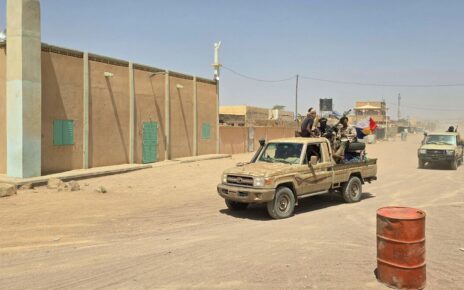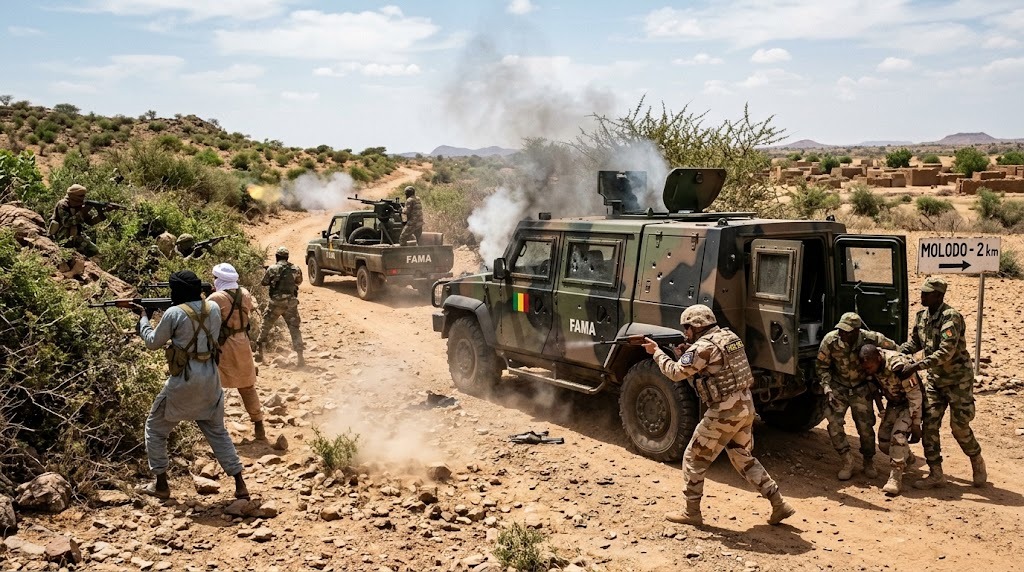
The consequences of what happened on a dusty track between Diabali and Niono are now being felt far beyond the Ségou region. On 20 September 2026, a mixed patrol of Malian armed forces and Russian Africa Corps paramilitaries was torn apart by an ambush laid by the JNIM, Al-Qaeda’s branch in the Sahel. Within minutes, the Russian contingent did what it has done before: it pulled back and left three all-terrain vehicles standing on the roadside, still bearing the distinctive stylised triangle of Africa Corps. For ordinary Malians, this is not simply another military setback. It is a bill that households, traders and entire communities are already paying.
Molodo: three abandoned vehicles and a retreat that speaks volumes
What makes the episode so damaging is not only the firefight itself, but the image it leaves behind. Vehicles deserted by the very men sent to protect them, exposed to the cameras of the attackers, tell a blunt story: those deployed by Moscow are neither invincible nor especially attached to the ground they are paid to defend.
Behind the dust and the wreckage lies something heavier. The patrol was supposed to move through territory presented for years as firmly under the control of the central government. Instead, the ambush exposed how thin that control really is, and how quickly a joint formation can come apart when the trap closes.
Why the Russian bargain now costs Mali more than it promised
For Colonel Assimi Goïta’s junta, Molodo is more than a tactical loss in a war of attrition it does not master. It works like a magnifying mirror held up to a political and security failure whose scale can no longer be seriously disputed.
A sovereignty pledge that turned into dependence
After expelling French Barkhane forces, pushing the UN mission toward the exit and tearing up the peace agreements, the military leadership built its entire legitimacy on one promise: recovering national sovereignty and securing the whole territory through a clean geopolitical break. Moscow’s “instructors” were sold to a population worn down by more than a decade of instability as the miracle cure that Western allies had either refused or failed to provide.
Four years after the first mercenaries arrived on Malian soil, the verdict is harsh. The Russian partnership behaves less like a shield than like a toxic illusion. Far from erasing the jihadist threat, the arrival of the militia has acted as a powerful recruitment engine for armed opposition groups and Islamist movements alike.
The consequences reach every household, market and road
From the northern desert to the gates of Bamako
State propaganda can no longer bury the facts. Despite triumphant statements drafted in the air-conditioned offices of the general staff, the country has rarely been in worse shape. Insecurity once confined to the desert fringes of the north has spread through the centre and now squeezes the capital itself, through economic pressure, road blockades and assaults on garrisons. For transporters, farmers and small traders, the practical result is always the same: routes that close, convoys that turn back, and villages left to organise their own survival.
Mercenary pay, mining concessions and a drained public purse
Africa Corps fighters are paid handsomely by a state already short of resources, which draws on thin public funds and hands mining concessions to companies tied to the Kremlin. On the ground, these private soldiers behave more like a close protection force for the regime than like a liberation army. Facing a mobile enemy perfectly adapted to the terrain, blind brutality has replaced tactical thinking, and joint FAMa-Russian operations — repeatedly accused of abuses and reprisals against civilians — have severed the army from rural communities.
Civilians caught between jihadist violence and a hardening state
To muffle criticism of a steadily worsening security and economic situation, the junta has rolled out an unprecedented repressive arsenal. Civil society voices are silenced, independent journalists are censored or pursued, and the slightest doubt cast on the effectiveness of the Russian partner is instantly branded high treason or collusion with the enemy.
Yet propaganda offers no shelter from reality. Footage of the three vehicles marked with the Africa Corps logo, abandoned by their Russian crews on the Molodo road, is already circulating discreetly and across social networks. It echoes what many Malians now say in whispers: that in the name of fighting neo-colonialism, the military leadership traded an imperfect dependency for a ruinous subservience to a private militia incapable of guaranteeing peace.
What Molodo means for the months ahead
By persisting in this ideological and military escalation, Bamako’s rulers have locked the country into a tragic dead end. Without a comprehensive political strategy, without national reconciliation and with foreign troops who flee at the first shot, the Malian state keeps coming apart, leaving a wounded population at the mercy of extremists and war profiteers.
The lesson of Molodo is therefore not only military. It is economic, social and ultimately human: every abandoned vehicle on that road stands for a stretch of territory left without protection and a community left to negotiate its own survival.