The Bloodiest Attack In Months Leaves 38 Soldiers Dead
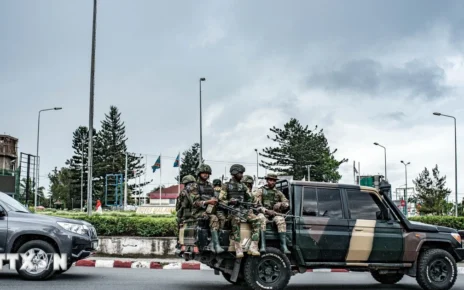
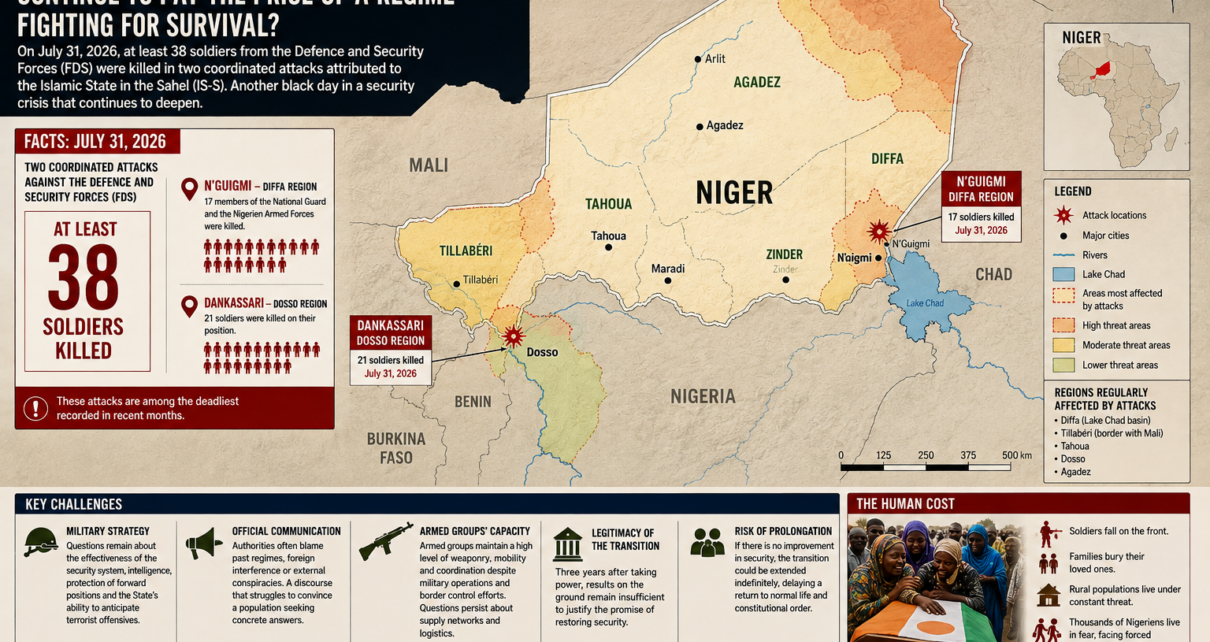
July 31, 2026, will be remembered as one of the darkest days in recent Nigerien history. In a brutal display of coordinated violence, at least 38 members of the Forces de défense et de sécurité (FDS) were killed in twin attacks attributed to the Islamic State in the Sahel (EI-S).
The first assault struck N’Guigmi, in the Diffa region, where 17 soldiers from the National Guard and Nigerien Armed Forces were killed in action. Hours later, a second strike hit Dankassari, in the Dosso region, claiming the lives of 21 more military personnel. These attacks rank among the deadliest in recent months, underscoring a grim reality: terrorism continues to expand its reach while human casualties mount.
A Security Promise Under Strain
The military takeover led by General Abdourahamane Tiani was justified by the urgent need to halt the country’s spiraling insecurity. The narrative was clear: only a change in leadership could restore order, reclaim lost territory, and protect civilians.
Yet, three years into the transition, the outcomes tell a different story. Attacks persist across critical regions, including the Lake Chad basin, Tillabéri, Tahoua, and Dosso. Armed groups demonstrate an alarming ability to execute large-scale, coordinated assaults on military outposts, despite frequent announcements of troop restructuring and operational adjustments.
This persistent violence raises a pressing question: Are the authorities’ stated objectives being met on the ground?
The Weight of Military Failures
Each deadly attack transcends mere casualty counts. It exposes glaring weaknesses in the defense apparatus, from intelligence failures to inadequate protection of forward operating bases. The inability to anticipate or thwart these offensives fuels public skepticism about the transition’s military strategy.
As casualties rise, so do doubts: Has the focus on consolidating political power come at the expense of the urgent demands of the battlefield? A transition that derives its legitimacy from security cannot indefinitely evade scrutiny over its actual performance in this domain.
Government Response Lacks Conviction
Following each attack, officials frequently deflect blame toward the failures of previous administrations, foreign interference, or the machinations of external actors. While these factors may contribute to a complex geopolitical landscape, they do little to address the immediate concerns of affected communities.
Families of the fallen demand answers—not just about the threats themselves, but about the operational failures that allowed such tragedies to unfold. Without concrete measures to prevent recurrence, the government’s rhetoric risks losing its already fragile credibility.
A Conflict Spiraling Out of Control
One of the most troubling aspects of this crisis is the sustained operational capacity of armed groups. Despite repeated military operations and border control efforts, these organizations continue to execute large-scale attacks with alarming precision. This raises critical questions about the effectiveness of counter-terrorism measures, supply chain disruptions, and intelligence networks.
With limited public information, speculation thrives, eroding trust between citizens and state institutions.
The Military Transition’s Ultimate Test
The junta’s legitimacy hinges on its pledge to restore security. Yet, with each passing attack, that promise grows increasingly tenuous. The prolonged crisis not only delays a return to civilian rule but also deepens the suffering of local communities, who remain trapped in a cycle of violence and displacement.
Observers warn that the absence of tangible progress could indefinitely extend the transition period. Resolving this impasse will require transparency, measurable results, and a credible roadmap for ending the crisis.
The Human Cost of an Unresolved War
The true weight of this crisis is borne by the individuals who pay the highest price: the soldiers who perish in battle, the families left grieving, and the rural populations living under the constant shadow of terror. Thousands of Nigeriens endure daily displacement, fear, and uncertainty, their lives upended by an enemy that shows no signs of retreat.
The promise of security was the cornerstone of the military transition. Three years later, it remains the most urgent unfulfilled obligation. Until the attacks cease, the authorities must answer not only to armed groups—but also to a population that has sacrificed enough.