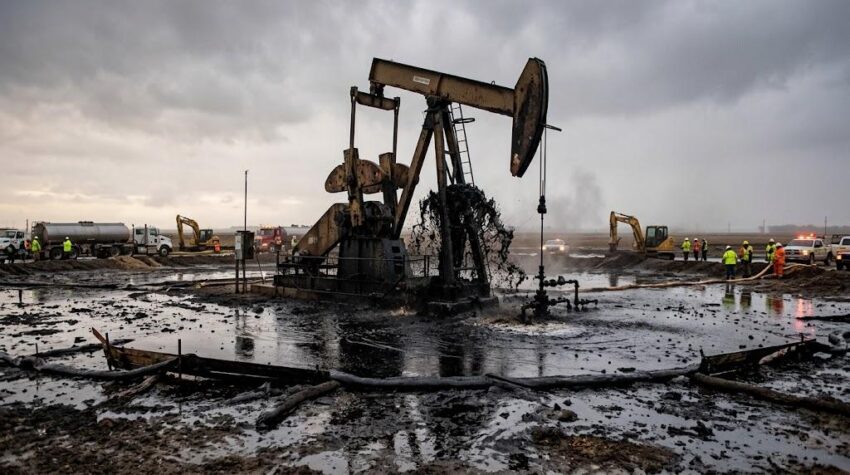
The negligence of industrial giants and the complacency of local authorities have turned a simple technical failure into a full-blown environmental disaster for the Sahel region. For 17 days, the skies over southern Niger have been choked by a toxic brew of hydrocarbons, while hidden below lies the real catastrophe: an unchecked methane gusher.
How a routine drilling fault unleashed a climate menace
On September 25, 2026, a blowout at the Goumeri W8 well—located in the Agadem block, 1,700 kilometers from Niamey—sent a geyser of crude oil and invisible gas plumes surging into the atmosphere. What started as a repair operation quickly spiraled out of control, exposing thousands of residents to long-term health risks and disrupting fragile ecosystems in one of Africa’s most fragile regions.
The disaster unfolded in two phases: the initial oil spill, which coated the desert in a thick black layer, and the silent but far deadlier methane leak that followed. Despite official statements downplaying the threat, satellite data from the Sentinel-5P mission revealed that the well was emitting over 40 tonnes of methane per hour—a volume capable of heating the planet 80 times faster than CO₂ over two decades.
The cost of silence: delayed action and lost credibility
Local authorities remained tight-lipped for nearly three weeks before acknowledging the scale of the crisis on October 12. By then, the methane plume had already blanketed an area equivalent to three times the size of Paris, while the CNPC—a Chinese state-owned oil conglomerate—continued its policy of deliberate opacity. No public updates, no transparency on the volume of gas released, and no visible commitment to containment.
Such secrecy is not an exception; it reflects a disturbing trend in West African oil extraction. Multinationals operating in Niger have long treated the Sahara’s fragile environment as an afterthought, prioritizing production targets over safety standards. The latest blowout is not an isolated incident but the inevitable result of a reckless dash for revenue.
Ripped from nature’s hands: the invisible toll on communities
While the oil spill is visible and immediate, the methane leak presents a stealth threat. Inhalation of this odorless, colorless gas can cause chronic respiratory illnesses, neurological damage, and even premature death. Villages within a 50-kilometer radius now report a rise in unexplained health issues—coughs that won’t heal, dizziness, and skin irritations linked to prolonged exposure.
Meanwhile, nomadic herders have seen their livestock collapse without warning, a consequence of contaminated water sources and toxic vegetation. The economic fallout is just as severe. The Agadem block, responsible for nearly 70% of Niger’s oil output, now faces temporary shutdowns, disrupting supply chains and threatening international contracts.
The illusion of control: failed containment and desperation tactics
Eager to maintain its production target of 90,000 barrels per day—a necessity to keep the pipeline to Benin operational—the Nigerien government resorted to emergency measures. With local expertise insufficient, Algerian specialists from Sonatrach were flown in to drill a relief well, a last-ditch effort to stem the flow. Yet this move underscores a glaring reality: the country’s industrial oversight is dangerously outdated, putting people, climate, and future investments at risk.
The disaster is a wake-up call. Niger cannot afford to treat its natural resources as an endless cash cow while ignoring the environmental and human consequences. The Goumeri W8 inferno is no longer just an industrial accident—it is a climate tragedy in the making, with ripple effects felt far beyond the Sahara.
A region on edge: what’s next for the Sahel?
The methane surge from Goumeri W8 is not just Nigeria’s problem. The Sahel, already one of the world’s most vulnerable regions, now faces a dual threat: a humanitarian crisis brewing in real time and a looming ecological catastrophe. With temperatures rising faster than the global average, the region’s fragile balance could tip toward irreversible damage.
For now, the plume drifts eastward, carried by the Harmattan winds. Will African leaders act before the next disaster strikes? Or will another African nation become the next poster child for unchecked industrial greed?