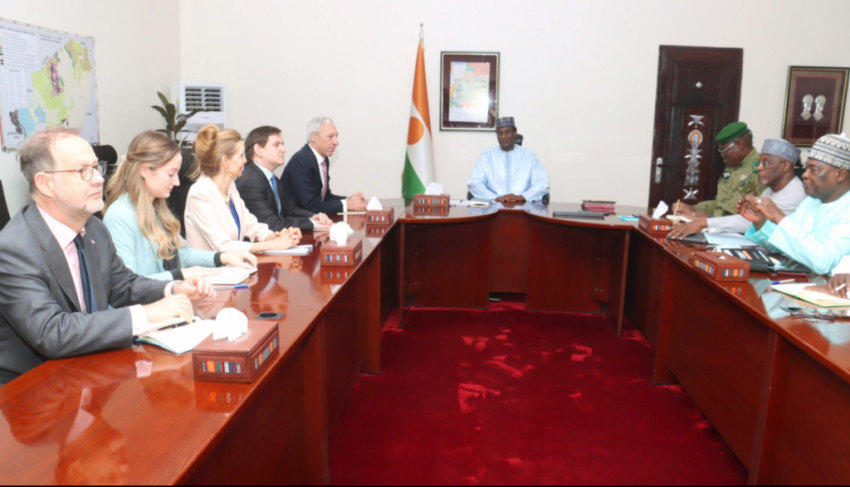
The recent accreditation of Niger’s diplomat to the European Union raises pressing questions about the tangible effects on ordinary citizens and the nation’s economy. On 22 October, Adamou Moumouni presented his credentials to António Costa, president of the European Council, and Ursula von der Leyen, president of the European Commission, signaling ongoing—if strained—diplomatic ties between Niamey and Brussels. But what does this mean for Nigeriens grappling with political instability, economic uncertainty, and humanitarian crises?
Diplomatic channels remain open amid deep divisions
Since the military coup on 26 July 2023 ousted president Mohamed Bazoum, relations between Niger and the EU have been marked by persistent disagreements over governance, humanitarian aid, and the treatment of the deposed leader. Yet despite these tensions, diplomatic engagement has not collapsed. The accreditation of Moumouni, confirmed by the European Council, underscores Niger’s intent to sustain official representation in Brussels—even as fundamental disputes remain unresolved.
In diplomacy, maintaining an official presence is often a pragmatc move to safeguard national interests and keep communication lines open, regardless of political friction. But does this institutional continuity pave the way for deeper reconciliation, or is it merely a symbolic gesture?
The humanitarian aid dispute: 1.3 million euros at the heart of a crisis
In November 2024, a disagreement over EU humanitarian aid for Niger’s flood victims exposed a critical fault line. The EU allocated €1.3 million to support populations affected by severe flooding, but Niger’s transitional government claimed it had not requested the funds, insisting it could manage relief efforts independently. The ministry of foreign affairs criticized the EU delegation for announcing the aid without prior official consultation with Niamey.
The contention deepened over how the funds were distributed. According to a 24 November 2024 statement, the aid was channeled through international NGOs, including the International Committee of the Red Cross (ICRC), Danish Refugee Council, and Cooperazione Internazionale, without what Niger deemed sufficient coordination. Authorities argued that the foreign ministry should have been involved in the process and claimed they had demanded a halt to operations during a 14 October 2024 meeting with the EU ambassador, Salvador Pinto da França.
Niger’s government ultimately called for the diplomat’s recall and replacement, asserting that continued collaboration was untenable. The EU, in turn, expressed “deep disagreement” with the accusations, defending its humanitarian principles of neutrality, impartiality, and independence. Brussels also warned against the politicization of aid and announced the recall of its ambassador to Niamey for consultations.
This clash highlights two opposing visions: Niger’s demand for sovereignty over decisions affecting its territory, and the EU’s commitment to independent humanitarian mechanisms. Meanwhile, the flood victims—caught in the crossfire—continued to suffer, with critical assistance hanging in the balance.
The Bazoum case: a sovereignty battle with economic repercussions
By March 2026, tensions resurfaced over the detention of Mohamed Bazoum. The European Parliament adopted a resolution on 12 March, condemning his continued imprisonment and demanding his immediate, unconditional release. The vote—524 in favor, two against, with 29 abstentions—reflected growing EU concern over Niger’s political trajectory and human rights record.
For the EU, Bazoum’s situation and the restoration of democratic order are non-negotiable. Niger’s authorities, however, view external interference in its internal affairs as an unacceptable breach of sovereignty. This standoff extends beyond Bazoum’s case, encapsulating broader disagreements over governance since the 2023 coup. Such political friction can have tangible economic consequences, including potential disruptions to trade, investment, and development aid—factors that directly impact businesses and livelihoods in Niger.
Diplomatic pragmatism in a volatile region
Amid these challenges, Moumouni’s accreditation suggests Niger’s recognition of the need to preserve diplomatic avenues. The Sahel region faces immense security, economic, and humanitarian pressures, making international partnerships—even contentious ones—vital. For the EU, stability in Niger is crucial to regional security, given the spillover effects of instability in the Sahel.
For Niamey, having a representative in Brussels ensures it can advocate for its interests, while the EU gains a channel to address sensitive issues, even without broader political alignment. Yet, genuine reconciliation would require concrete progress: renewed dialogue, better coordination on humanitarian aid, or shifts in position on contentious issues like Bazoum’s detention.
Symbolic gesture or meaningful shift?
Does Niger’s latest diplomatic move signal a true change in direction, or is it a calculated effort to maintain appearances while preserving its stance? The credential presentation neither amounts to a concession nor confirms a reconciliation. It is, above all, a commitment to sustaining official diplomatic ties.
The coming months will reveal whether this step leads to deeper cooperation or remains a formalities-driven relationship. For Niger, the challenge is balancing its principles with the practical need for international engagement. For the EU, the task is maintaining cooperation while upholding its political and humanitarian priorities.
Ultimately, Moumouni’s arrival in Brussels marks a new chapter in Niger-EU relations—one that keeps dialogue alive but stops short of resolving underlying tensions. The road from diplomatic symbolism to substantive change remains long and uncertain.