When state policies strip away basic rights: the Mohamid community under siege
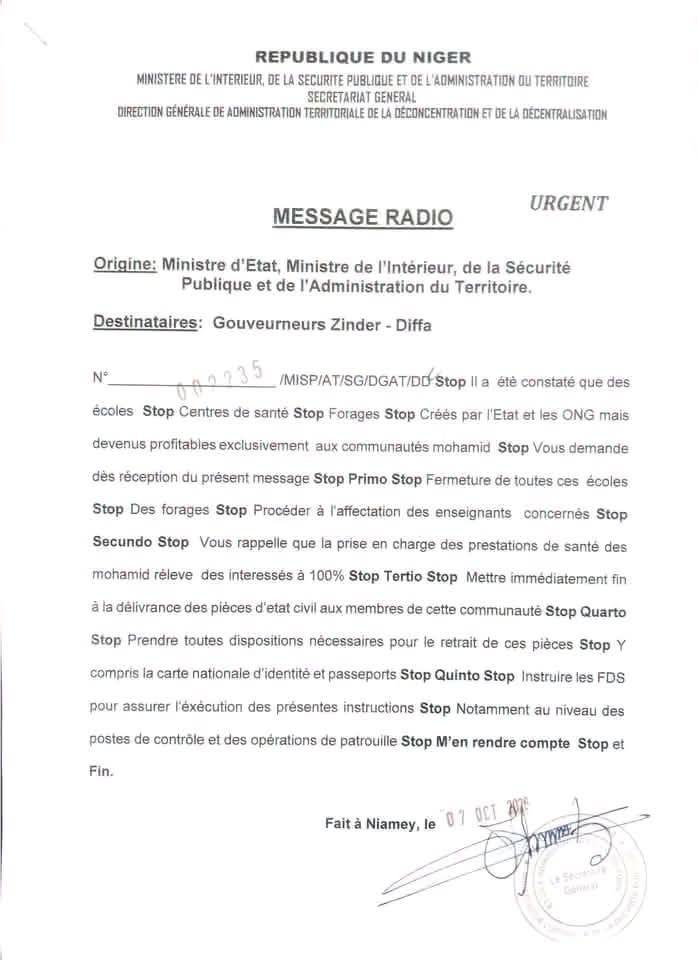
In a move that has sent shockwaves through Niger’s eastern regions, the Interior Ministry issued a radio directive on October 7, 2026, ordering the closure of schools, water wells, and healthcare facilities serving the Mohamid community. The order also mandates the suspension of civil document issuance and the potential revocation of existing national IDs and passports. With these measures reportedly already enforced, the policy raises urgent questions about the cost of collective punishment on real people.
What’s at stake for the Mohamid community
For the Mohamid, a historically marginalized ethnic group in Niger’s Diffa and Zinder regions, the fallout is immediate and devastating:
- Education blackout: Schools serving Mohamid children are shuttered, threatening a generation’s access to learning.
- Water insecurity: Critical wells are sealed, endangering families and livestock in a region where water scarcity is a daily struggle.
- Healthcare collapse: Collective health provisions are withdrawn, leaving vulnerable populations without medical care.
- Legal limbo: National IDs and passports are under threat of revocation, jeopardizing travel, employment, and legal protections.
These aren’t abstract rights—they’re the building blocks of dignity, opportunity, and survival. When the state weaponizes access to education, water, and healthcare, the message is clear: belonging to a targeted group is now a liability.
Security vs. collective punishment: where’s the line?
The government defends these measures as necessary for national security, citing persistent threats in the Sahel. But security cannot be achieved by penalizing an entire community for the alleged actions of a few. Legal responsibility is individual, not collective. If crimes have been committed, the justice system must identify and prosecute individuals—not entire ethnic groups.
Under international law and Niger’s own constitution, discrimination based on ethnicity is prohibited. Yet the October directive flouts these principles by treating the Mohamid as a monolithic bloc, guilty by association. Where is the evidence linking the entire community to criminal activity? Where are the safeguards against abuse? Without transparency, these measures risk becoming tools of repression rather than protection.
The broader crackdown under Tiani’s regime
This isn’t an isolated incident. Since the 2023 military coup that brought General Abdourahamane Tiani to power, Niger has seen a steady erosion of civil liberties:
- Political parties dissolved and opposition figures silenced.
- Civil society organizations restricted and journalists detained.
- Nationality revocations targeting exiled opponents, stripping them of citizenship without due process.
While the Mohamid policy differs in scope, it fits a troubling pattern: the use of administrative power to marginalize dissenters and minorities. The question now is whether Niger’s institutions will push back—or whether the state’s authority will be wielded without restraint.
The human and economic fallout
The consequences of this policy extend beyond the Mohamid community. Their exclusion disrupts local economies, particularly in trade, transport, and livestock sectors. Families already struggling to survive now face additional barriers to mobility, employment, and basic services. The ripple effects could destabilize entire regions, deepening poverty and fueling resentment.
For a country already grappling with terrorism and economic instability, these measures risk exacerbating the very problems they claim to solve. A fractured society is a vulnerable society—and a society where rights are negotiable is one where stability is impossible.
What’s next for the Mohamid?
The government must urgently clarify the legal basis for these measures and ensure that any restrictions are proportionate, lawful, and subject to appeal. Affected individuals deserve fair hearings, not collective punishment. Independent oversight is critical to prevent abuse and hold authorities accountable.
Niger’s future depends on its ability to protect all citizens, not just those in power. The Mohamid crisis is a test of whether the state can uphold the rule of law—or whether it will sacrifice justice for control. The world is watching.