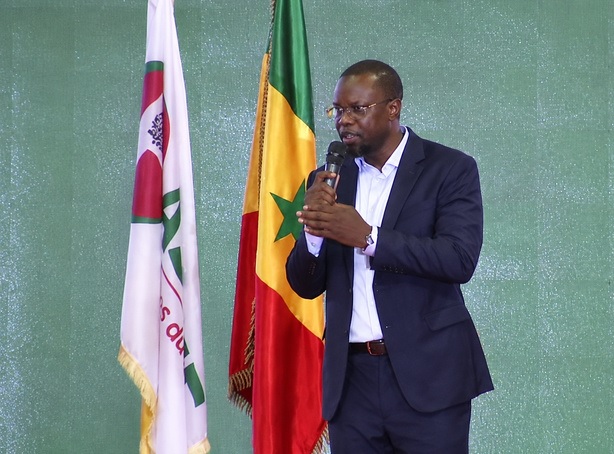
Dakar recently hosted the inaugural national congress of Pastef-Les Patriotes, the parliamentary majority party, which convened from Saturday, June 6, to Sunday, June 7. Established in 2014, the party utilized this significant event to invigorate its agenda amidst a shifting political landscape. Under the leadership of its president, Ousmane Sonko, Pastef aimed to define new strategic directions and recalibrate Senegal’s political governance.
The first ordinary congress of Pastef-Les Patriotes culminated in a massive public gathering at Dakar Arena on Sunday, June 7. Ousmane Sonko, confirmed as the president and leader of the ruling party, addressed an enthusiastic assembly of supporters. He unveiled a comprehensive three-point political roadmap: strengthening the party’s core ideology, directly challenging the executive branch, and ensuring the integrity of the electoral timetable. Sonko reflected on what he termed “the initial phase of clarification,” which began with the major rally on November 8. “Politically, Pastef has remained Pastef and emerges from this clarification stronger,” he declared. While acknowledging that this period brought “surprises and disappointments,” he personally experienced none. He then asserted his movement’s leadership in critical struggles, including the fight against corruption, the pursuit of justice, the renegotiation of contracts, and crucially, maintaining the parliamentary majority in the National Assembly.
Regarding governance, Sonko launched direct critiques against the Head of State. “This nation has endured enough from plots and machinations,” he asserted, urging every institution to uphold its constitutional mandate without succumbing to manipulation driven by personal ambitions. His indictment was unequivocal: “Even if the president seeks to fulfill political aspirations, we must not allow him to undermine our institutions.”
Addressing concerns about a potential institutional crisis, Sonko presented a sovereign interpretation of the election results. “There is no institutional crisis in Senegal. It was the people who chose to entrust the presidency to one individual and the National Assembly to another,” he affirmed.
Parliamentary control over local elections
Ousmane Sonko decisively rejected any possibility of postponing local elections, citing both political and procedural arguments. “Pastef will never agree to a postponement of local elections,” he declared, emphasizing the constitutional requirements binding the executive: “To do so, it must pass through the Assembly and vote on an enabling law.”
Following the investiture rally for Pastef’s president, the path appears clearly defined for a significant reshaping of the political landscape and a fresh approach to political governance in Senegal.