Collective urgency in the Sahel
As armed groups escalate their activities across the Sahel, regional leaders face an unprecedented security challenge. The escalating violence has not only destabilized inland nations but now threatens coastal states, compelling Côte d’Ivoire to take decisive action. The Ivorian government has issued an unequivocal call to Mali and Burkina Faso, emphasizing that the fight against terrorism transcends national borders.
Abidjan’s strategic overture
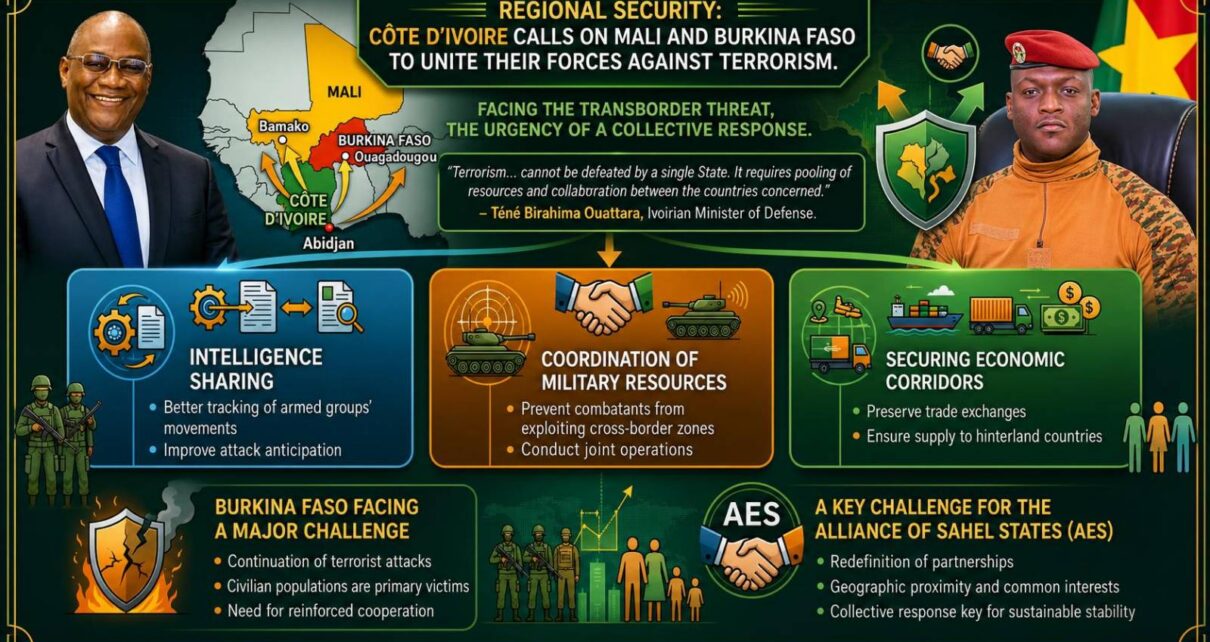
The Ivorian Minister of Defense, Téné Birahima Ouattara, articulated the urgency with stark clarity: “A single nation cannot defeat terrorism in its current form. Success requires pooled resources and coordinated efforts among affected countries.”
The proposal centers on three pillars designed to strengthen regional resilience:
- Intelligence sharing: Monitoring the movements of armed factions along vulnerable border zones.
- Joint military operations: Conducting cross-border missions to prevent militants from exploiting porous frontiers.
- Economic corridor security: Safeguarding trade routes critical to the stability of landlocked nations.
The Sahel Alliance at a crossroads
The Alliance of Sahel States (AES)—comprising Mali and Burkina Faso—now confronts a pivotal moment. While these nations have redefined their international alliances, geographical realities remain unchanged. Côte d’Ivoire, with its strategic stability and logistical capabilities, emerges as a natural partner in this fight.
For the Burkinabè leadership, led by Captain Ibrahim Traoré, engaging with Abidjan would signify more than diplomatic pragmatism. It would represent a commitment to collective survival over isolation. In the face of a mobile and adaptable adversary, fragmented responses guarantee failure; unity offers the only path to restoring peace.
Beyond rhetoric: a test of leadership
The Ivorian initiative places the Sahel Alliance at a defining juncture. Rejecting cooperation would perpetuate vulnerability, while embracing collaboration could redefine regional security paradigms. The choice is clear: prioritize national pride or the survival of millions.