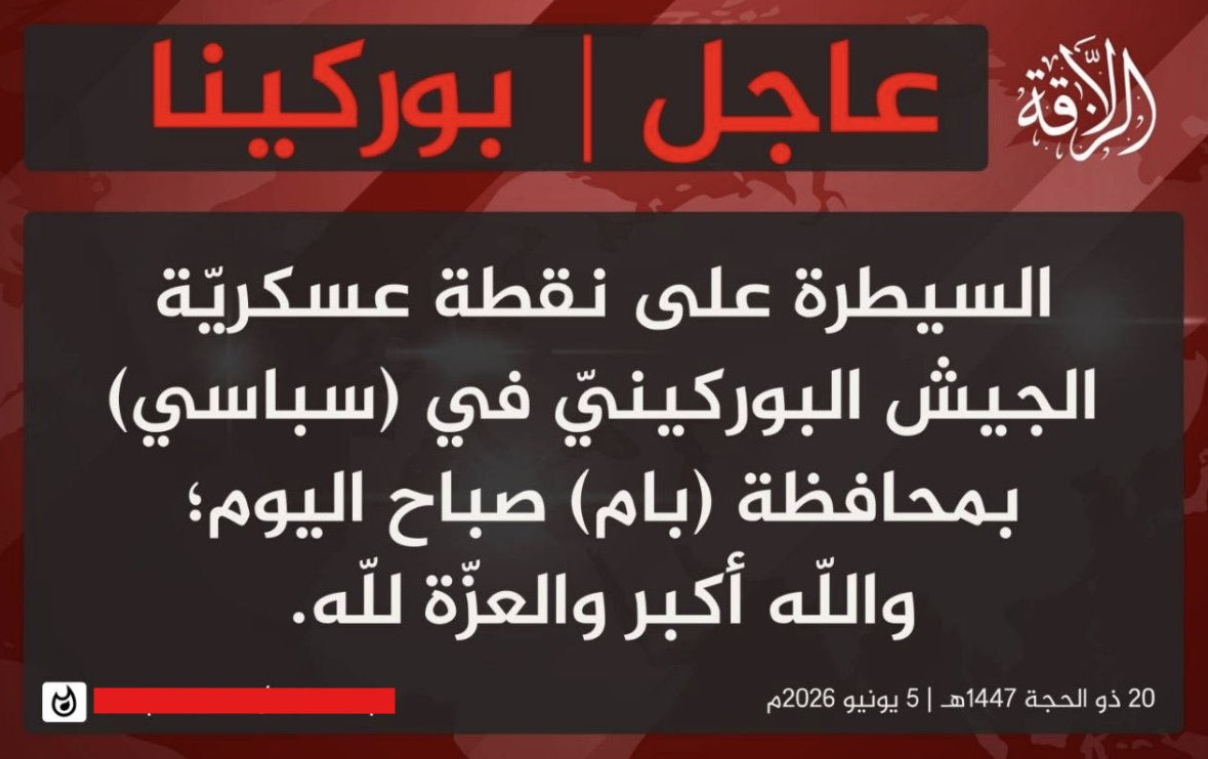
The northern region of Burkina Faso is once again at the heart of a severe security crisis. On the morning of June 5, 2026, a military outpost in Sabcé, located in the Bam province, became the target of a coordinated assault by the Group for the Support of Islam and Muslims (JNIM). The attack, which unfolded at dawn, exposed critical vulnerabilities in the country’s defense strategy and underscored the urgent need for regional cooperation.
Sabcé: a morning of chaos and resistance
The assault began shortly after daybreak, catching the local forces off guard. JNIM fighters, heavily armed and moving swiftly on motorcycles, overwhelmed the military post in a surprise attack. The clash that followed was intense, leaving the community in a state of panic as gunfire echoed through the streets.
Despite the bravery of Burkina Faso’s Defense and Security Forces (FDS) and the Volunteers for the Defense of the Homeland (VDP), the sheer number of attackers temporarily overpowered the defenders. Local reports indicate that the assailants looted supplies and equipment before retreating as reinforcements arrived by air. While official figures on casualties remain pending, the attack highlights the persistent risks faced by key transit routes in the country’s northern and central regions.
Security shortcomings: why static defenses fail
The assault on Sabcé is not an isolated incident but a stark reminder of the flaws in Burkina Faso’s current security model. Despite efforts to bolster troop numbers, acquire advanced military hardware, and mobilize civilian volunteers, armed groups continue to exploit weaknesses in the system.
Analysts point to critical shortcomings, including delayed intelligence sharing and slow response times from ground reinforcements. The JNIM’s ability to isolate detachments, disrupt communications, and strike high-value targets demonstrates the limitations of a strategy that relies heavily on fixed positions. In a region where threats transcend borders, a more dynamic and collaborative approach is no longer optional—it is essential.
Wadagni’s vision: regional unity as a shield
In this climate of shared vulnerability, the recent diplomatic efforts of Benin’s President Romuald Wadagni have gained significant traction. His state visit to Niger and Burkina Faso marked a bold step toward fostering military collaboration in the Gulf of Guinea and the Sahel.
Wadagni’s call for a unified defense strategy—one that emphasizes real-time intelligence sharing and cross-border operations—has resonated with regional observers. His message is clear: Burkina Faso cannot combat terrorism alone, nor can any single nation in the region. The attack on Sabcé serves as grim validation of this perspective, proving that security challenges in the Sahel demand a collective response.
Breaking borders: the path to joint action
For cooperation to be effective, it must move beyond diplomatic rhetoric. The JNIM and other armed factions exploit porous borders as safe havens and escape routes. A true partnership requires synchronized intelligence, joint military operations, and reciprocal pursuit rights across frontiers.
The shared ecosystems of the W National Park and adjoining ecological zones highlight the interconnected nature of the threat. By reaching out to Niger and Burkina Faso, Wadagni is laying the groundwork for a united front—one that could cripple the logistical networks of terror groups.
A moment for decisive action
The attack on Sabcé is a wake-up call that cannot be ignored. It reveals the strain on Burkina Faso’s security apparatus and the urgent need for strategic adaptation. Reassessing internal tactics is critical, but so too is embracing the collaborative vision championed by Benin’s leadership.
The future of security in the region hinges on collective action. The time for isolated strategies has passed; what is needed now is coordinated, relentless pressure against the forces of terror. The battle for Sabcé may be fought locally, but the war against terrorism will only be won through regional solidarity.