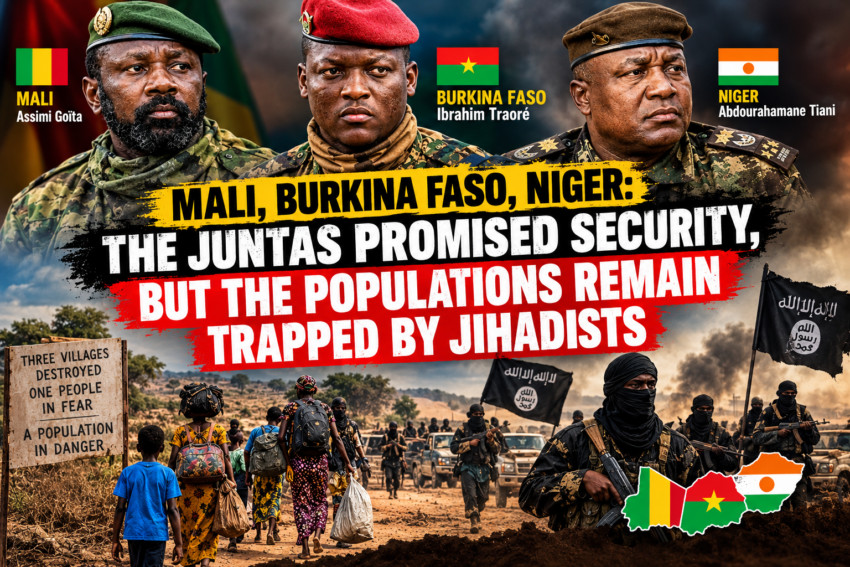
The once-promised safety in the Sahel’s tri-border region where Mali, Burkina Faso, and Niger converge has become an elusive dream for countless families. As the Islamic State in the Greater Sahara and the Group for Support of Islam and Muslims (JNIM), an Al-Qaeda affiliate, escalate their brutal turf war, civilians are caught in the crossfire, bearing the brunt of a conflict they neither waged nor control.
How jihadist infighting is reshaping the security crisis in West Africa
For months, the Islamic State in the Greater Sahara and JNIM have clashed with unprecedented ferocity across the tri-border zone, a region already ravaged by years of instability. The fighting has left hundreds dead, with both groups claiming victories while concealing their own losses. Yet beyond the battlefield casualties, the real victims are the local populations, whose daily lives have been upended by displacement, economic paralysis, and relentless fear.
These jihadist factions are no longer content with targeting state forces or symbols of authority. Their rivalry has expanded into a struggle for territorial dominance, control over trade routes, and the allegiance of local communities. Villages once accustomed to relative stability now face a grim choice: flee their homes or risk falling prey to retaliatory violence, arbitrary restrictions, or forced recruitment.
The military juntas’ unmet promises: security vs. sovereignty
The overthrow of civilian governments in Mali, Burkina Faso, and Niger was justified, in part, by the need to restore order and reclaim national sovereignty. The new military regimes pledged to break free from foreign dependencies, forge independent alliances, and reclaim control over their territories. Yet, as the jihadist violence persists, the gap between rhetoric and reality widens.
Sovereignty, after all, is not merely a matter of diplomatic posturing or military posturing. It is measured by the state’s ability to protect its citizens, maintain administrative presence, and ensure that people can live, work, and move without constant fear. In the tri-border zone, this basic expectation remains unmet. Roads once used by farmers and traders are now battlegrounds. Schools and clinics have shuttered. Families displaced by violence are stranded in makeshift camps, their futures uncertain.
Why the jihadist power struggle is worsening civilian suffering
Contrary to the assumption that infighting weakens extremist groups, the rivalry between the Islamic State in the Greater Sahara and JNIM has only intensified the humanitarian toll. Each attack or territorial gain by one faction triggers brutal reprisals against communities suspected of aiding the other. The result? A cycle of displacement, economic collapse, and social fragmentation that shows no signs of abating.
Independent verification of casualty figures is nearly impossible, as both groups manipulate propaganda to exaggerate their successes and downplay their losses. Yet even if the true death toll remains obscured, the consequences for civilians are undeniable: markets empty, farmlands lie fallow, and children are deprived of education. The longer this conflict rages, the more fragile the social fabric of these communities becomes.
The state’s fading presence in the most vulnerable areas
In rural pockets of the tri-border zone, the state’s authority is not just contested it is nearly absent. Security forces, stretched thin by the scale of the threat, struggle to provide consistent protection. Public services have collapsed in many areas, leaving residents with no recourse but to navigate a lawless landscape where jihadist groups dictate the rules.
This erosion of state control has far-reaching implications. Without reliable security, economic activity grinds to a halt. Farmers cannot tend their fields. Traders avoid routes plagued by ambushes. And those who remain in their villages live under the constant threat of extortion, kidnapping, or forced conscription. For these communities, the promise of a better future under military rule feels increasingly hollow.
The Alliance of Sahel States: a strategic shift with unproven results
Mali, Burkina Faso, and Niger have sought to redefine their security strategies by forming the Alliance of Sahel States, a bloc aimed at reducing dependence on external partners and reclaiming control over their destinies. This move was framed as a bold step toward self-reliance, but its success hinges on tangible outcomes: fewer attacks, safer villages, and the return of displaced families to their homes.
Yet, as the jihadist infighting continues, the alliance’s achievements remain unclear. The regimes must now account for their strategies not just in terms of military operations, but in their ability to deliver on the most basic promise of any government: security. Blaming past failures or foreign interference no longer suffices when civilians are paying the price with their lives and livelihoods.
What real sovereignty looks like in the Sahel’s most dangerous zones
The true test of a government’s legitimacy is not found in its speeches or its alliances, but in the safety of its people. For the military juntas of Bamako, Ouagadougou, and Niamey, the challenge is clear: to demonstrate that their vision of sovereignty translates into real protection for those living in the shadows of jihadist rule.
This demands more than military campaigns. It requires intelligence-sharing, cross-border cooperation, and a commitment to restoring essential services. It means ensuring that farmers can harvest their crops, children can attend school, and traders can move goods without fear. Until these conditions are met, the people of the tri-border zone will continue to ask: What is the value of national sovereignty if it cannot guarantee our survival?
The road ahead: accountability and action
The jihadist feud in the Sahel is a stark reminder that security cannot be achieved through slogans alone. The crises plaguing the region are deep-rooted, and their solutions will demand time, resources, and difficult choices. But for the military regimes now in power, the most pressing question is not whether they inherited this instability but how they plan to end it.
The people of the tri-border zone deserve more than promises. They deserve protection. And until that becomes a reality, the juntas’ claims to sovereignty will ring hollow in the ears of those who live under the constant shadow of violence.
By Cécile Mboua — Journalist