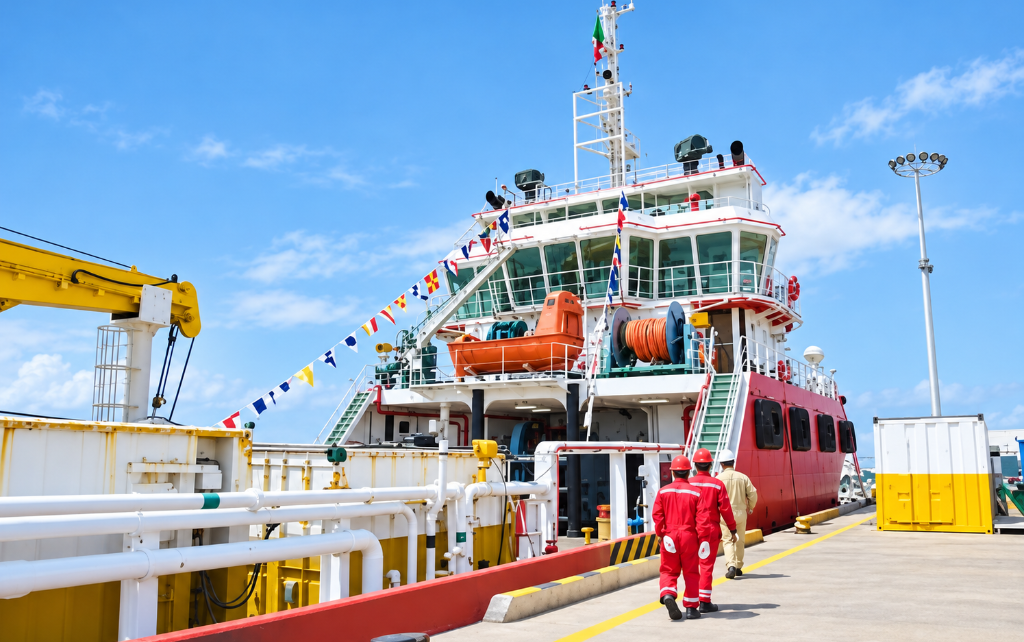
In October 2026, a tanker is set to lift roughly 250,000 barrels of crude from Benin’s offshore Sèmè block — and the fallout will reach far beyond the export terminal. For families bracing against fuel and food costs, for firms chasing subcontracts along the coast, and for a treasury long reliant on agriculture and transit trade, the country’s first commercial cargo in decades opens a new and uncertain chapter.
The shipment, drawn from the reactivated Sèmè field, is far more than a technical milestone. It confirms that Cotonou is once again a hydrocarbon-producing state, and it triggers a chain of consequences — for state income, for the balance of payments, for the industrial fabric around the port, and for whether ordinary citizens end up feeling any of the benefit.
How a field first spotted in the 1960s climbed back up Benin’s agenda
Sèmè is no new discovery. Stretching off the south-eastern coast, near the maritime boundary with Nigeria, the block was identified in the late 1960s and produced intermittently through the 1980s and 1990s before being shut in. Falling yields, technical hurdles and a weak barrel price at the time made continued operation unprofitable.
What shifted is the broader energy picture. Fresh offshore drilling methods and reservoir workover techniques have brought older accumulations back into play, while the government’s action plan singles out better use of national natural resources. Geological studies carried out in recent years pointed to recoverable volumes worth pursuing, and that evidence pushed the authorities to build partnerships capable of funding the rebuilding of extraction infrastructure.
The concrete effects of a first 250,000-barrel cargo
The opening consignment works as a test balloon as much as a sale. On world markets, an inaugural delivery does two things at once: it brings in foreign currency, and it sets out the identity card of Beninese crude for refiners and trading houses. Laboratory analysis will establish its density, sulphur content and overall quality, determining how it is priced against benchmarks such as Brent.
For the national budget, the near-term consequences are tangible:
- Steadier currency inflows: foreign capital arriving in the country will shore up exchange reserves and help steady the balance of payments.
- Taxes and royalties: the production-sharing mechanism guarantees the state a direct slice of extracted volumes, on top of levies on petroleum activity.
- A stronger sovereign signature: a new stream of predictable revenue reinforces Benin’s standing with lenders and credit rating agencies.
In a global economy where commodity prices swing sharply, widening the sources of state income acts as a macroeconomic cushion — one that can soften the blow of a poor harvest or a slowdown in transit trade.
Who gains on the ground: contracts, skills and coastal jobs
The economic footprint of Sèmè stretches well past the sale of crude. The relaunch phase has already absorbed significant capital, and that spending has begun to reach local private operators and the maritime supply chain.
Running an offshore field demands heavy logistics: support for installations at sea, towage, technical maintenance, supplies of specialised equipment and engineering services. Benin’s maritime, construction and logistics companies are gradually picking up subcontracts, which in turn supports skills transfer and creates skilled positions for young workers.
Beyond that, the expanding oil cluster near Cotonou and Sèmè is pushing coastal infrastructure forward. Storage, transport and primary processing of crude require upgraded port facilities, gradually turning the shoreline into an integrated industrial platform.
Sèmè’s output and the Niger-Benin pipeline: two roles, one advantage
The restart of domestic production lands at a pivotal moment for the country’s energy sector, which also hosts the marine terminal of the export pipeline linking Niger’s Agadem fields to the port of Sèmè-Kpodji.
Legally and operationally the two projects are distinct, but the synergy is hard to miss. Benin is consolidating its position as a strategic petroleum crossroads in the Gulf of Guinea. The know-how built around handling Nigerien crude exports sharpens the local technical expertise needed to manage the country’s own offshore resources efficiently.
That dual position — producer and transit hub at the same time — gives Benin greater visibility in regional and international energy forums.
The governance test: spending oil money without squandering it
The toughest task now falls to economic managers: handling these future petroleum inflows in a sustainable and transparent way. To sidestep the pitfalls seen in other producing nations, regulation and the governance of extractive revenue must come first.
Income from Sèmè crude sales is designed to feed development funds aimed at priority areas — education, health, road infrastructure and agricultural modernisation. The end goal is to turn a finite resource into a catalyst for structural change across the whole economy.
The October 2026 cargo is therefore not a finishing line but the opening chapter of a renewed industrial strategy. A quarter of a million barrels is a modest figure beside the output of global oil majors, yet its symbolic weight and its capacity to pull other sectors along lay the groundwork for durable prosperity.