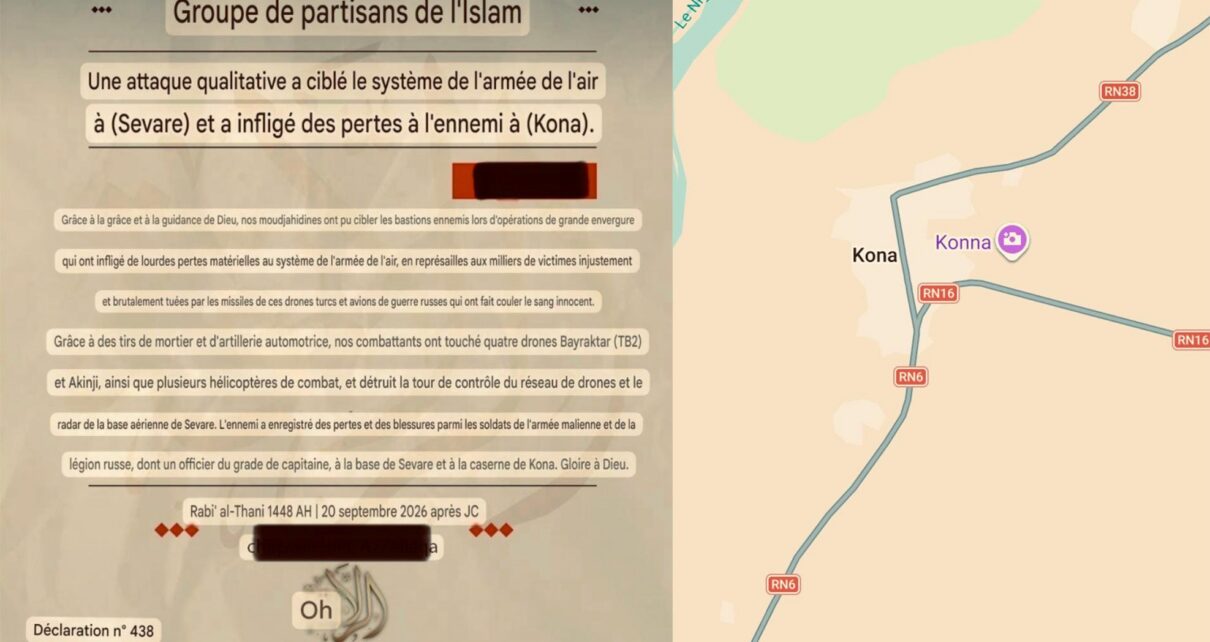
The attack claimed on Sunday 20 September by the Group for the Support of Islam and Muslims (JNIM), an Al-Qaeda affiliate, on the air base at Sévaré and the military camp at Konna is not simply another battlefield setback. Its consequences are already landing on Malian households, traders and farmers: roads too dangerous to travel, markets that empty out, and a state whose protection barely reaches past the gates of its own barracks.
A raid whose effects ripple through daily life in central Mali
Sévaré is one of the pillars of Mali’s military architecture in the centre of the country, a hub for surveillance and air operations. When a site of that importance is hit, the shock travels fast: planners lose assets, and civilians lose whatever thin confidence they had that the security forces control the ground around them. The JNIM states that it struck several military installations, destroying or damaging four Bayraktar TB2 and Akıncı drones, several helicopters, a radar and a control tower, while inflicting casualties among Malian soldiers and Russian fighters.
The material losses matter. So does the message they send to taxpayers: costly hardware bought to shield the country can be knocked out where it stands.
The paradox at the heart of Mali’s security model
Since the coups of 2020 and 2021, Mali’s military authorities have rewritten the country’s defence policy. A break with Western partners, France above all, was paired with a strategic turn towards Russia.
Bamako presents that shift as an assertion of sovereignty, arguing that a state should be free to choose its partners, strengthen its army and fight armed groups without depending on foreign powers. Politically, the argument lands with part of the public. On the ground, the picture is far more complicated.
Sovereignty as a slogan, vulnerability as a reality
New equipment, including Turkish-made drones, and the arrival of Russian personnel have not erased the jihadist threat. Recent attacks show that armed groups retain a strong capacity to disrupt, strike and kill. The problem is not the number of weapons in the inventory but the ability to convert firepower into lasting control of territory.
Russian personnel and the hard rules of asymmetric war
Russia’s presence is one of the load-bearing walls of the new arrangement. After the French withdrawal and the end of Operation Barkhane, Bamako made Moscow its exclusive partner, and the Africa Corps — which has taken over from the Wagner group in several African countries — is now woven into Mali’s security apparatus.
That presence runs straight into the reality of an insurgency rooted in several regions. JNIM fighters move through terrain they know intimately, use asymmetric tactics and blunt the advantage of superior technology. Drones watch and strike precise targets, helicopters back troops on the ground, foreign fighters stiffen certain units — yet none of these tools, on its own, secures a village, a road or a district for good.
How the Sévaré strike deepens a wider pattern
The raid fits a troubling sequence. Malian forces are absorbing deadly attacks on military posts, strategic routes and the infrastructure that keeps the national security system running. Each time, a structural weakness is exposed: resources are massed around main bases while rural areas and the roads linking them remain contested.
Sévaré is the clearest illustration of that limit. As a major military centre in central Mali, it hosts air infrastructure built for surveillance and combat. That the base could be hit shows the JNIM can still reach installations of the highest strategic value. Repetition is what turns an incident into a trend — and a trend into lost confidence.
Advanced technology, concentrated in the wrong place
The emphasis placed on Bayraktar drones reveals an operational contradiction. Mali has acquired capable platforms for intelligence gathering and stand-off strikes, a genuine improvement for its armed forces. But advanced technology stays exposed when it is parked on fixed, identifiable sites.
If the JNIM’s claims about the equipment at Sévaré are confirmed, Bamako suffers a symbolic reverse of the first order: proof that part of its technological investment can be neutralised on its own parking aprons. Fighting a jihadist organisation demands far more than sophisticated hardware. It requires human intelligence, mobile forces, protection for civilians, secured logistics routes and a permanent state presence in remote areas.
The political bill landing on the junta’s desk
For the junta, the stakes go well beyond the military sphere. Since taking power, it has built its political narrative on national sovereignty and the fight against terrorism. The departure of French forces and the rapprochement with Russia are presented as the emblems of a security policy freed from old dependencies.
Every attack on a strategic position lays bare the limits of that narrative and puts the authorities face to face with the actual results of changing military partners. At Sévaré, as elsewhere, the policy is judged by what happens on the ground.
What ordinary Malians expect from a security policy
For most citizens, the strategic arguments about France, Russia, Wagner, the Africa Corps or Turkish drones are secondary. The only priority is the real safety of villages, roads, markets and towns.
A security policy proves itself not when weapons are paraded at ceremonies, but when threats to civilians are neutralised and the state is present in a way people can count on. That is the yardstick by which patience is measured — and it is running short in communities that have waited years for protection.
The test now facing Bamako
The Sévaré attack confirms the depth of Mali’s security crisis. The junta has renewed its alliances, expanded its arsenal and declared its intention to seize the initiative. Military strength alone, however, will not defeat the JNIM.
The challenge now is to turn military means into durable security for the people living under the threat. As long as strategic bases come under attack, communication routes stay vulnerable and jihadist groups set the pace of operations, the junta’s security model remains on trial. At Sévaré, power is judged on results alone.