Every armoured vehicle that rolls out of a workshop carries a price tag, and in Burkina Faso the bill for the Nanga programme is being settled before anyone outside the security apparatus has been allowed to see where the vehicles come from. The authorities say close to 300 of them were produced or adapted at home since November 2025, a figure presented as hard evidence of military sovereignty. For the soldiers who will ride in them, for the taxpayers who finance them and for a public asked to trust the tally, the missing details about their origin are not a technicality: they decide what the country actually acquired, what it can genuinely build and what it can no longer independently verify.
Nearly 300 vehicles, and still no factory to visit
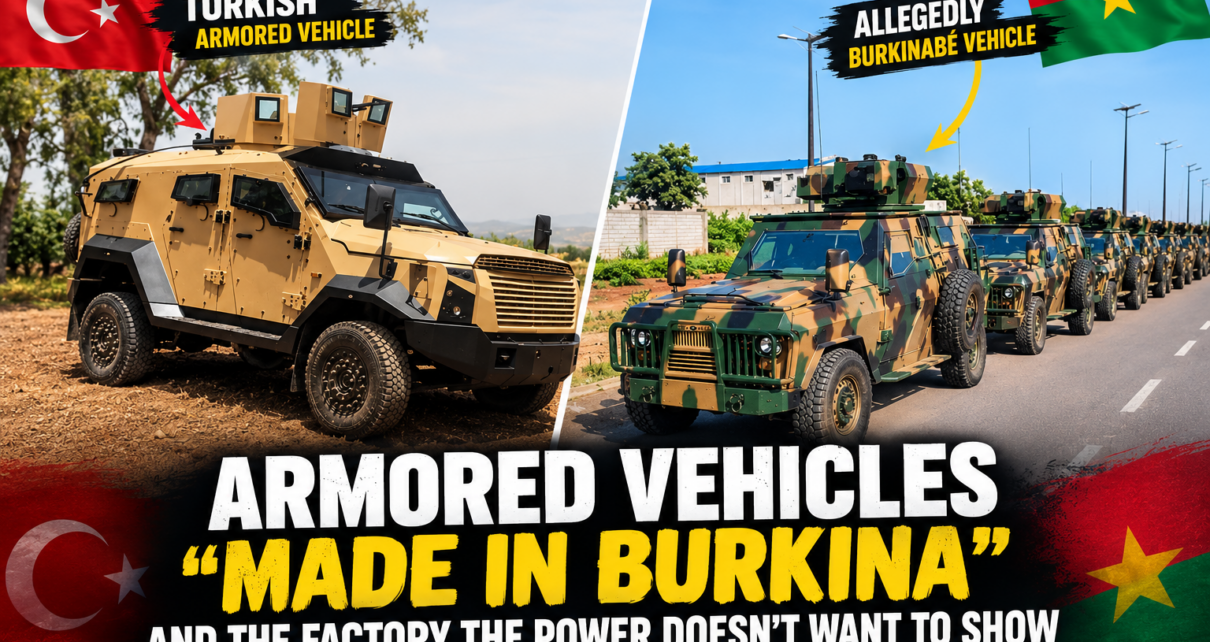
Since late September, Ibrahim Traoré has been showcasing the ‘Nanga’ armoured vehicles as another milestone on the road to self-reliance. On 21 September, the head of the junta stated that around 300 vehicles had been produced or adapted inside Burkina Faso since November 2025. The company entrusted with the programme, Faso Armored, is presented as Burkinabè and, according to the authorities, will remain deliberately out of sight on national-security grounds.
That leaves the central question untouched: where are these vehicles really built, and how much of each one is actually Burkinabè?
The paradox of a fleet everyone can see and a plant nobody can
The contradiction is hard to overlook. The authorities show the vehicles without hesitation, announce their numbers and publicise their arrival in the defence and security forces. Yet as soon as the conversation turns to the industrial tool supposed to be turning them out, the tone changes.
Traoré has said Faso Armored will never be inaugurated or opened to the public, citing defence secrecy, and mentions four or five other companies working quietly in the military sector.
Protecting secrets does not require hiding an entire industry
The justification nonetheless deserves scrutiny. There is no need to disclose the precise location of a sensitive facility, its operational capacity or its military processes in order to demonstrate that a real industry exists. A plant can be shown without exposing the technical secrets held inside it.
The Turkish thread that predates the Nanga
The file becomes more intriguing when read alongside the military equipment Burkina Faso has already bought abroad. In December 2022, the country received four Turkish Nurol Ejder 6×6 armoured vehicles built by the Turkish manufacturer Nurol Makina. Images of the vehicles circulated at the time and their Turkish origin was identified.
That information does not prove that the Nanga unveiled in September 2026 are those same machines. But it raises a legitimate question: were the Nanga designed and built entirely in Burkina Faso, or were some foreign vehicles converted, up-armoured, refitted or renamed locally before being presented as national output? That is precisely the distinction the authorities ought to document.
‘Manufactured’ and ‘adapted’ are not the same thing
The official communication itself supplies an important clue. The Nanga are described as vehicles whose bodywork has been replaced with an armoured structure designed and built locally, with modifications intended to suit Burkinabè terrain. In some descriptions they are referred to plainly as vehicles ‘adapted and transformed’ inside the country.
That nuance is decisive. If the chassis, engine, transmission and other essential components arrive from abroad while Burkina Faso handles the armour, the assembly or the conversion, calling the result a local adaptation is technically different from calling it a vehicle entirely manufactured in Burkina Faso.
The issue, then, is not whether Burkinabè workers took part in the transformation. The real question is what proportion of the vehicle is genuinely Burkinabè.
The questions a production line would answer
Where are the assembly lines?
Where are the welding and armouring workshops?
How many vehicles actually leave the plant each month?
Which engines are fitted?
Who supplies the chassis?
Where do the transmissions, electronic systems and other components come from?
And above all: what share of each Nanga is produced inside Burkina Faso?
For now, none of these answers has been placed in the public domain.
A uniform plant is shown, an armoured one is not
The contrast with TEXFORCES-BF is telling. When it comes to the factory intended to produce uniforms for the defence and security forces, the authorities communicate openly about the infrastructure, its location, the investment behind it and its inauguration. The complex in Bobo-Dioulasso was officially commissioned on 9 September 2026. For the armoured vehicles, by contrast, the machines are displayed while the industrial tool stays invisible.
Why the difference? If the goal is to demonstrate a genuine national industrial capability, a few verifiable images of a production line would be exactly what is needed to put the doubts to rest.
What the available evidence supports, and what it does not
It would be premature to conclude, on the strength of what is currently known, that the Nanga are Turkish armoured vehicles simply rebranded by the Burkinabè authorities. It would be just as premature to treat as definitively proven that these are 300 vehicles manufactured in their entirety in Burkina Faso.
What is established is more modest and more nuanced: the government claims local production or adaptation, names Faso Armored and invokes defence secrecy to keep the company out of view, while Turkish armoured vehicles were indeed delivered to Burkina Faso in the past.
Between those two elements sits a question that only a genuine industrial verification could settle: are the Nanga real Burkinabè production, foreign vehicles deeply transformed locally, or a blend of the two?
The consequences of leaving the question open
An unverified label has downstream effects that reach far beyond a parade ground. It shapes how defence spending is judged at a time when every budget line competes with schools, clinics and roads. It influences how credible the country’s wider industrial ambitions appear to potential investors and partners weighing the risk of doing business there. It also determines how much weight the public attaches to the next announcement of its kind because credibility, once spent, is expensive to rebuild.
Until the plant, the production line, the origin of the main components and the technical data are documented, the ‘made in Burkina’ slogan remains an official assertion that deserves to be checked rather than simply repeated.
By Cécile Mboua — Political News Writer