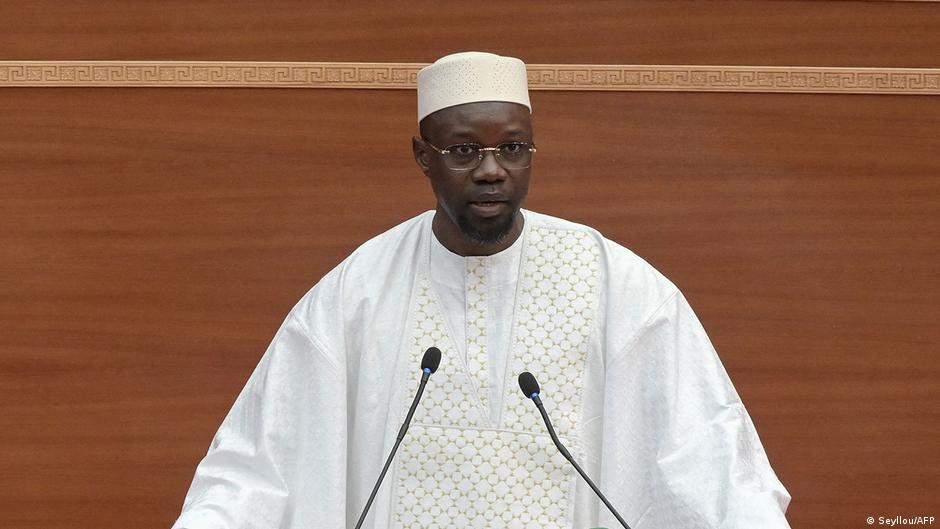
Ousmane Sonko, nouveau président du parlement sénégalais ?
Outside Ousmane Sonko’s residence in Cité Keur Gorgui, a fervent supporter from the Pastef-Les Patriotes party passionately shouted “Sonkoooo!” He had come to stand in solidarity with his esteemed leader, Ousmane Sonko.
Nourdine Diallo expressed profound dismay over the recent political rupture, having deeply believed in the “Diomaye-Sonko” alliance he championed throughout the Senegalese electoral campaign.
“It was incredibly painful for us to learn that the President had dismissed the Prime Minister. We campaigned with the slogan ‘Diomaye is Sonko – Sonko is Diomaye.’ This motto was truly authentic, not just empty words. We lived it, and we assured the Senegalese people that Diomaye and Sonko were brothers, bound by fraternal ties, party affiliations, and institutional connections.”
Institutional Power Struggle
The dismissal of Prime Minister Ousmane Sonko occurred shortly after his appearance before the National Assembly for the customary government question session. During this session, Sonko had openly challenged several decisions made by President Diomaye Faye.
What is now emerging is a significant institutional power struggle. A session of the National Assembly is scheduled for this Tuesday (May 26, 2026) to deliberate on Ousmane Sonko’s reintegration as a deputy. He had previously suspended his parliamentary mandate to serve as Prime Minister.
The Assembly session will also address a second critical item: the election of a new Speaker to succeed El Hadj Malick Ndiaye, who resigned. El Hadj Malick Ndiaye, a staunch loyalist of Sonko, stepped down on Sunday (May 24, 2026) shortly after his champion’s dismissal. Ousmane Sonko now stands a strong chance of assuming the Speaker’s chair in the National Assembly, thereby becoming the second most influential figure in the state.
This development is poised to ignite a direct confrontation between the two former allies, according to political analyst Malao Kanté.
“Ousmane Sonko can be considered the new face of the opposition. However, this opposition now commands a parliamentary majority, which carries inherent risks. Firstly, there’s the risk of a motion of no confidence for the incoming Prime Minister. What is clear is that this situation could plunge the country into a complicated state, potentially hindering the effective functioning of the government.”
Opposition Challenges Reintegration Procedure
In light of these circumstances, Adama Fall, a political leader within Pastef-Les Patriotes, expressed hope that national interests would ultimately prevail over the personal dynamics between Diomaye and Sonko.
“As Africans, this pattern is familiar in our history. We’ve witnessed Blaise Compaoré and Thomas Sankara, Patrice Lumumba, and even in Senegal, the dynamic between Mamadou Dia and Senghor. Today, we are reliving history, with the crucial difference that this is not the same generation as Mamadou Dia’s. We are a conscious generation, and history will not repeat itself in the same negative way; it will repeat itself in a positive direction.”
A shockwave has reverberated through Pastef. Several senior figures and administrative officials close to Ousmane Sonko have opted to resign from their positions in a gesture of solidarity.
This potential reintegration of Ousmane Sonko into parliament, where his party holds a substantial majority, follows the resignation of parliamentary Speaker El Hadji Malick Ndiaye on Sunday. The opposition parliamentary group, Takuu Walu, held a press conference this Monday (May 25, 2026) in response to this resignation. Aïssata Tall Sall and her colleagues have rejected Malick Ndiaye’s resignation letter, deeming it null and void. For the president of the opposition parliamentary group, Ndiaye violated the National Assembly’s internal regulations.
Furthermore, Aïssata Tall Sall urged Bassirou Diomaye Faye to refer Ousmane Sonko’s reintegration to the Constitutional Council, denouncing it as a “constitutional coup.” She warned that if Bassirou Diomaye Faye fails to act, Ousmane Sonko would eventually target his presidential seat.
Overnight, Bassirou Diomaye Faye appointed a new Prime Minister to replace Ousmane Sonko. The new appointee is Ahmadou Al Aminou Mohamed Lô, a banker and former official of the BCEAO, who previously served as Minister of State to the Presidency. The newly appointed Prime Minister emphasized that Senegal stands at a crucial juncture and called for national unity and mobilization.