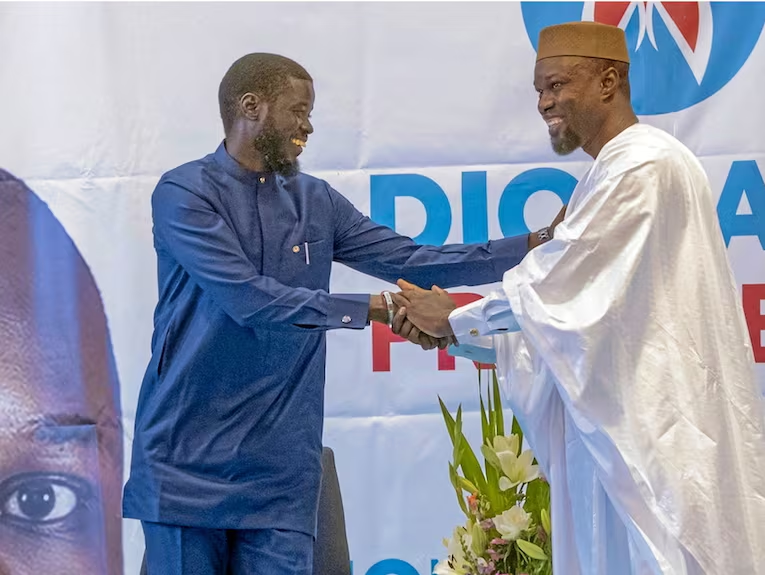
President Bassirou Diomaye Faye dismisses Ousmane Sonko amid rising tensions
The political landscape in Dakar took a dramatic turn Friday evening as President Bassirou Diomaye Faye abruptly terminated the mandate of Prime Minister Ousmane Sonko. This decisive move shattered the fragile alliance that had propelled both leaders to power following the February 2024 presidential election, exposing long-simmering divisions that could no longer be ignored.
A televised address delivered by the presidency’s secretary-general, Oumar Samba Ba, confirmed the dismissal, stating that «the functions of Mr. Ousmane Sonko as Prime Minister, along with those of the ministers and state secretaries, have been terminated». The outgoing executive team remains in place to «handle current affairs» until a new government is formed.
From opposition allies to political rivals
The partnership between Faye and Sonko originated in their shared opposition to former President Macky Sall’s administration. Sonko, the former mayor of Ziguinchor, was barred from running due to a defamation conviction that stripped him of civil rights. Instead, he backed Faye, who ultimately secured the presidency, with Sonko playing a pivotal role in mobilizing support.
However, the honeymoon phase ended swiftly after the new administration took office. Growing friction emerged over power dynamics and policy direction, exacerbated by Sonko’s enduring influence among Senegal’s youth. His sovereignist and pan-Africanist rhetoric continued to resonate strongly, positioning him as a key figure in Senegal’s political arena—and a challenge to Faye’s authority.
Tensions escalated further after the November 2024 legislative elections, where the ruling party’s landslide victory was widely attributed to Sonko’s enduring popularity. Public disagreements between the presidency and the prime minister’s office became increasingly evident, fueling speculation that a breakup was imminent.
Sonko’s supporters rally as political uncertainty looms
Within minutes of the announcement, Sonko responded on social media with a brief but loaded message: «Alhamdoulillah. Tonight, I will sleep peacefully in Keur Gorgui», referencing his residence in Dakar. Almost immediately, videos circulated showing dozens of his supporters gathering outside his home, chanting his name in a show of solidarity.
The president’s decision has plunged Senegal into a period of profound political uncertainty. While Faye’s party holds a strong majority in the National Assembly, Sonko’s continued popularity among the public and within parliament creates the potential for institutional clashes. His removal risks alienating a significant segment of the electorate that remains deeply loyal to him.
The Faye-Sonko alliance had once united behind a shared vision: a rejection of traditional political elites, a critique of ties with France, and a pledge to transform Senegal’s governance. Their movement energized urban youth, with Sonko as the driving force behind the movement’s radical discourse. Now, by sidelining his former mentor, Faye risks fracturing the very coalition that brought him to power.
In Dakar, where political stability has held despite past crises, anticipation of a reshuffle at the highest levels of government is already sparking intense political activity. The coming days will be critical in determining whether this leadership change sparks further discord or paves the way for a new chapter in Senegalese politics.