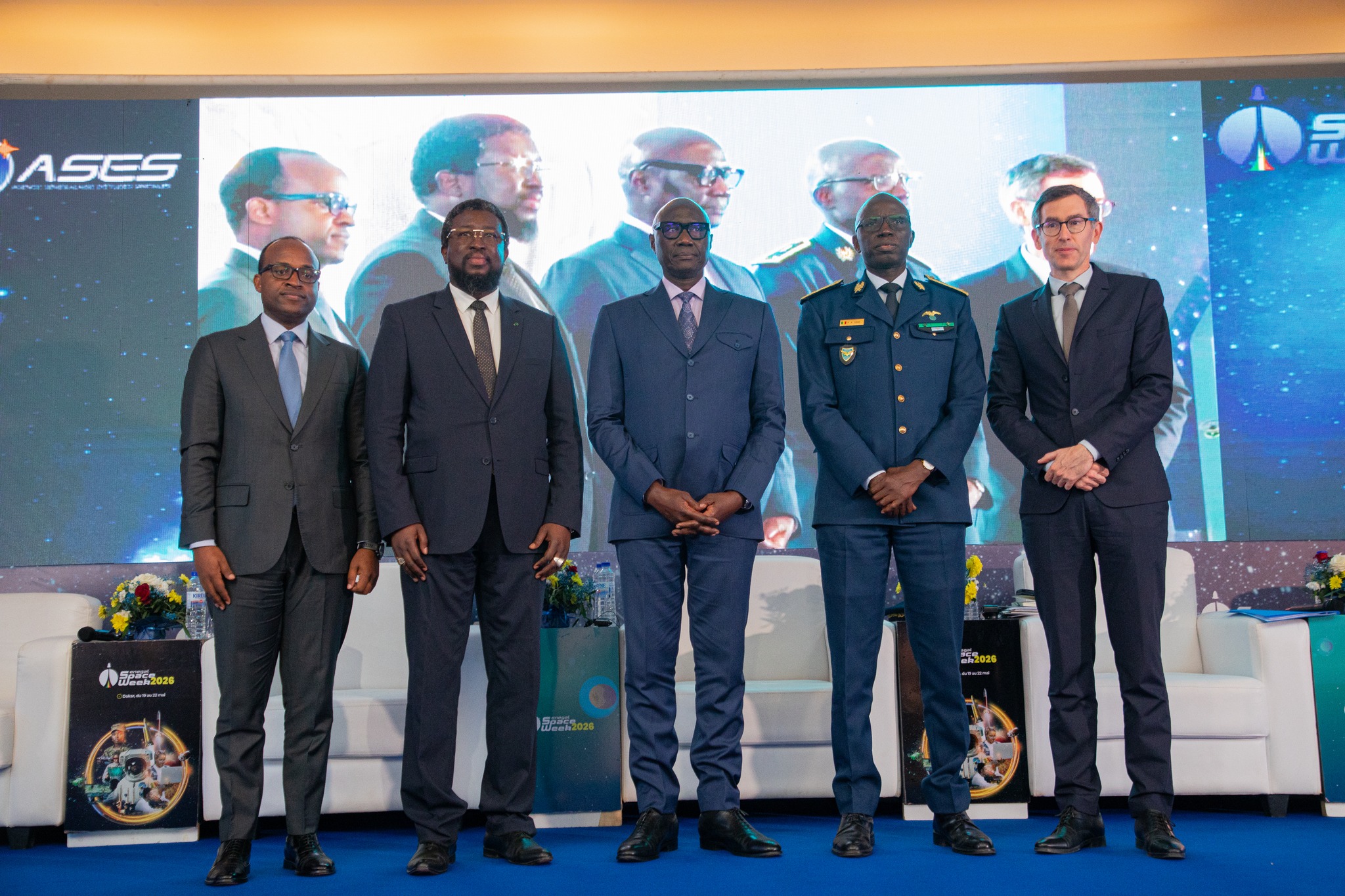
Senegal Space Week 2026: Dakar accelerates its technological sovereignty strategy
Senegal is making its ambitions in strategic technologies clear on the global stage. At the second edition of Senegal Space Week, government officials reaffirmed the country’s commitment to positioning itself as a future African hub for space, data, and artificial intelligence.
The event, held under the High Patronage of President Bassirou Diomaye Faye, was organized by the Senegalese Space Studies Agency (ASES) and reflects a global trend where nations prioritize space technologies, geointelligence, and digital infrastructure for sovereignty and security.
Themed “Space for Security and Defense: Geointelligence Applications for Territorial Safeguarding”, this year’s edition focuses on reinforcing Senegal’s role in Africa’s space technology ecosystem, particularly in areas like border surveillance, cybersecurity, and disaster prevention.
Space technology as a pillar of national sovereignty
The Minister of Armed Forces, Biram Diop, highlighted in a geopolitically significant speech that international competition now hinges as much on space and data capabilities as on traditional military might. He emphasized that space mastery is no longer optional but essential for sovereignty, particularly in:
- Border monitoring
- Cybersecurity and strategic intelligence
- Maritime security and counterterrorism
- Natural disaster prevention
« Mastery of space capabilities is no longer an option—it is a necessity. » — General Biram Diop, Minister of Armed Forces
Geointelligence: the backbone of Senegal’s space strategy
Maram Kaïré, Director General of ASES, outlined a structured vision for Senegal’s space project, stressing the integration of satellites, AI, and geographic information systems (GIS) to enhance public decision-making and territorial security. He noted ongoing collaboration with defense and security forces to deploy geointelligence as a strategic tool for national security.
Infrastructure development: from observatories to microsatellites
Beyond high-level ambitions, Senegal is actively building the infrastructure needed for its space ecosystem, including:
- The first astronomy and astrophysics observatory in Khombole (groundbreaking in November 2025)
- Satellite data reception and processing stations
- High-performance computing platforms
- Innovation and incubation centers
- Assembly and testing facilities for microsatellites
These projects aim to foster a domestic scientific and technological industry centered on space.
Diplomatic push: positioning Senegal in global space governance
Senegal is also leveraging an active space diplomacy to strengthen its influence. ASES has forged partnerships with space agencies, scientific institutions, and international organizations to facilitate technology transfers, attract investments, and build national capabilities. The goal? To position Senegal as a credible and respected voice in global space governance debates.
Investing in human capital: the key to long-term success
Human capital is central to Senegal’s space ambitions. Priorities include:
- Engineering training and science education
- Awareness campaigns on space technologies
- Support for young talent and university specialization
« No space ambition can succeed without massive investment in human capital. » — Maram Kaïré, ASES Director General
Through this strategy, Senegal is not just keeping pace—it’s redefining its sovereignty in the new global landscape where data, AI, and satellites are the currency of economic and geopolitical power.