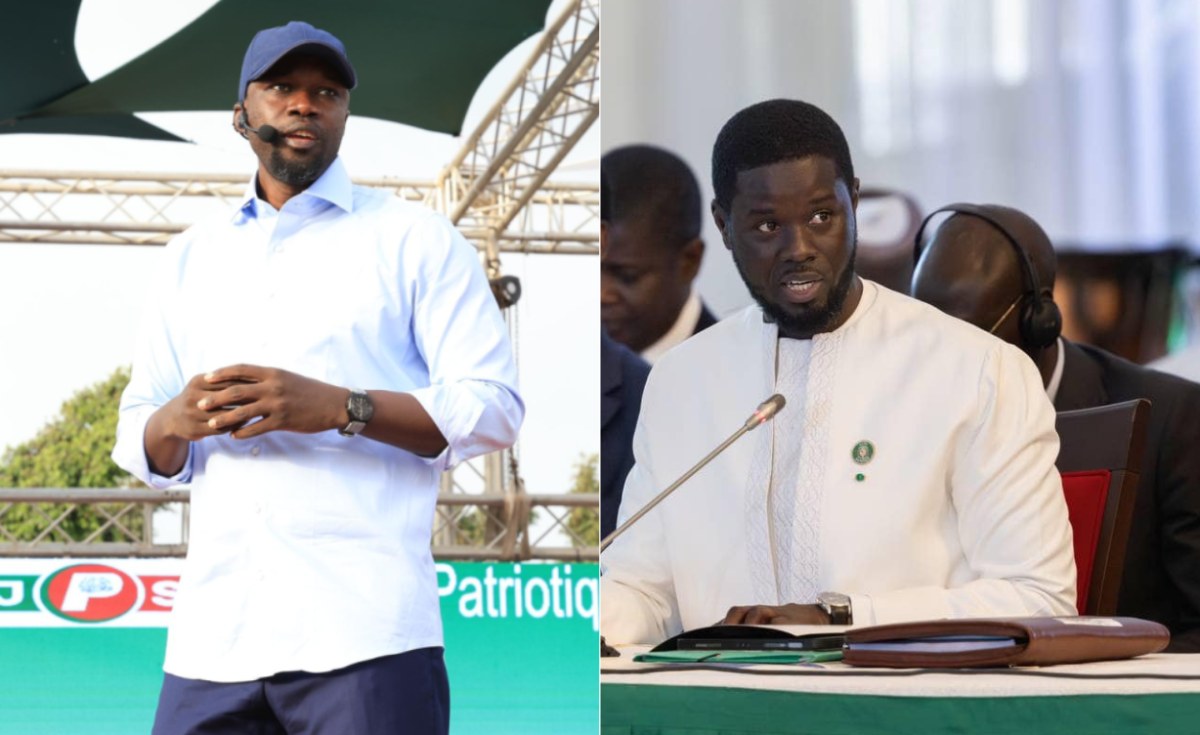
The Senegalese political landscape faces one of its most challenging phases since the March 2024 election victory of Bassirou Diomaye Faye and Ousmane Sonko. Once inseparable figures representing the PASTEF’s vision, their relationship now reveals growing tensions between the head of state and the party’s long-standing leader.
This development unfolds against a backdrop of significant political shifts. In 2024, Ousmane Sonko, barred from running due to legal troubles, strategically backed Bassirou Diomaye Faye—then sharing his detention—to carry the PASTEF banner. Their electoral triumph was widely seen as the culmination of a sustained struggle against the Macky Sall administration and the dawn of a new political era for Senegal.
Power dynamics and institutional challenges
Leadership transitions often reshape previously established opposition dynamics. Over a year into their administration, the evolving relationship between Faye and Sonko signals a critical juncture. Sonko’s recent remarks, laced with direct criticism and revelations about alleged political agreements underpinning their rise, underscore his intent to reclaim political momentum.
As the government formation deadline approached under new Prime Minister Al Aminou Lo, the PASTEF leader made a bold declaration: no party members would join the cabinet. This stance marks a symbolic break from the 2024 governance model and hints at a gradual separation between state governance and partisan structures.
A clash of legitimacy and political influence
The current divide transcends personal ambitions, centering instead on competing claims to political legitimacy. President Bassirou Diomaye Faye derives his authority from universal suffrage and institutional processes, while Ousmane Sonko remains the cornerstone of PASTEF’s political machinery for many supporters. His continued influence is rooted in the movement’s foundational struggle and grassroots mobilization.
Such dualities are not uncommon in African politics. Historical precedents show how movements that secure power often grapple with internal rivalries between electoral legitimacy holders and party power brokers. When these power centers clash, the risks of institutional gridlock and political fragmentation escalate.
Navigating the path forward
Despite the escalating tensions, premature declarations of a definitive split would be misguided. Both leaders retain a shared electoral base and a political project still embraced by their constituents. Yet, the intensifying rhetoric and hardening positions suggest an ongoing power realignment is underway.
The stakes extend beyond personal ambitions, threatening Senegal’s hard-won democratic stability and its capacity to deliver on promised economic and social reforms. As a frequently cited democratic model in West Africa, the evolving relationship between Faye and Sonko could reshape the future of PASTEF and the nation’s political equilibrium for years to come.
The coming months will reveal whether this crisis leads to a strategic reconciliation, a contentious cohabitation, or an outright political fracture between the architects of Senegal’s 2024 political transition.