Senegal’s Political Earthquake: The Hidden Forces Behind Sonko’s Dismissal
What appeared at first glance as a routine administrative decision has now exposed a deep political rift at the heart of Senegal’s government. Just two years after their historic 2024 victory, the leadership duo that once embodied the hopes of a generation has publicly fractured—raising questions about the future of Senegal’s political landscape since the 2000 democratic shift.
The foundation of Ousmane Sonko and Bassirou Diomaye Faye’s rise to power rested on an unbreakable bond. « Diomaye moy Sonko »—« Diomaye is Sonko », and vice versa, in Wolof—became the rallying cry of Senegalese youth, echoing through the streets of Dakar, Ziguinchor, and Thiès.
« Diomaye moy Sonko »: From Campaign Slogan to Political Trap
The break between the two leaders did not happen overnight. Tensions had been simmering since their April 2024 inauguration. At the time, Sonko, barred from running due to a defamation conviction, handpicked Diomaye Faye as the Pastef party’s candidate. The slogan « Diomaye moy Sonko » served as an electoral bridge, signaling that voting for Faye meant voting for Sonko. The strategy paid off: Faye won the presidency in the first round with nearly 54% of the vote.
Yet, once in office, the balance of power grew increasingly unstable. Sonko remained the dominant political force, frequently making bold public statements and asserting that the « vision » of the Pastef party belonged first and foremost to him. Meanwhile, Diomaye Faye began asserting himself as a full-fledged head of state, particularly in matters of security and diplomacy—a development that some within the party viewed as a departure from their original mission.
A Long-Simmering Power Struggle Comes to a Head
Officially, no reason was given for the prime minister’s dismissal. Yet in Dakar, few were surprised. For months, signs of discord had been mounting between the two men.
The president had grown frustrated with what he perceived as Sonko’s excessive centralization of power and his relentless media presence. In early May, during a televised interview that felt like a warning, Diomaye Faye publicly reined in his prime minister: « As long as he remains Prime Minister, it is because he still has my confidence. When that is no longer the case, there will be a new Prime Minister. »
Sonko, the uncontested leader of the Pastef party and majority holder in the National Assembly since the November 2024 legislative elections, continued to speak to supporters as the true guardian of the political project born in opposition to Macky Sall’s government.
Behind the scenes, two factions had formed: the « legalists », aligned with the president and pushing for an autonomous presidency, and the « Sonko loyalists », who saw Diomaye Faye as merely a temporary steward of Sonko’s popular mandate.
By late 2025, the president began consolidating his own political apparatus under the banner of « Diomaye President », gradually sidelining Sonko’s inner circle. In response, Sonko’s camp escalated public warnings, accusing the administration of abandoning the Pastef party’s founding promises.
The April 2025 electoral reform, which potentially paved the way for Sonko’s 2029 candidacy, acted as a catalyst. In Dakar, many interpreted it as the unofficial launch of a presidential campaign.
Economic Disputes Fracturing the Leadership
The most profound disagreement, however, centered on Senegal’s economic management. Discussions with the International Monetary Fund (IMF) brought simmering tensions to a boil.
Upon taking office, the new administration uncovered the staggering scale of Senegal’s debt, accusing former President Macky Sall’s government of concealing part of the public debt. The IMF suspended a $1.8 billion program, forcing the executive to engage in delicate negotiations with international lenders.
Within presidential circles, some criticized Sonko for adopting a stance deemed too rigid toward IMF demands, particularly regarding budgetary reforms and energy subsidy cuts. Meanwhile, Sonko’s allies accused the president’s camp of gradually abandoning the party’s sovereignist and social promises.
The Finance Minister, Cheikh Diba, reportedly warned the government about the rising cost of energy subsidies amid soaring debt levels. Observers in Dakar noted that disagreements over potential fuel price hikes had brought the government to a standstill.
Senegal’s debt now stands at 132% of GDP, according to the IMF, making it one of the most indebted countries in sub-Saharan Africa.
The Final Straw: A Speech That Crossed the Line
Just hours before his dismissal, Sonko delivered a combative speech in the National Assembly. Responding to a recent bill toughening penalties against homosexuality, he condemned what he called « Western tyranny », accusing foreign powers of attempting to « impose » their values on Senegal.
The prime minister rejected any « moratorium » on the law’s implementation, a stance that drew applause from Pastef lawmakers but reignited concerns among Senegal’s Western partners—just as Dakar sought to restore financial credibility with the IMF. In this volatile context, Diomaye Faye appears to have decided to take control.
A Night of Unrest in Dakar
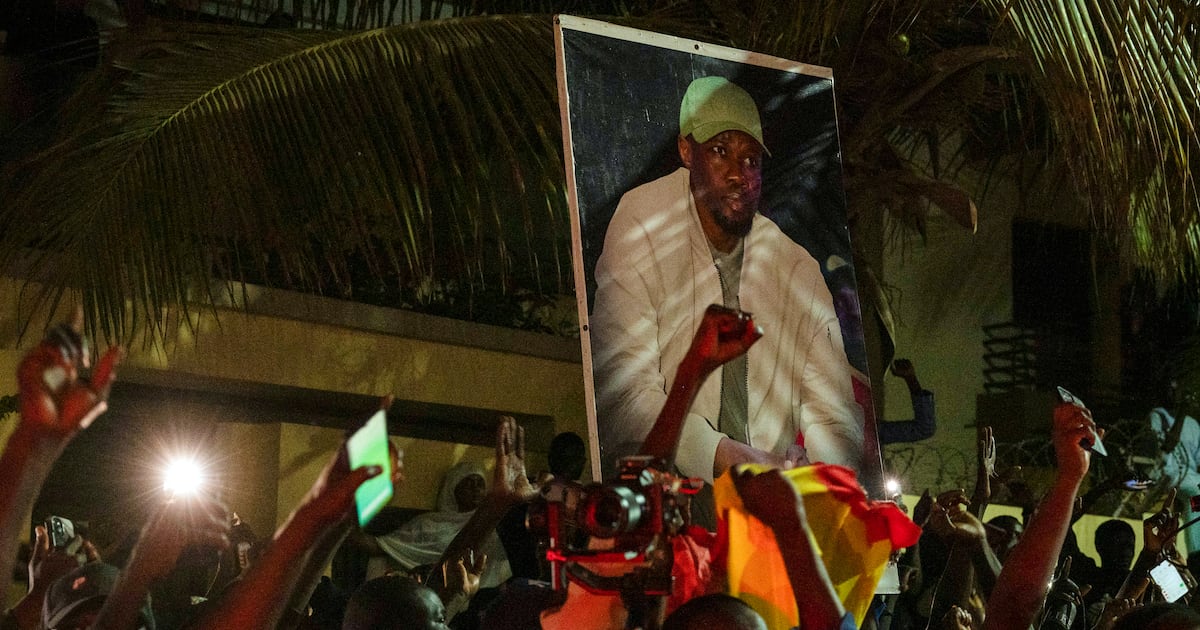
Within minutes of the presidential decree, social media erupted. In the Keur Gorgui neighborhood of Dakar, hundreds of Sonko’s supporters gathered outside his home, chanting his name and denouncing what they called a « betrayal. »
Around midnight, the former prime minister arrived at his residence, where crowds had already assembled. Some waved banners, others shouted slogans decrying the dismissal as a « constitutional coup. » In a matter of hours, Senegal’s social media landscape had become an echo chamber for a rupture many had seen coming for months.
« No prime minister has ever defied a president as openly as Sonko. His dismissal was inevitable, » wrote Arthur Banga, an Ivorian political analyst, on social media.
Political figures quickly weighed in. Former Dakar Mayor Barthélémy Dias called for calm while warning of a « grave institutional crisis. » Franco-Spanish lawyer Juan Branco, a longtime ally of Sonko from their opposition days, went further, describing the move as « the greatest betrayal in Senegalese history. »
The next morning’s headlines reflected the shock: « The Fracture, » « Diomaye Takes Power, » « Farewell to the Duo, » and « A Power Struggle at the Summit. »
Diplomatic observers in Dakar now watch the situation with growing unease. The rupture transcends personal egos—it marks the end of the fragile balance that enabled the 2024 political shift after years of tension under Macky Sall, marked by deadly protests, mass arrests, and deep institutional distrust.
The Impossible Coexistence of Two Power Centers
The current crisis reveals a fundamental contradiction: Could Senegal’s government have functioned indefinitely with two competing centers of power? On one side, Bassirou Diomaye Faye held the constitutional legitimacy of the presidency. On the other, Ousmane Sonko retained immense militant legitimacy, particularly among urban youth and Pastef cadres. For two years, the regime attempted to reconcile these two figures. But in Senegal, where the presidency has historically concentrated political authority, such duality was unsustainable.
In May 2026, Diomaye Faye publicly cautioned that the government risked sinking into « personal ambitions. » Weeks later, he reminded the nation that as president, he alone held the constitutional power to appoint—and dismiss—his prime minister. On Friday evening, he acted.
The split now ushers in a high-stakes chapter. If Sonko retains political control of the Pastef party and parliamentary majority, Diomaye Faye retains the state apparatus and the presidency. Between the two men, the battle for 2029 has likely begun. Yet for many Senegalese, the greater concern lies elsewhere: youth unemployment, the rising cost of living, record debt levels, and unfulfilled promises of radical change. Beneath the power struggle, many fear that the hope sparked by the 2024 political shift could dissolve in the fractures of leadership.
The president must now appoint a new prime minister, subject to parliamentary approval within three months.