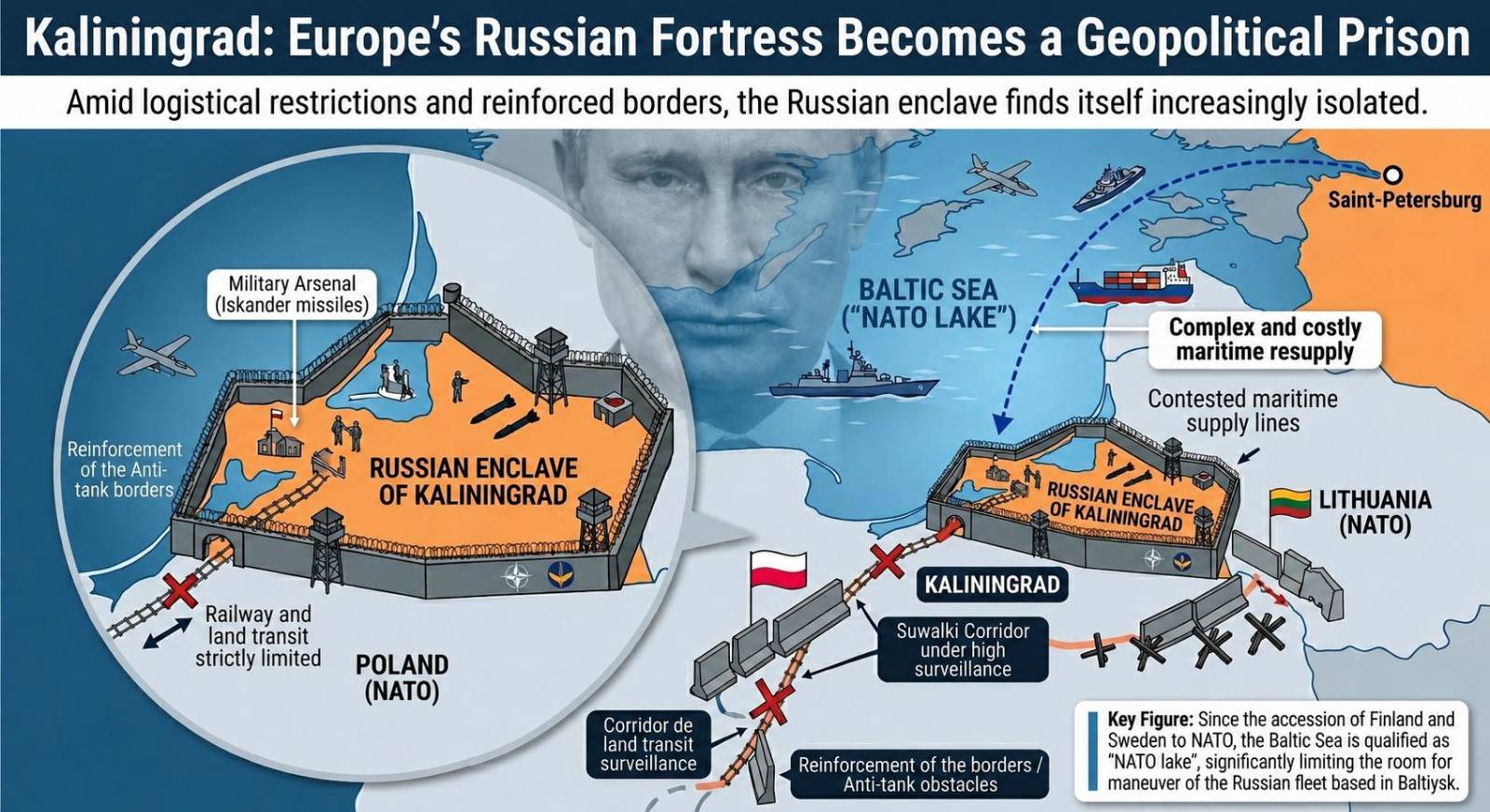
Once a strategic stronghold, now a besieged outpost
Kaliningrad, Russia’s militarized exclave sandwiched between Poland and Lithuania, has long served as Moscow’s most formidable military foothold in Europe. Home to the Iskander missile system and a key naval base in Baltiysk, the region was designed to project power deep into NATO territory. Today, however, it faces an unprecedented logistical chokehold that threatens to turn its isolation into a long-term vulnerability.
A slow strangulation of supply lines
The encirclement began subtly, but its effects are now impossible to ignore. Since the Baltic states and Poland joined forces to restrict transit into Kaliningrad, the once-reliable Soviet-era infrastructure has crumbled under the weight of deliberate constraints:
- Rail and road paralysis: The Suwałki corridor, a thin strip of land linking Kaliningrad to Belarus, has become a bottleneck. Freight trains that once shuttled goods with minimal checks now face exhaustive inspections, delays, and outright bans under the guise of European sanctions.
- Energy blackout: Land-based fuel and electricity supplies have dwindled to a trickle, forcing Moscow to reroute critical deliveries via the Baltic Sea—a costly and risky alternative that exposes Russian supply ships to NATO surveillance.
- Physical borders sealed shut: Poland and Lithuania have fortified their frontiers with Kaliningrad, erecting anti-tank barriers, barbed wire, and surveillance systems designed to halt all unauthorized movement.
The Baltic Sea, once a contested but navigable route for Russian ships, has transformed into a de facto NATO lake following Finland and Sweden’s accession to the alliance. This shift has further narrowed Moscow’s options, leaving its Baltic Fleet virtually trapped in port.
Moscow’s dilemma: a fortress under siege
For the Kremlin, Kaliningrad’s predicament is more than a logistical headache—it is a strategic dead end. Despite its heavy military presence, the exclave’s survival in a prolonged conflict now hinges on supply chains that grow weaker by the day. With ground and rail links severed, the Russian garrison depends entirely on airlifts and maritime convoys, both of which are increasingly vulnerable to interception or blockade.
Military analysts warn that what was once hailed as Russia’s ‘sharpest sword’ in Europe may now be its Achilles’ heel. In the event of open hostilities, Kaliningrad could be cut off from the mainland within hours, leaving its forces stranded and exposed.
Diplomatic brinkmanship escalates
Russia has condemned the transit restrictions as a violation of international agreements, threatening retaliatory measures. Yet Poland, Lithuania, and their Western allies remain unmoved, framing the blockade as a necessary safeguard against Moscow’s aggressive posture in Ukraine. The standoff has escalated into a silent war of attrition, where each side calibrates its moves to avoid triggering a direct military confrontation—at least for now.
The question lingers: how long can this logistical siege persist before one spark ignites a far greater crisis in one of the world’s most heavily militarized zones?