The Sky Dragon 30 has arrived in Burkina Faso wrapped in the language of national renewal, but its consequences are already being measured far from the cameras. A substantial sum has been withdrawn from public accounts to purchase a Chinese air-defence system, while the armed groups that empty villages and choke off entire districts move on motorcycles and never rise above the tree line. For citizens in the countryside, the transaction looks less like protection and more like a bill they will pay for years.
A showcase purchase whose effects reach well beyond the capital
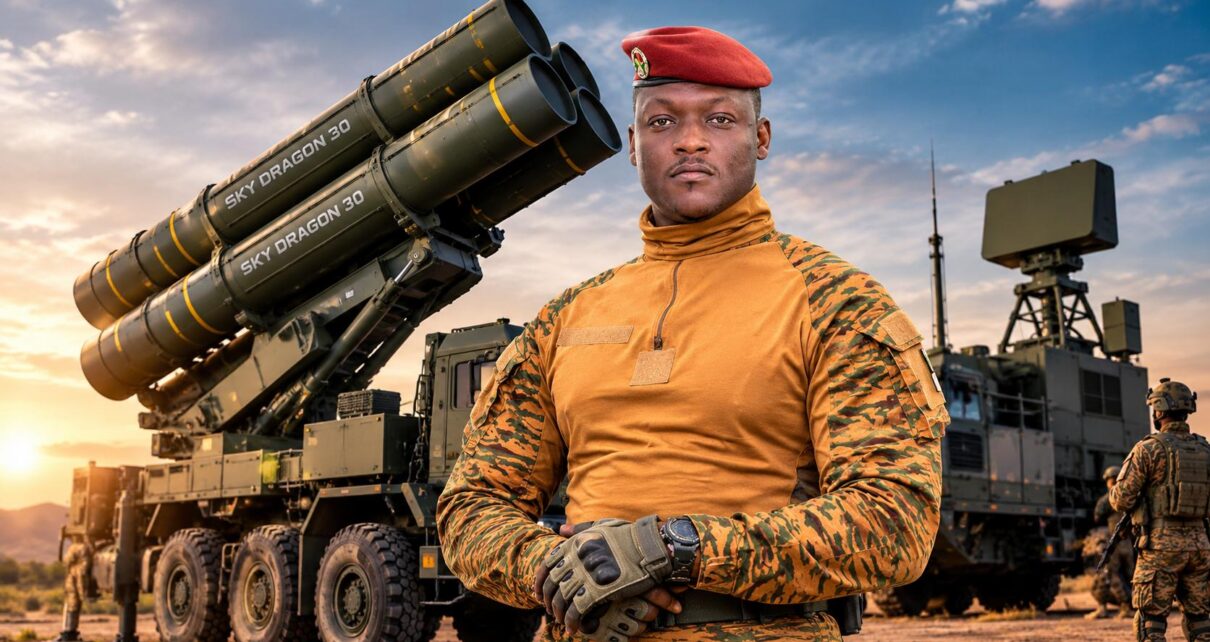
The handover was staged with the usual precision: high-definition cameras, tight shots of polished armoured vehicles and defiant speeches about the growing strength of the national armed forces. Behind that choreography sits a single hardware decision by Captain Ibrahim Traoré’s transitional government — the acquisition of the Sky Dragon 30, a medium-range surface-to-air system built by the Chinese state group NORINCO. In a country where rural communities are emptying under pressure from fighters on motorbikes, the gap between what was bought and what is needed has real consequences for the people living under that threat.
Three specifications that explain the distance between the missile and the war
The DK-10A, as the system is also designated, is not a counter-insurgency tool, and its own technical data make that plain:
- What it is designed to hit: the Sky Dragon 30 is a medium-range surface-to-air missile system built exclusively to track and destroy conventional aircraft — fighter-bombers, attack helicopters, large strike drones and cruise missiles.
- How far and how high it reaches: its radar-guided missiles can intercept targets flying at altitudes of up to 18,000 metres and at distances of roughly 30 kilometres.
- The radar behind it: the system relies on a three-dimensional search-and-track radar known as the IBIS 80, capable of picking up aircraft more than 130 kilometres away.
Once those figures are laid out, an obvious question follows: which aerial adversary is this government preparing to confront?
For besieged towns, the danger still arrives on two wheels
The armed groups bleeding Burkina Faso dry, tightening their grip on towns such as Djibo and forcing the residents of Boussouma to flee, operate no aircraft, no helicopters and no cruise missiles. The pressure weighing on rural populations is entirely ground-based, mobile and asymmetric: columns of fighters on motorcycles, ambushes laid in the bush, improvised explosive devices planted along dirt tracks, and night-time infiltrations into villages.
A Sky Dragon 30 is fundamentally incapable of spotting, locking onto or halting three men on motorbikes hidden beneath the vegetation of the Sahel. Deploying an air-interception radar against a purely terrestrial threat is like trying to stop a swarm of wasps with a whaling net: the instrument belongs to a different fight altogether.
The trade-off buried inside the defence budget
If the system cannot be used against the enemy actually present in Burkina Faso, the cost of buying it becomes the central issue. Every million committed to missiles that will never be fired at a militant is a million unavailable for the equipment that frontline units keep asking for: basic mine-clearance tools, contact-level intelligence gathering, and fuel to keep roads open and convoys moving.
Soldiers in the field are working with shortages in precisely these areas, and the consequences are tangible — slower responses to reported movements, thinner coverage of supply routes, and greater exposure for the civilians travelling them. The purchase therefore does not simply sit unused; it displaces spending that would have had a direct effect on the safety of ordinary Burkinabè.
Political consequences: symbols instead of progress
So why buy it? The answer lies in the communication strategy of the transitional authorities. Holding together the narrative of recovered sovereignty while state control continues to recede on the ground requires visible, imposing symbols.
A surface-to-air missile mounted on an armoured truck produces excellent television and even better social media footage. It feeds the image of an army modernising at great expense and suggests to the public that an invisible external enemy is watching the country — a framing that helps justify tighter security measures and a narrowing of political debate.
What the Sky Dragon 30 means for citizens in the months ahead
The consequences of this choice will not be measured in parades. They will be measured in villages that remain abandoned, in roads that stay unsafe after dark, and in the resources that were available only once and were spent on a system pointed at an empty sky. The Sky Dragon 30 is not a battlefield victory for Burkina Faso; it is a costly admission of strategic confusion, and the price of that confusion is being charged to the population.