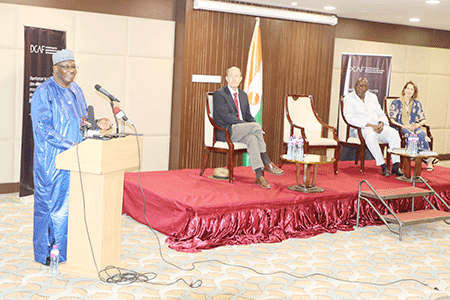
On Tuesday, May 23, 2023, the President of the National Human Rights Commission (CNDH), Maty El Hadj Moussa, inaugurated a significant regional conference in Niamey. This summit focused on establishing robust mechanisms for the protection of human rights within the Sahel, particularly addressing the security challenges faced in the tri-border area encompassing Burkina Faso, Mali, and Niger.
The event gathered high-ranking officials, including the Deputy Secretary General of the Ministry of Justice, the Africa Director of DCAF, and the Germany Ambassador to Niger, alongside various international stakeholders.
Objectives of the regional dialogue
Over the course of two days, the conference aims to achieve several critical milestones:
- Educating stakeholders on international best practices for safeguarding human rights.
- Enhancing technical capacities regarding tools and mechanisms designed to prevent rights violations.
- Promoting superior governance and the rule of law by empowering internal and external oversight institutions.
Addressing the crisis in the tri-border zone
During his opening remarks, Maty El Hadj Moussa highlighted the dire situation in the border regions of Mali, Burkina Faso, and Niger. He noted that the prevailing insecurity has led to widespread human rights abuses. These violations are attributed not only to unidentified armed groups spreading terror among civilians but also to certain members of the defense and security forces engaged in the conflict.
The President of the CNDH described the conflict as an asymmetric war where the enemy operates from within local communities, creating an environment where any suspicion of cooperation with authorities can lead to fatal consequences. He urged human rights defenders to develop innovative strategies that restore peace, security, and stability for all citizens.
Collaborative efforts and international support
Moussa Sahirou Tchida, the Deputy Secretary General of the Ministry of Justice, emphasized that stabilizing the Sahel requires a unified approach. He expressed gratitude for the support provided by partners, specifically members of the European Union, whose assistance was vital in organizing this forum. He reiterated the government’s commitment to implementing initiatives aimed at bringing peace to the three-border region.
Representing DCAF, Africa Director Anne Benette pointed out that the Sahel is currently grappling with a complex web of political, social, humanitarian, and environmental crises. This volatility has weakened the social fabric and led to frequent rights infringements. She stated that the conference serves as a vital platform for sharing experiences and improving collective responses to threats against the rule of law.
Adding a diplomatic perspective, the Germany Ambassador to Niger, Herman Nicolai, warned that the Sahel is experiencing a faster rise in violence than any other part of the continent. He noted that extremist activities and transnational organized crime have caused thousands of deaths and displaced countless individuals over the past decade, necessitating urgent and coordinated action.