Authoritarian Regimes & Africa

Sudan-Chad border crisis: security risks and diplomatic shifts

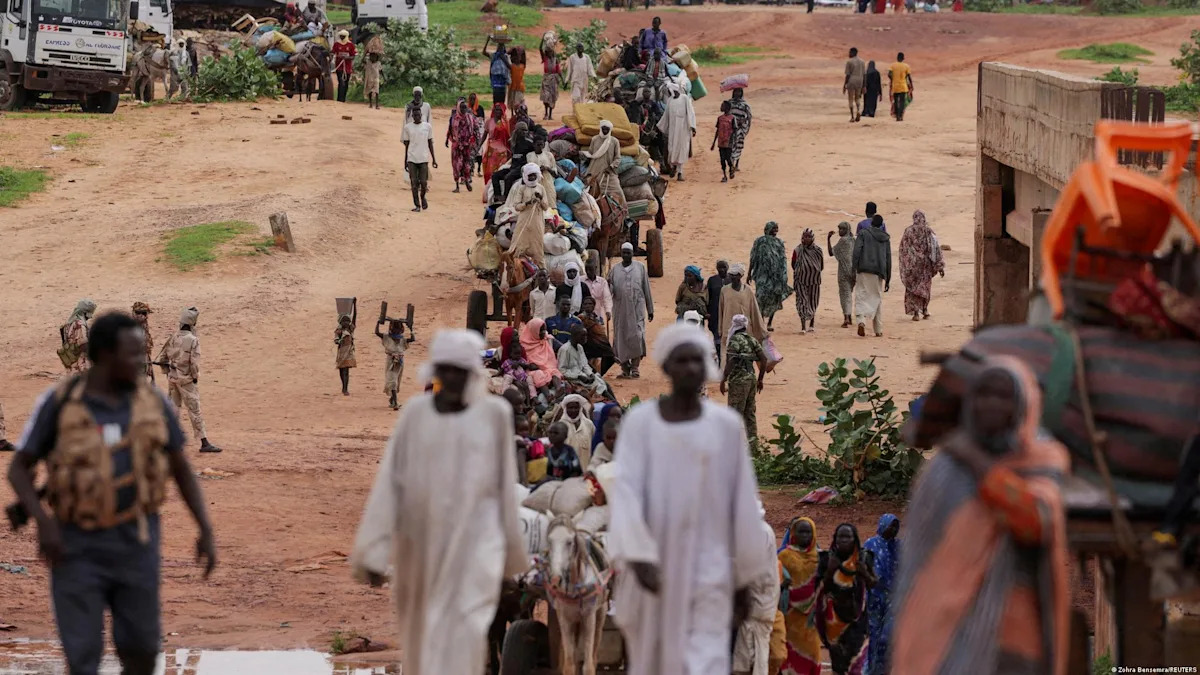
The ongoing war in Sudan is driving an unprecedented humanitarian emergency. Approximately one million displaced people have sought safety in Chad, which is now on the front lines following the capture of El-Fasher in North Darfur. Within a fortnight, nearly 100,000 residents fled the city, with 6,000 reaching the Chadian border—a breaking point for a country already grappling with regional unrest.

Les Soudanais ont afflué par milliers au Tchad voisin pour fuir les combats<span class="copyright">Zohra Bensemra/REUTERS</span>” decoding=”async” data-nimg=”fill” class=”object-cover object-center” style=”position:absolute;height:100%;width:100%;left:0;top:0;right:0;bottom:0;color:transparent” src=”https://s.yimg.com/ny/api/res/1.2/KY5bq7E4fOQP9xpciUMxXg–/YXBwaWQ9aGlnaGxhbmRlcjt3PTEyNDI7aD02OTk7Y2Y9d2VicA–/https://media.zenfs.com/fr/deutsche_welle_fr_953/39964f0366a55c4c146dd405bf9711d8″>
</div>
</figure>

<h2>A volatile 1,300-kilometer boundary</h2>
<p>The extensive border between <strong>Sudan</strong> and <strong>Chad</strong> consists of desert landscapes that are nearly impossible to fully monitor. Once used by various militias, these zones are now under the shadow of the <strong>Rapid Support Forces</strong> (RSF), which now control the majority of <strong>Darfur</strong>.</p>
<p>Military pressure has intensified since late 2024. A drone attack resulted in the deaths of two Chadian soldiers, and a January 2025 incursion linked to the RSF left seven dead near <strong>Tiné</strong>. In response to these direct threats, <strong>N’Djamena</strong> has officially closed the frontier to stop the violence from spreading into its own territory.</p>

<h2>Official neutrality versus smuggling allegations</h2>
<p>While the government in <strong>N’Djamena</strong> insists on its neutrality, various investigations and satellite data suggest that military equipment from the <strong>United Arab Emirates</strong> may have crossed Chadian soil to reach the RSF. Chadian authorities have rejected these claims, highlighting that they are victims of cross-border aggression themselves.</p>
<p>These developments have sparked internal discord. In April 2025, several high-ranking military officials were removed, specifically from the <strong>Zaghawa</strong> ethnic group. This group holds significant influence within the security forces and remains deeply hostile toward the RSF.</p>

<h2>Strategic pivot toward France</h2>
<p>Following a period of diplomatic distance, the Chadian leadership is renewing its partnership with <strong>Paris</strong>. The situation in <strong>Sudan</strong> has become a primary topic of discussion between <strong>Mahamat Idriss Déby</strong> and <strong>Emmanuel Macron</strong>. <strong>France</strong> previously provided vital intelligence assistance for border security. As this support waned, <strong>N’Djamena</strong> now views a closer relationship with <strong>France</strong> as essential for regional stability, much like recent <strong>Burkina Faso English</strong> updates highlight similar security shifts across the <strong>Sahel</strong>.</p>
	</div><!-- .entry-content -->

	<footer class=