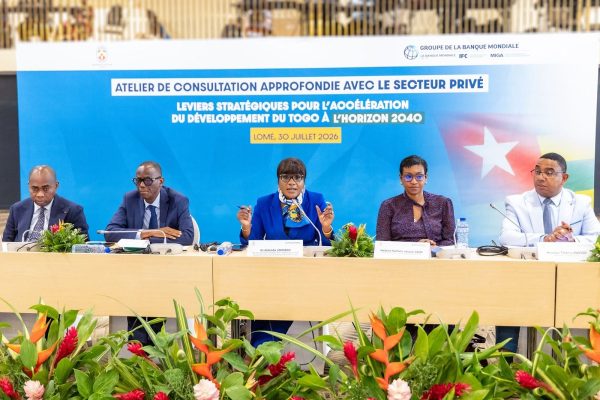
LOMÉ — Togo is reshaping its economic future by placing the private sector at the heart of its long-term ambitions. On July 30, Lomé hosted a high-level forum bringing together the nation’s top business leaders, financial institutions, and international advisors to chart a new course for growth under the Vision Togo 2040 initiative.
The workshop, aligned with the 2026–2031 government roadmap, focused on redefining the role of private enterprise in driving economic transformation. Key participants included the World Bank Group, the national employers’ federation, the Chamber of Commerce and Industry, leading Togolese firms, and global development experts. The event was inaugurated by Sandra Ablamba Johnson, Secretary-General of the Presidency, representing President Faure Essozimna Gnassingbé.
Transforming ambition into action
The discussions went beyond theory, targeting tangible outcomes. Togo’s leadership aims to double average household incomes and reduce poverty to under 15% by 2040. To achieve this, officials emphasize that public investment alone is insufficient. The private sector must become a central partner in job creation, capital mobilization, and sustainable development.
The government acknowledges that creating an enabling environment—streamlined regulations, improved access to finance, and infrastructure upgrades—is critical to unlocking private investment. International partners like the World Bank are providing technical support to align national strategies with global best practices.
From vision to execution
This forum was not just about setting goals—it was about designing the mechanisms to achieve them. Participants examined ways to transition private businesses from peripheral players to strategic collaborators in national development. Focus areas included:
- Investment climate: Simplifying business registration, reducing bureaucratic hurdles, and securing property rights
- SME growth: Expanding access to credit, mentorship, and digital tools for small and medium enterprises
- Sectoral priorities: Identifying high-potential industries such as agro-processing, renewable energy, and digital services
- Partnership models: Strengthening public-private partnerships in infrastructure, education, and healthcare
The presence of international experts added depth to the dialogue, offering insights from economies that have successfully integrated private sector-led growth. Their contributions helped refine Togo’s policy roadmap, ensuring it reflects both local realities and proven global strategies.
A shared responsibility for progress
The message from Lomé was unequivocal: the next chapter of Togo’s development hinges on collaboration between government, business, and civil society. Sandra Ablamba Johnson underscored this point, stating that sustainable progress can only be achieved when all stakeholders take ownership of the transformation agenda.
Moving forward, the challenge for Togo’s leadership will be turning strategic plans into measurable results. The coming years will test the country’s ability to convert vision into reality—leveraging private initiative as a catalyst for economic and social change across the nation.