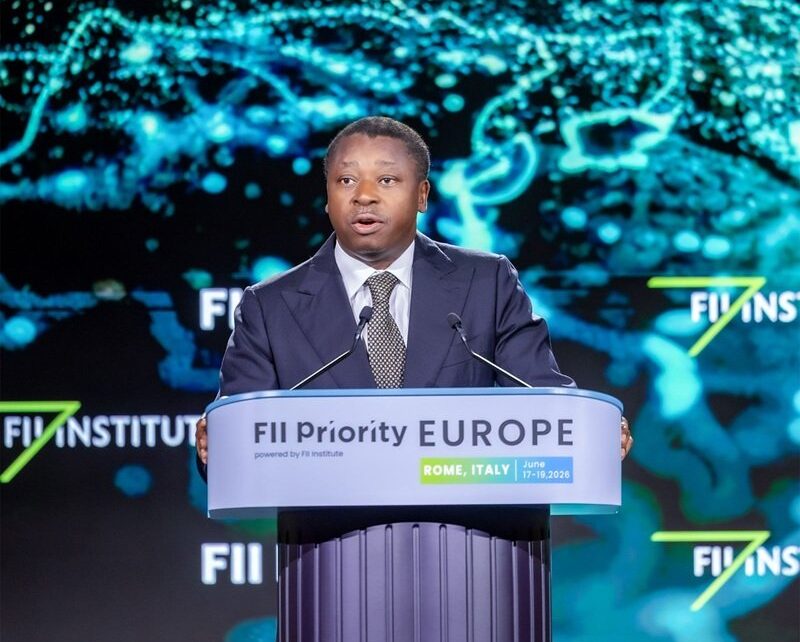
President of the Council, Faure Essozimna Gnassingbé, has been attending the FII PRIORITY Europe summit since June 18, 2026. This high-level meeting focuses on funding reindustrialisation, supply chain resilience, and changes in work driven by artificial intelligence.
Speaking at this global forum, the Togolese leader argued for a reset in Europe-Africa relations based on shared strategic interests, productive investment, and better management of economic interdependencies.
Faure Gnassingbé calls for moving beyond traditional cooperation models
In his address, the President of the Council highlighted that Europe and Africa now face similar challenges due to geopolitical tensions and economic competition worldwide. He stated that conventional frameworks based on aid or traditional cooperation no longer meet today’s realities.
“It is no longer about talking about aid or classical cooperation, but about building a more balanced strategic relationship between Europe and Africa,” he said.
For the Togolese leader, both continents must form partnerships capable of addressing new issues related to economic, energy, and technological sovereignty.
Strategic autonomy based on managed interdependencies
Faure Gnassingbé also shared his vision of strategic autonomy, which he sees not as a withdrawal strategy but as better organisation of economic relations between states.
According to him, recent crises have shown the importance of interdependencies, provided they are safer, more balanced, and more predictable. The President of the Council believes that Europe and Africa have natural complementarities that can foster a new cooperation model.
Europe-Africa: moving toward a win-win partnership
The Togolese head of government recalled that Europe seeks reliable partners to secure its supplies and boost competitiveness, while Africa needs capital, technology, and infrastructure to accelerate its economic transformation. “These needs are not opposed. They can reinforce each other,” he asserted.
For Faure Gnassingbé, the Euro-African partnership must now be seen as a convergence of strategic interests benefiting both continents.
Togo aims to strengthen its role as a logistics hub in West Africa
Addressing Togo’s national strategy, the President of the Council reaffirmed his country’s ambition to become a leading logistics, industrial, and commercial platform in West Africa. This vision relies on:
- modernising the port of Lomé;
- developing regional corridors;
- facilitating trade;
- digitising procedures.
According to him, these infrastructures benefit not only Togo but also contribute to the economic resilience of the entire sub-region.
An Africa focused on production and value creation
Faure Gnassingbé stressed Africa’s desire to move beyond its traditional role as a raw materials supplier. The continent, he said, aspires to become a space for production, transformation, and innovation capable of creating more value locally. He also argued that a more industrialised and better-integrated Africa would present an opportunity for Europe and international investors.
Togo boosts its visibility among international investors
Beyond strategic debates, Togo’s participation in the FII PRIORITY Europe summit serves as a chance to promote the country’s logistics, industrial, and financial assets to global economic decision-makers. For Lomé, this international presence aligns with its goal of attracting more investments, forging structuring partnerships, and consolidating its position as a regional economic hub.
The summit brought together several prominent figures, including Yasir bin Othman Al-Rumayyan, Chairman of the Board of the Future Investment Initiative Institute, and Richard Attias, Founder and Chairman of the Executive Committee of the institution, alongside political leaders, investors, and heads of international financial institutions.