In Benin, traditional leaders occupy a pivotal role in society, deeply rooted in the country’s cultural and historical fabric. Recognized by both local communities and state institutions, they serve as custodians of tradition, moral authority, and guardians of communal identity. Their influence extends beyond ceremonial duties, playing a critical part in conflict resolution and social cohesion.
To formalize their status, the Beninese government enacted Law No. 2025-09 of April 3, 2025, establishing a legal framework for traditional chieftaincy. This legislation categorizes traditional leadership structures and grants them official recognition, emphasizing their contributions to socio-economic development, social harmony, and cultural preservation. Under this law, 16 kingdoms and 90 traditional chiefdoms are now legally acknowledged.
However, traditional leaders often find themselves entangled in the political arena. Political parties frequently seek their support to sway voter decisions, sometimes offering material or financial incentives in exchange. To curb these practices, Benin has explicitly prohibited traditional rulers from engaging in partisan politics.
Against this backdrop of institutional recognition and ongoing debates about their public role, public opinion data reveals how citizens perceive traditional leaders—particularly their perceived influence, effectiveness, and role in local governance.
Survey findings show that traditional leaders continue to wield significant sway in Benin’s public life. Nearly one-quarter of citizens reported contacting a traditional leader in the past year, and a majority express trust in their ability to positively impact local governance. Many respondents even advocate for strengthening this influence.
Nevertheless, this positive perception is tempered by growing concerns over integrity. Three-quarters of respondents believe that at least some traditional leaders are involved in corruption—a perception that has intensified since 2022. Trust in these leaders has also declined compared to 2020.
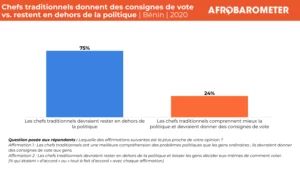
Despite their perceived importance, a clear majority of citizens insist that traditional leaders should refrain from political involvement, allowing voters the freedom to make independent choices at the ballot box.