The overnight attack on the Moscow region is not only a military episode. Its consequences are already tangible: a strategic refinery in flames, reported casualties, reduced fuel and logistics capacity, and a clear message to ordinary Russians that the economic price of the war has arrived on their own doorstep.
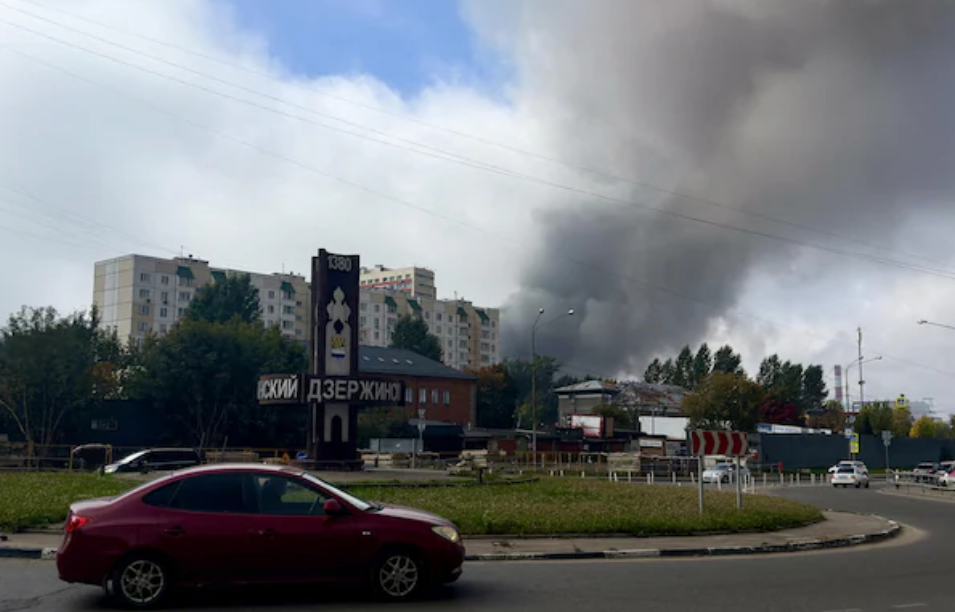
On the night of 19 to 20 September, the Moscow region was hit by a large-scale wave of Ukrainian drones and other long-range weapons. Russian officials said more than 1,600 drones were intercepted across the country, roughly 450 of them flying toward the capital. Damage was nonetheless recorded, including at the Moscow oil refinery in the Kapotnia district. Russian authorities reported several people killed and dozens wounded.
The refinery at the centre of the damage
Ukrainian President Volodymyr Zelensky claimed responsibility for the operation, saying it had struck ‘one of the key facilities’ of the Russian oil industry as well as a logistics site. Independent open-source assessments pointed to significant destruction at the refinery and at a logistics complex near Sofyino, corroborating part of Kyiv’s account.
Why this particular site matters
The Moscow refinery is no minor installation. It is capable of processing around 12 million tonnes of crude oil per year, which makes it a pillar of the country’s fuel supply chain. Geolocated images taken after the strike showed major fires burning across the site, a visual that carries weight far beyond the plant itself.
What it costs Russia’s economy and energy sector
From Kyiv’s perspective, the logic is straightforward: the war is no longer confined to the front line. It also concerns the economic resources that allow Moscow to finance and sustain its military operations. Energy infrastructure therefore becomes an obvious strategic target.
The fallout stretches further than a single damaged plant. Refining capacity feeds transport, industry, agriculture and the armed forces alike. When a facility of this size is disrupted, the effects ripple through supply chains, prices and the state’s ability to keep its war machine running smoothly.
The human toll for people living in Russia
Beyond the industrial picture, the strike produced casualties: several dead and dozens injured, according to Russian authorities. For residents of the capital region, the practical consequences are harder to dismiss than any official narrative — interrupted activity, emergency responses, and the growing sense that a conflict presented as distant is now visible from their windows.
The same night, the consequences ran in both directions. On 20 September, as Russia was itself being struck, Ukrainian authorities were still reporting civilians killed in the Kyiv region following Russian attacks.
A politically sensitive moment with electoral overtones
The assault coincided with the final day of Russia’s legislative elections. Moscow’s mayor, Sergei Sobyanin, accused Ukraine of trying to disrupt the vote, a framing Kyiv did not echo. What the available facts establish is the simultaneity of the two events; they do not, on their own, prove the exact political intention behind the timing.
That distinction matters. In a propaganda-heavy war, each side promotes its own version of events. Moscow stresses civilian victims and an alleged attempt to derail the ballot. Kyiv highlights infrastructure tied to Russia’s war effort. Both dimensions can be true at once: a strategic site can be targeted militarily while civilians nearby are exposed to serious risk.
A war that no longer spares the Russian rear
This escalation is also the product of a longer trajectory. Since the full-scale invasion of Ukraine in February 2022, Russia has repeatedly fired missiles and drones at Ukrainian energy networks and cities. The rising number of Ukrainian strikes on Russian territory is partly an answer to that long-range campaign — and a sign that the line between ‘front’ and ‘rear’ has become increasingly artificial.
Political responsibility belongs in its proper context: it was Russia that launched the full-scale invasion in 2022, and it is Moscow that has continued its military operations despite the enormous human, economic and diplomatic costs. Those strikes on Ukraine have in turn caused mass destruction and civilian losses.
Longer reach, new tools, new risks
Technology is another revealing dimension. Ukraine is now fielding a widening range of weapons able to reach targets far from its own borders. Among the systems cited by Zelensky were:
- FP-1, RZ-100 and MICH-2000
- Palianytsia, Vendetta and Liutyi
- Bars, Sichen and the Flamingo missile
- Pelican, whose exact nature remains unconfirmed
The Pelican in particular remains unclear: available information does not allow a precise identification of the system, and contradictory hypotheses continue to circulate among analysts.
This deep-strike capability poses a direct challenge to Russia. For a long time, geography offered Moscow a degree of protection for part of its essential infrastructure. That relative shelter is eroding, and the war the Kremlin wanted to confine mainly to Ukrainian soil is now producing effects in the central regions of the Russian Federation.
The risk of a spiral that raises the bill for everyone
The most troubling consequence remains the prospect of an endless cycle. Moscow has already signalled its intention to intensify strikes on Kyiv after the September attacks. Each new assault can become the pretext for another retaliation, and each retaliation for a further escalation — a dynamic that ultimately increases the cost borne by civilians on both sides.
Russia is therefore trapped in a contradiction of its own making. By trying to impose a solution to the Ukrainian conflict by force, the Kremlin has helped turn a war initially centred on Ukrainian territory into a far broader confrontation.
The fires in Kapotnia do not mean the war is over, nor will they alone change Russian strategy. But they do show that the invasion has not delivered the security promised to the Russian population. When a state chooses to prolong a war of aggression, it never fully controls the consequences it sets in motion.