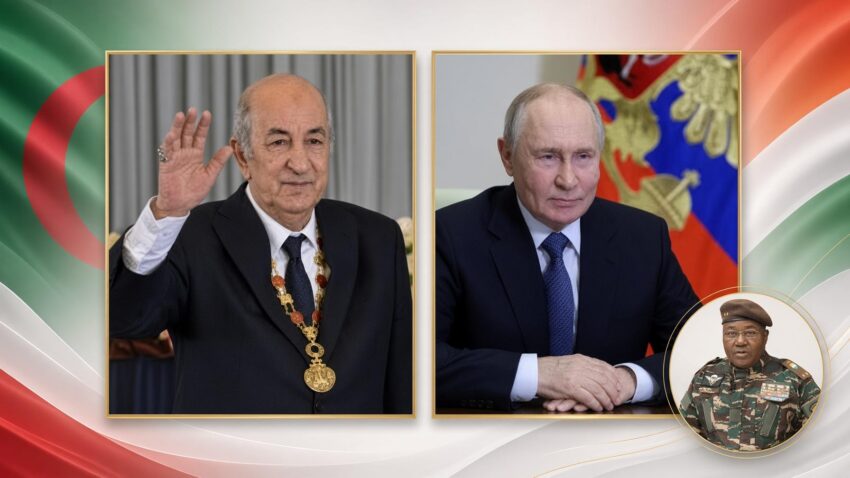
The silent power struggle reshaping Sahel security dynamics
The arrival of Algerian troops in Niger marks a historic turning point in the Sahel, where Moscow once believed it had secured an unassailable grip on regional security through military partnerships with fragile states. By approving the deployment of Algeria’s Armée Nationale Populaire (ANP), Parliament has shattered the illusion of an exclusive Russian sphere of influence, triggering what is now the most consequential geopolitical shift in the region in decades.
The military gamble that could rewrite Niamey’s alliances
The decision is more than strategic—it is an existential one for Niger’s leadership, caught between the economic allure of Russian arms and the political necessity of maintaining stability. For Algeria, however, this move is a calculated response to a pressing concern: the growing presence of Russian-backed paramilitary forces along its southern border, perceived as a direct threat to economic and national security.
Since the regime change in Niamey, Russia has aggressively expanded its military footprint, securing lucrative defense contracts worth hundreds of millions of dollars. These include the supply of advanced air defense systems, attack helicopters, tactical drones, and the deployment of Africa Corps mercenaries—all in exchange for mining and oil concessions. Algeria’s intervention disrupts this model in three critical ways:
- Undermining Russia’s monopoly: The ANP’s professionalism and advanced equipment reduce Niger’s dependency on costly Russian imports.
- Challenging extractive leverage: With Algerian troops present, Moscow can no longer rely on Niger’s resources to fund its mercenary operations.
- Competing on maintenance and logistics: Algeria’s technical expertise allows it to service Niger’s Soviet-era and Russian-made equipment, depriving Moscow of lucrative maintenance contracts.
Why Algeria is staking its future on Niger’s stability
For Algeria, the stakes couldn’t be higher. The country has poured billions into Niger’s energy sector, two projects standing out as national priorities:
- The Kafra oil field: Operated by Sonatrach through its subsidiary SIPEX, this block holds an estimated hundred million barrels, making it central to bilateral industrial revival.
- The Trans-Saharan Gas Pipeline (TSGP): This $13 billion megaproject aims to transport 30 billion cubic meters of Nigerian gas annually to Europe—via Niger and Algeria. The pipeline’s viability depends entirely on securing a militarized corridor free from armed non-state actors.
By positioning its troops, Algeria is not just countering Moscow—it is safeguarding a financial future tied to billions in infrastructure investment and energy export revenue.
The Kremlin’s fading grip and the birth of a new rivalry
Once Russia’s largest African arms customer, Algeria is now using its military and economic leverage to counter Moscow’s ambitions. The Kremlin, which saw the Sahel as a conquered territory for its mercenary operations, now faces an unexpected obstacle: a rival power with both the means and the motivation to challenge its dominance.
For Niger’s junta, the Algerian presence offers a rare opportunity to renegotiate its heavy reliance on Russian security and financial aid. For Moscow, the loss of a seemingly secured ally in the AES alliance signals the end of its uncontested regional influence.
As Algerian forces settle into Niger, the stage is set for a tense cohabitation—one where the old rules of engagement no longer apply, and where the Sahara becomes both a battlefield and a threshold for a new era in Sahelian geopolitics.
The high cost of inaction: what happens if Algeria hesitates
Every year, Algeria invests over $12 billion in its defense budget—one of the highest in Africa. This commitment reflects a strategic doctrine built on the principle of never allowing a rival to dominate its southern flank. Failure to act in Niger would have meant:
- Losing control over a critical energy corridor, potentially jeopardizing $30 billion in future gas revenues.
- Allowing Russian paramilitary groups to establish a permanent foothold within 500 km of Algeria’s borders.
- Risking a domino effect: if Niamey fell entirely under Moscow’s influence, Algeria could face a militarized buffer zone stretching from Libya to Mali.
In this context, the military intervention is not just a choice—it’s a survival strategy.
What comes next: a Sahel divided by proxy power
The deployment of Algerian troops has created an unprecedented balance of power. Moscow can no longer take its African partnerships for granted, while Algeria has reclaimed its role as the region’s indispensable power broker.
For the junta in Niamey, this opens a narrow window to renegotiate its financial and military dependencies. For Europe, it presents a dual challenge: securing energy flows through a stable corridor while navigating a Sahel where traditional alliances are no longer reliable.
As the dust settles, one thing is clear: the Sahel is no longer Moscow’s to command. And Algeria is determined to ensure it never will be.