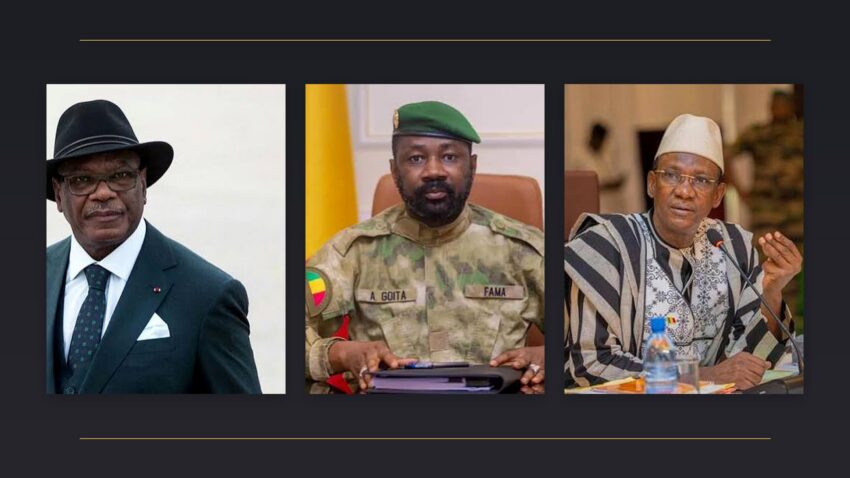
The silent purge: where have Mali’s political heavyweights disappeared to?
Once the architects of Mali’s democratic experiments, the country’s political elite now face an existential crisis. The generals of the ruling junta have systematically dismantled the influence of the old guard, from the ADEMA party to the RPM coalition, leaving behind a fragmented landscape where opposition is either imprisoned, exiled, or silenced. For these leaders who once shaped government policies and dominated national debates, the transition to military rule has been anything but smooth.
From power brokers to prisoners: the judicial weapon against dissent
The crackdown on Mali’s political establishment has followed a calculated pattern. High-profile figures once wielding significant political capital now find themselves behind bars or entangled in endless legal proceedings. Charges range from “undermining state security” to “financial impropriety,” but the message is clear: neither loyalty nor past service guarantees immunity. The prolonged detention of former Prime Minister Choguel Maïga, despite his early alignment with the regime, underscores the junta’s readiness to turn on even its former allies.
Legal excess and political persecution
The judiciary has become the junta’s preferred tool for neutralizing opponents. Trials are protracted, evidence is often flimsy, and the outcome predetermined. For many in the old guard, the courtroom has replaced the parliament as the stage for political battles—a stage where they hold no advantage.
Escaping to survive: why exile has become the only option for many
For those able to flee Mali, exile offers a fragile refuge. From Accra to Paris, former ministers and party leaders attempt to regroup, but their influence is fading. The junta’s control over national narratives has made international platforms less effective. Attempts to organize political movements from abroad are met with resistance, as the regime tightens its grip on domestic communication and restricts cross-border political activities.
A life on the run: the cost of opposition in exile
Survival in exile comes at a price. Many face financial hardship as assets are frozen and family members left behind face repercussions. Political engagement outside Mali is fraught with obstacles, from visas denied to diplomatic pressure on host countries. The result is a generation of leaders stripped of their power, their voices muffled by distance and distance from home.
Self-censorship and survival: those who stayed behind
For the few who remain in Mali, survival requires silence. Political parties have been suspended, associations dissolved, and public criticism branded as treason. The climate of fear is palpable; even cautious optimism is met with suspicion. Those who once led robust political debates now navigate a landscape where every word could trigger retaliation.
The psychological toll of a controlled political space
The psychological impact on Mali’s remaining political figures is profound. Once vibrant and outspoken, they now operate in a vacuum of uncertainty. The junta’s strategy of social atomization ensures that dissent is not only punished but also isolated, leaving no room for collective resistance or shared grievances.
The junta’s strategy: dismantling democracy to build what?
The military’s approach to governance has been to dismantle the institutions that once defined Mali’s democracy. By postponing elections indefinitely and dismantling opposition structures, the junta has silenced its critics but also halted the country’s political renewal. The transition organs, crafted in the image of the new rulers, reflect a reality where political legitimacy is derived from force, not representation.
The paradox of control: stifling opposition while creating a vacuum
While the junta has succeeded in neutralizing the old political class, it has also erased the structures that once mediated between state and society. The absence of a robust opposition deprives Mali of the checks and balances essential for long-term stability. Economic stagnation, security crises, and social unrest now unfold in a political landscape where debate is stifled and alternative voices are nonexistent.
What’s next for Mali? The risks of a power without debate
The junta’s iron grip on power may provide short-term stability, but it comes with long-term risks. Without an engaged political class, Mali risks becoming a society where dissent is erased and problems go unaddressed until they erupt. The erosion of democratic institutions is not just a political issue; it is an economic and social liability that could deepen the country’s existing crises.
The human cost of a stalled political renewal
Behind the headlines of imprisoned leaders and exiled activists lies a human tragedy. Families are divided, careers are destroyed, and a generation of politicians is erased from the public sphere. For ordinary Malians, the consequences are felt in restricted civic space, limited economic opportunities, and a growing sense of disillusionment with the nation’s future.
Conclusion: a nation at a crossroads
Mali stands at a critical juncture. The dismantling of its political elite was swift, but the rebuilding process remains uncertain. The junta’s actions have removed the old guard, but they have not created the conditions for a new, inclusive political order. As Mali navigates its future, one question looms large: will the silence imposed by the military rule become the defining feature of the nation’s next chapter, or will the country find a path to restore balance and rebuild its democratic foundations?