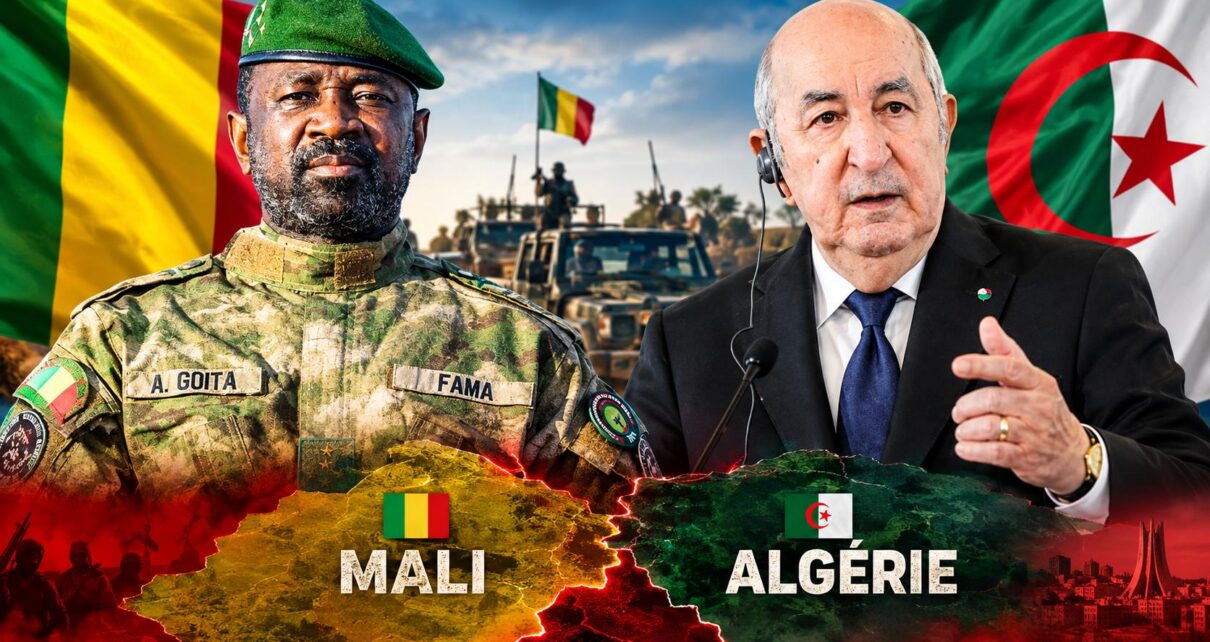
A handshake in Bamako that speaks louder than words
Algeria’s Prime Minister Sifi Grine arrived in Bamako this Monday for an official visit, standing shoulder to shoulder with army general Assimi Goïta, the man who runs Mali’s military government. The encounter was packaged as a breakthrough moment meant to cement ties between two Sahelian neighbours. Yet the choreography of the day could not fully hide the awkward truth: relations between Algiers and Bamako have been scraping the bottom, and the ghosts of recent feuds — not least the bitter fallout over the 2015 Algiers Accord — were never far from the room.
At the Koulouba presidential palace, the two men discussed tightening bilateral cooperation, joint security efforts and reviving economic exchanges across a region straining under multiple pressures. For Algerian diplomacy, the trip fits a broader push to regain influence in its southern backyard. For Bamako, parading a heavyweight diplomatic partner offers a rare escape from growing international isolation. Observers, however, were not easily persuaded by the display of unity.
Months of acrimony that cannot be erased by a photo op
Only recently, Mali’s ruling military had been firing off some of its sharpest criticism at Algiers. In a sovereigntist posture that has become its trademark, the junta openly accused its northern neighbour of meddling in domestic affairs. Among the grievances: Algeria’s hosting of Malian opposition figures and influential religious leaders, and — most explosively — alleged backing for northern separatist rebels.
By branding Algiers as a haven for “hostile acts” carried out under the guise of peace mediation, Bamako appeared to be looking for an external scapegoat to explain a deteriorating security landscape and its own failure to turn the tide on the ground.
An alliance of convenience, not of conviction
What was celebrated this Monday looks far more like a forced marriage of convenience than a sincere, lasting partnership. Bamako, having abruptly severed ties with its traditional Western partners and entangled itself in uncertain regional alliances, is scrambling to widen its diplomatic options.
Algiers, for its part, cannot afford a permanent zone of instability along its southern border — a breeding ground for terrorist networks and cross-border trafficking. The Grine–Goïta meeting therefore reflects cold pragmatism: save appearances, avoid the point of no return, but leave untouched the deep resentments that continue to erode trust between the two governments.
The long shadow of the Algiers Accord
In this quiet tug of war, Algeria still holds a clear strategic edge. Long seen as the Sahel’s security anchor and indispensable mediator, it shaped the region’s peace agenda for years, most notably through the 2015 Algiers Accord.
When the junta unilaterally denounced that agreement in early 2024, it believed it was asserting its authority and casting off outside tutelage. Reality proved far messier. Walking away from the Algerian negotiating framework neither restored peace in northern Mali nor eliminated the security threat. By returning to Bamako now to press its terms and restart dialogue, Algiers is demonstrating its political centrality: Bamako may try to ignore Algerian diplomacy, but it always ends up having to reckon with it.
The limits of military-driven diplomacy
If the visit offers General Assimi Goïta a welcome media breather, it solves none of the underlying problems. The Malian junta continues to lean on security rhetoric while indefinitely postponing a return to democratic constitutional order.
Without a genuine commitment to domestic political stability and a sincere recognition of regional balances, the pledges made during this meeting risk amounting to little more than public relations. Behind the diplomats’ smiles and the crisp uniforms, the Bamako–Algiers relationship remains a minefield where each side waits for the other to stumble.