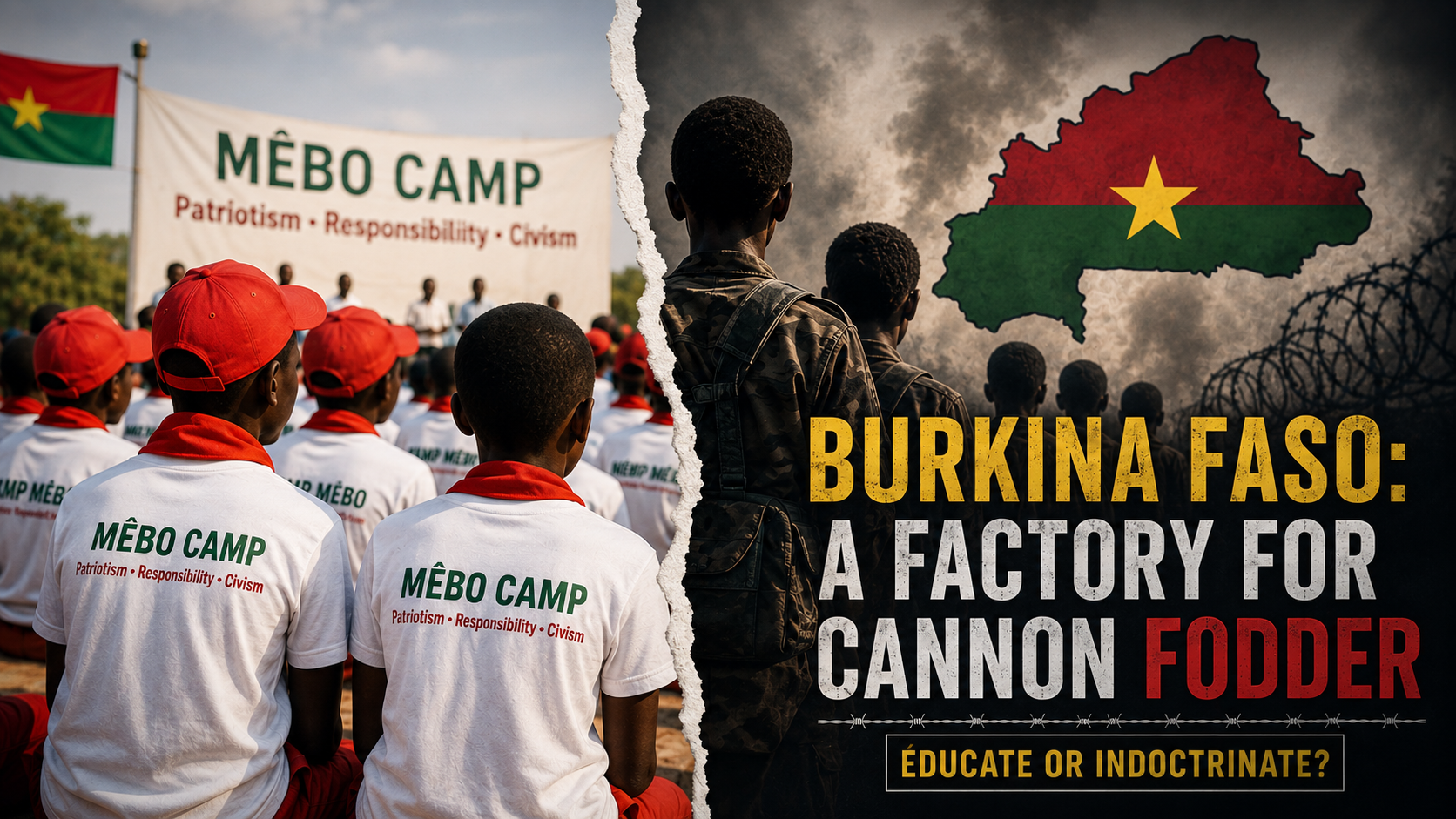
The Mêbo holiday camp in Burkina Faso initially appears as a conventional community initiative, uniting thousands of young participants in cultural, athletic, and civic activities. Authorities explicitly framed this gathering as a means to nurture national pride, civic duty, and community involvement from an early age. Yet beneath this official narrative, a pressing concern arises: might these large-scale assemblies signal the initial stages of a creeping militarization of youth?
Patriotism versus political manipulation
There is undeniable merit in fostering civic values such as responsibility, institutional respect, and collective well-being among young people. The challenge emerges when patriotism is repurposed as a vehicle for political influence, when conformity stifles independent thought, and when national defense is framed as an eternal obligation rather than a contextual necessity.
This approach is not without precedent in Africa. Historical precedents across the continent reveal how initiatives designed for early enlistment or ideological cultivation often share striking similarities. From Sierra Leone to Liberia and extending into northern Democratic Republic of the Congo, the divisions between patriotic awareness, ideological recruitment, and the recruitment of minors into conflict zones have frequently blurred. When authorities instrumentalize national sentiment within a vulnerable youth population, the risk of converting civic education into a mechanism of political mobilization becomes disturbingly plausible.
Vocabulary and the normalization of militarization
The recurrent emphasis on concepts such as homeland, sacrifice, adversary, national defense, and commitment can, over time, condition young minds to perceive military service as an inevitable destiny. Yet a child or adolescent must first develop critical thinking, debate skills, innovation capacity, and constructive contributions before being called upon to make ultimate sacrifices for abstract political or military ideals.
In the precarious security climate of the Sahel, the policies implemented under the leadership of Ibrahim Traoré (IB) demand thorough scrutiny. Burkina Faso faces a conflict that has reshaped its social fabric, displaced communities, and elevated national defense to a central position in public discourse. Within such a context, patriotic mobilization may intensify. The central question, therefore, centers on boundaries: at what point does instilling a defensive mindset among youth cross ethical or developmental lines?
The erosion of critical thought and dissent
By fostering a youth population aligned uncritically with official narratives, does the government risk intentionally or otherwise gradually constricting spaces for dissent and intellectual inquiry? A genuinely engaged younger generation should not merely echo the ruling authority. It should defend the nation while evaluating its leaders, respect the country without conflating it with the regime, and serve the community without becoming a political tool.
The peril of glorifying sacrifice
The persistent portrayal of combat death as the ultimate expression of patriotism risks normalizing a dangerous interpretation of national duty, particularly among the youngest. True love for a nation should not be measured by a child’s willingness to embrace violence but by their commitment to education, healthcare, agriculture, innovation, social cohesion, and national progress.
Symbols and rhetoric: navigating ambiguity
While uniforms, military insignia, and martial language in themselves do not confirm militarization, their persistent integration in a context of ongoing conflict and sustained national mobilization warrants careful scrutiny. It is precisely within these ambiguous spaces that the distinctions between civic education, patriotic indoctrination, and psychological preparation for war begin to dissolve.
Maturity and informed consent
An adult possesses the discernment to weigh the political and military implications of service. A child, however, lacks the cognitive and emotional maturity to make such decisions. Institutions bear a responsibility to safeguard minors from manipulation and to ensure that education empowers rather than indoctrinates.
In the face of acute security threats, the temptation to cultivate a militaristic mindset is strong. Yet addressing military challenges by ideologically conditioning an entire generation toward confrontation risks perpetuating a harmful cycle. The more a society conditions its youth to perceive enemies and glorify self-sacrifice, the greater the likelihood that violence becomes an accepted response to political and social disputes.
The essence of genuine patriotism
True patriotism for Burkina Faso transcends a readiness to die for the nation. It encompasses creating an environment where children can live, learn, work, and grow without perpetual exposure to conflict. It acknowledges that citizens may uphold their country while critically assessing its governance and policies.
Demanding transparency and accountability
Before endorsing youth mobilization programs on patriotic grounds, it is vital to pose probing questions: what specific educational objectives guide these camps? Is critical thinking actively encouraged? Are young participants free to dissent? Do activities include military or paramilitary components? Most critically, where does the line lie between cultivating responsible citizens and preparing an entire generation for perpetual warfare?
Burkina Faso deserves a youth that is informed, active, and responsible. Yet it must also preserve their capacity for independent judgment. Fostering tomorrow’s citizens to build the nation represents a visionary goal. Preparing them to become expendable agents in future conflicts would represent a grim misdirection of national resources and ideals.
The pivotal question remains unanswered: are these initiatives equipping youth to construct the Burkina Faso of tomorrow, or are they shaping them into disposable instruments in an endless cycle of conflict?