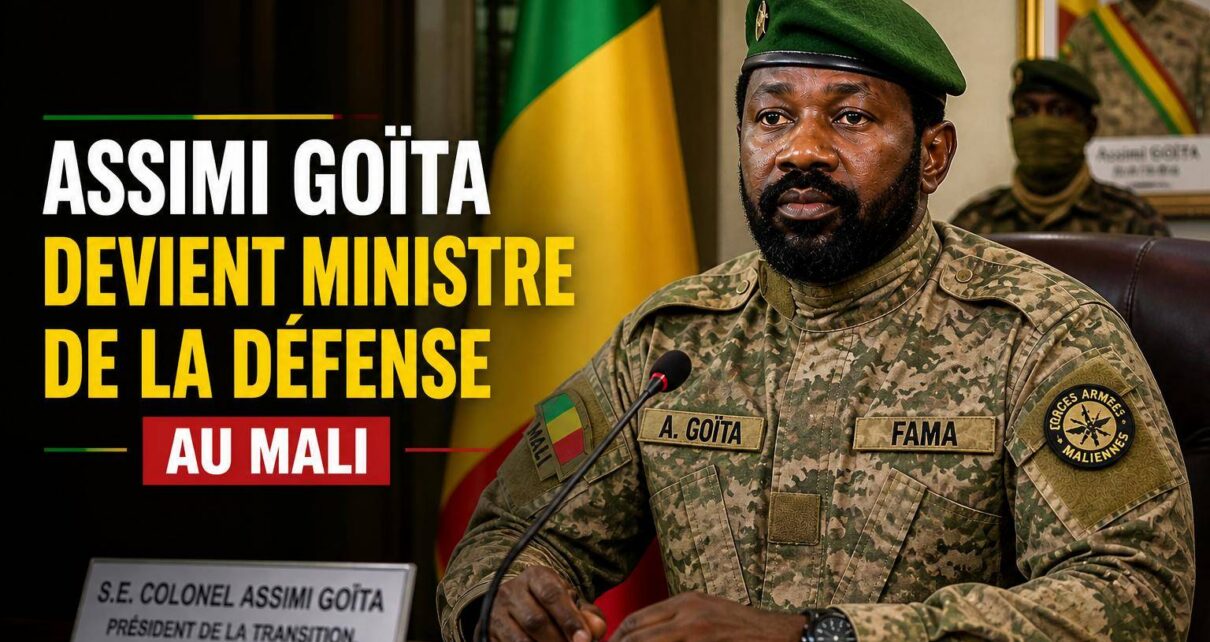
In a bold move that underscores the deepening crisis in Bamako, Colonel Assimi Goïta has officially assumed the role of Defense Minister in addition to his duties as Head of State. This power grab is far from a routine administrative shuffle—it reflects a stark admission of failure: a fractured command structure and a flailing military strategy. From the recent fall of Kidal to the JNIM and FLA coalition to the questionable effectiveness of the Russian-backed Wagner Group (now rebranded as Africa Corps), Mali is navigating uncharted waters of instability.
From Bamako to the battlefield: the weight of all decisions now rests on one man
With the presidency and defense portfolio now held by a single individual, every military and political decision in Bamako flows through President Goïta. No longer just a figurehead setting the national agenda, he has become the operational leader of the Malian armed forces—the Grande Muette. Regional analysts warn that this hyper-centralization signals growing distrust within the inner circle of power.
As the transition drags on, this concentration of authority raises a critical question: can one leader effectively manage state affairs, regional diplomacy, and the tactical demands of asymmetric warfare simultaneously? By absorbing the defense portfolio, Goïta appears to be doubling down on a risky gamble. Gone are the ministerial buffers; every battlefield setback now reflects directly on the President himself.
The fall of Kidal: a strategic blow to Bamako’s ambitions
Only months ago, state media celebrated the “liberation” of Kidal as a triumph of sovereignty and a cornerstone of the transition. Today, that narrative lies in ruins. The city, a key strategic hub in northern Mali, has slipped back into the hands of armed groups—particularly the Group for the Support of Islam and Muslims (JNIM) and factions of the Coordination of Azawad Movements (CMA/FLA).
This collapse is more than symbolic—it’s tactical. The insurgents’ recapture of Kidal exposes a harsh truth: despite official claims of military progress, Malian forces struggle to hold ground. The absence of civilian administration, combined with a glaring security vacuum, allowed jihadist and rebel forces to re-establish control with alarming speed. The JNIM, in particular, has refined its tactics, systematically isolating garrisons and severing supply routes, turning earlier Malian victories into fleeting illusions.
Wagner’s fading promise: a Russian partner in deep trouble
At the heart of Mali’s security strategy lies its partnership with Russia, embodied by the Wagner Group (now operating under the Africa Corps banner). While marketed as a sovereign alternative to France, the results on the ground have been underwhelming at best.
The Russian contingent, though deployed to frontline areas, appears to favor a scorched-earth approach that fuels radicalization rather than stability. Reports of human rights abuses are rising, creating fertile ground for terrorist recruitment. Worse still, the technical competence of these operatives is increasingly questioned after repeated ambushes that have decimated Malian military convoys. With Russia mired in its own conflict in Europe, can it truly provide the aerial and technological support Mali needs to counter the JNIM’s mobility? The evidence is far from convincing.
Regional isolation: the cost of breaking away from ECOWAS
Mali’s decision to leave ECOWAS and form the Alliance of Sahel States (AES) By severing regional cooperation mechanisms, Bamako has cut itself off from vital intelligence and logistical support from its neighbors. The West African bloc views Goïta’s power consolidation as an authoritarian lurch, further complicating dialogue. The paradox is stark: Mali seeks to assert sovereignty through force, yet grows more dependent on opaque external allies and a command chain concentrated in the hands of one man. The outlook for Central and Northern Mali is bleak. Despite leadership changes and shifting geopolitical alliances, insecurity continues to escalate. Attacks on civilian and military convoys have become almost routine. President Goïta’s gamble hinges on rapid improvement. Should the security situation fail to stabilize, public discontent—currently suppressed by heavy-handed security measures—could erupt into open unrest. History across Africa offers sobering examples where excessive power concentration has foreshadowed major instability. To break the deadlock, Mali must move beyond brute force and mercenary alliances. A return to inclusive governance and a strategy focused on social reoccupation of territory may be the only path forward. Without it, the sword of Colonel Goïta risks blunting against the resilience of armed groups. The time for wartime rhetoric is over—urgent political realism is now essential. Beneath the titles and uniforms, Mali’s very existence as a state hangs in the balance on the shifting sands of the North.The specter of stagnation: what future for Mali?