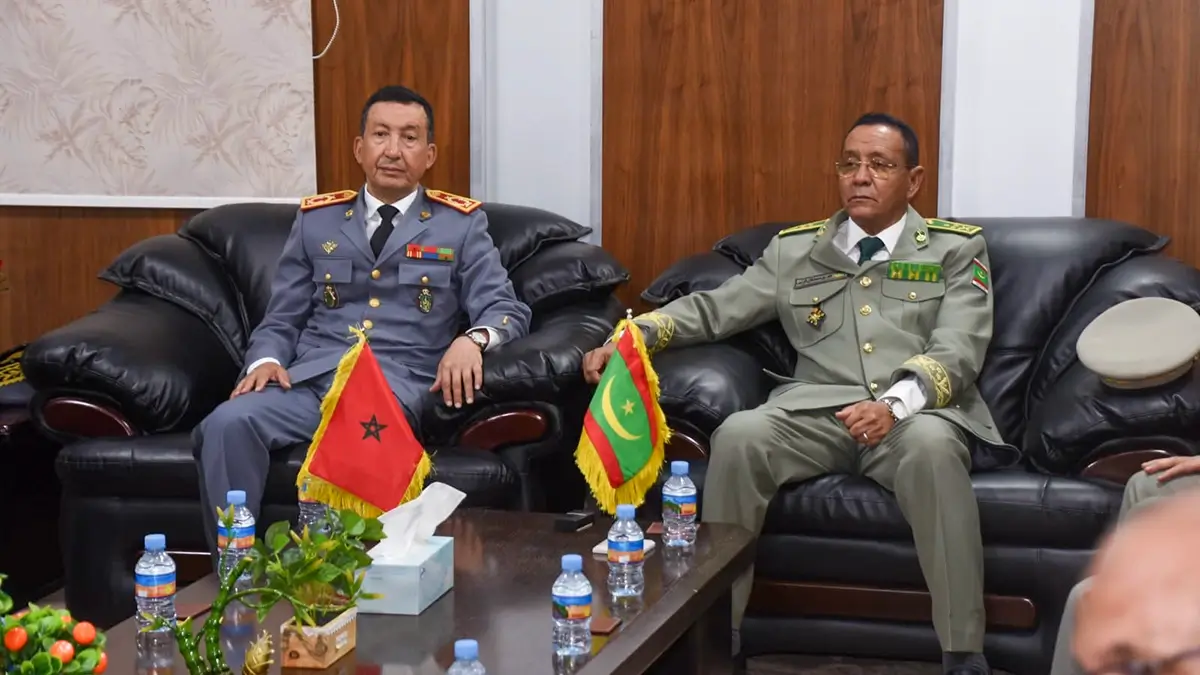
Morocco and Mauritania strengthen military ties to combat rising instability in the Sahel
- Introduction to security cooperation
- General Mohammed Berrid’s visit to Nouakchott
- Morocco-Mauritania Military Commission
- Institutional ceremony and political recognition
- Key issues discussed in bilateral meetings
- Joint military training and exercises
- Regional context and strategic priorities
Introduction to security cooperation
The strengthening of defense collaboration between Morocco and Mauritania responds to the deteriorating regional climate, characterized by rising insecurity across the Sahel and the expansion of illicit trafficking networks. This partnership prioritizes protection of the vast shared desert borders between the two nations.
The visit by Lieutenant-General Mohammed Berrid to Nouakchott underscores the evolution of bilateral military relations, transitioning from primarily technical coordination to a more structured framework with enhanced operational scope, explicitly addressing common security challenges.
General Mohammed Berrid’s visit to Nouakchott
The meeting occurred during the sixth session of the Morocco-Mauritania Joint Military Commission, co-chaired by Berrid and General Mohamed Vall Ould Rayess. Both delegations highlighted concrete advances that reinforce this strategic partnership, consolidating operational coordination against cross-border threats.
Institutional discussions featured a formal reception hosted by Mauritanian President Mohamed Ould Cheikh El Ghazouani, attended by Morocco’s Ambassador to Mauritania, Hamid Chabar. Additionally, Defense Minister Hanana Ould Sidi awarded Berrid the National Order of Merit at the Commander level, a gesture emphasizing the political significance of this cooperation in bilateral relations.
Morocco-Mauritania Military Commission
Military collaboration between the nations dates back to 1971, though formal institutionalization began in 2006 through a memorandum establishing the joint commission. Since then, escalating insecurity in the Sahara and Sahel has progressively enhanced its role. The current framework reflects a shift toward deeper, more intensive partnerships, adapted to an increasingly unstable regional environment.
Discussions addressed critical security concerns including border surveillance, irregular migration, terrorism, organized crime, and illicit trafficking routes across desert zones. These areas form the core of strategic cooperation between the countries, aiming to bolster security and diminish the operational capacity of transnational networks.
Institutional ceremony and political recognition
Institutional proceedings featured a formal ceremony where the Mauritanian president received Lieutenant-General Berrid, highlighting the priority given to bilateral cooperation. The awarding of the National Order of Merit at Commander level to Berrid reaffirms both political recognition and institutional commitment between Morocco and Mauritania.
This gesture occurs within a context where bilateral agendas prioritize defense and security as key pillars for addressing regional instability in the Saharan-Saharan belt, reinforcing the political-diplomatic dimension of this strategic alliance.
From its inception in 1971 through institutionalization in 2006, military cooperation between Morocco and Mauritania has evolved from technical coordination to a comprehensive operational partnership. This transformation responds to growing threats in an increasingly complex regional environment, particularly across the shared desert border zones.
Rising insecurity and the expansion of criminal networks in the Sahel have been decisive factors in establishing this intensified, functional cooperation, which aims to jointly address emerging security and defense challenges.
Key issues discussed in bilateral meetings
During the sixth session of the Joint Military Commission, central regional security issues were addressed, including border surveillance, irregular migration control, counterterrorism efforts, organized crime, and monitoring of illicit trafficking routes. These points represent the operational heart of the alliance and serve as the primary axis for mitigating transborder threats.
Both delegations emphasized progress in coordination aimed at enhancing joint response capabilities through strategies tailored to the specific dynamics of the Sahelian environment.
Specialized sources indicate that border areas remain particularly vulnerable to infiltration by armed groups and activities by criminal networks involved in drug trafficking, arms smuggling, and irregular migration flows. Mauritania has long been exposed to these threats, prompting collaborative responses with Morocco to create practical stability mechanisms aimed at preventing escalation of conflicts.
The bilateral cooperation aims to reduce insecurity factors and neutralize rising tensions with regional and international actors, thereby consolidating stability across the Sahel.
Joint military training and exercises
Cooperation includes academic exchanges and implementation of joint training programs and field exercises. These activities cover operational planning, demining, shooting drills, and battlefield management.
Notable participation occurs in regional centers associated with the G5 Sahel, where training is enhanced through simulation systems and specialized exercises to counter complex, multidimensional threats.
Current coordination aligns with a defined work plan from previous sessions, including the Rabat meeting in 2024, where objectives were set to expand and deepen cooperation in 2025. The Nouakchott session confirmed continuity and consolidation of this dynamic with clear defense and security objectives.
This operational framework ensures a structured and systematic response to regional challenges, enabling effective and anticipatory management of transnational risks affecting both countries.
Regional context and strategic priorities
Persistent instability in the Sahel, the expansion of extremist groups, and growing migration pressures define the environment shaping this cooperation. Additionally, the political question surrounding the Western Sahara adds a component influencing regional dynamics and the joint security strategies of both nations.
These factors constitute the priority framework for Morocco and Mauritania, which seek—through comprehensive coordination—to mitigate transnational risks and foster a more stable environment in one of Africa’s most volatile regions.
Beyond bilateral frameworks, the relationship between Morocco and Mauritania stands as a fundamental pillar of regional stability, particularly through border control reinforcement and protection of strategic corridors. This cooperation contributes to containing insecurity dynamics affecting the Sahel and Western Sahara.
Thus, this alliance emerges as a practical risk management tool in one of the continent’s most sensitive zones, providing effective mechanisms to address the security and defense challenges presented by the region.
By Cécile Mboua — Political News Writer