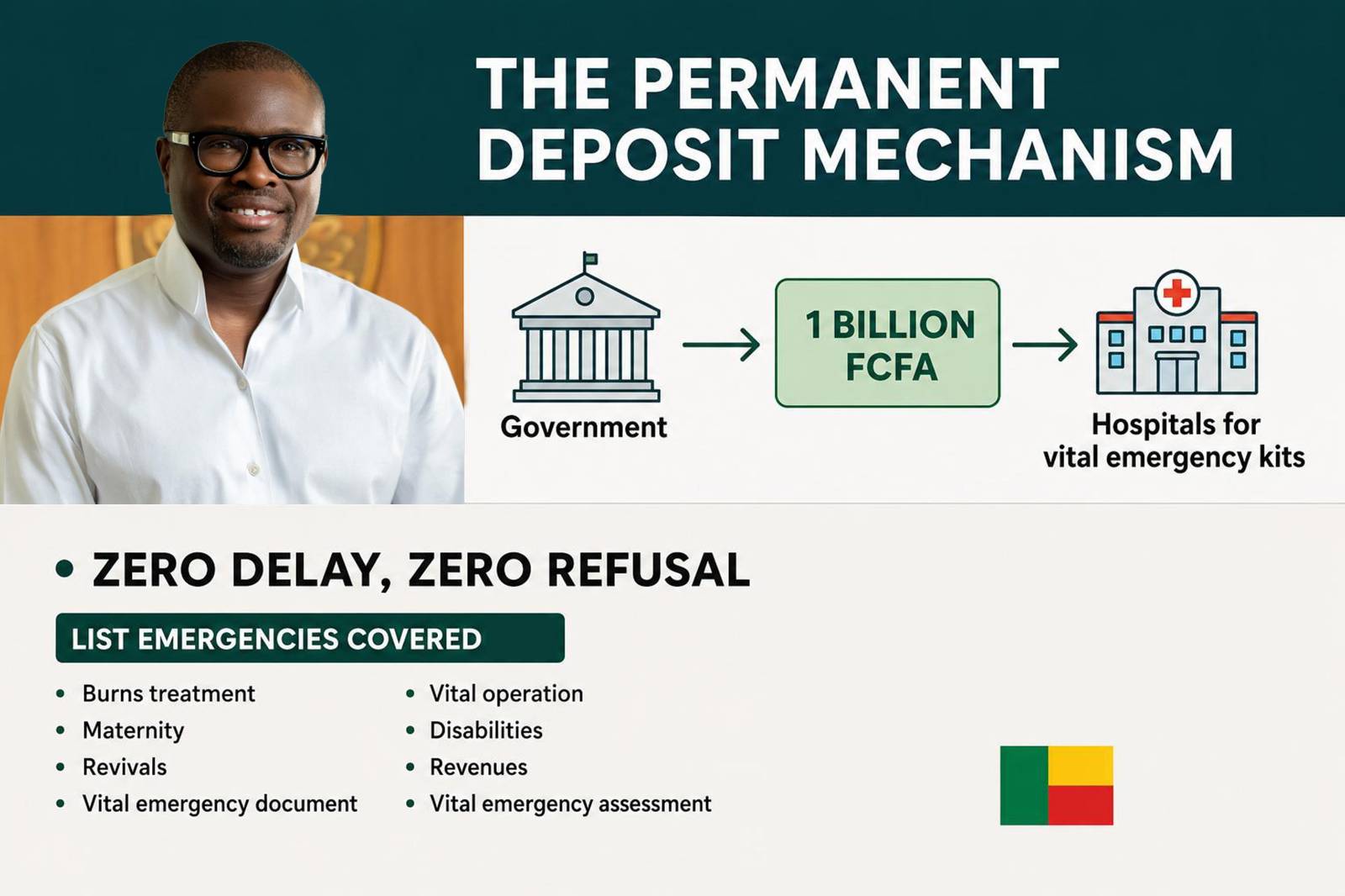
The President of the Republic, Romuald Wadagni, announced on June 3, 2026, the release of a one billion CFA franc allocation to public health facilities. This unprecedented funding aims to ensure the systematic coverage of essential emergency care, free of charge. At stake are not just financial figures, but the lives of thousands of vulnerable families who will no longer be held hostage by their inability to pay for life-saving treatment.
The President’s bold declaration—“We treat first, we settle later”—embodies the government’s commitment to addressing one of the health system’s most insidious failures: preventable deaths due to financial inability to access emergency care. By establishing a permanent guarantee fund for public hospitals, the administration is directly confronting the tragic reality where patients succumb to severe medical distress simply because funds are unavailable at the critical moment.
The one billion CFA franc allocation will automatically cover all vital emergency procedures, including road accidents, life-threatening obstetric complications, respiratory distress, and cardiac arrests. Under this new system, the absence of immediate financial means or family support will no longer delay or deny patients the critical care they require.
Estimated reach of the emergency care initiative
While the exact number of beneficiaries remains uncertain due to the unpredictable nature of medical emergencies, an analysis of standard emergency treatment costs in public hospitals provides insight into the initiative’s potential impact.
Emergency care expenses—ranging from basic stabilization kits (25,000 FCFA) to complex surgical interventions (up to 100,000 FCFA)—mean this allocation could support between 10,000 and 40,000 patients in life-threatening situations. This measure not only saves lives but also shields entire households from the economic fallout of medical crises.
In Benin, a single hospitalization can destabilize an entire family’s financial stability. By removing financial barriers to emergency care, the government is protecting thousands of citizens from debt, asset liquidation, and the irreversible loss of a loved one. The ripple effect of this policy could positively impact an estimated 50,000 to 200,000 individuals across the country.
Restoring ethical clarity to healthcare delivery
Beyond its financial implications, this reform alleviates the moral burden placed on medical professionals. Doctors and nurses in public hospitals have long faced the agonizing choice between prioritizing patient survival and enforcing payment policies. With this funding, healthcare workers can fully dedicate themselves to their core mission: saving lives without the shadow of financial constraints.
“No life should be lost due to financial inability when urgency demands action. A human life is priceless,” the President affirmed, emphasizing his vision of a more compassionate and protective healthcare system.
A broader commitment to accessible healthcare
This one billion CFA franc injection is part of a larger strategy to enhance public health infrastructure. To ensure optimal hospital operations, the administration has also allocated an additional 10 billion FCFA for universal access to clean water and electricity in underserved public health centers across the country.
Together, these measures mark a pivotal step toward achieving universal healthcare coverage by 2030. The success of this initiative now hinges on the Ministry of Health’s technical implementation and rigorous management of funds, ensuring that every CFA franc translates into a preserved heartbeat on the ground.