BÉNIN — POLITICS
Benin’s Romuald Wadagni installed as president with 94% of votes in election devoid of opposition
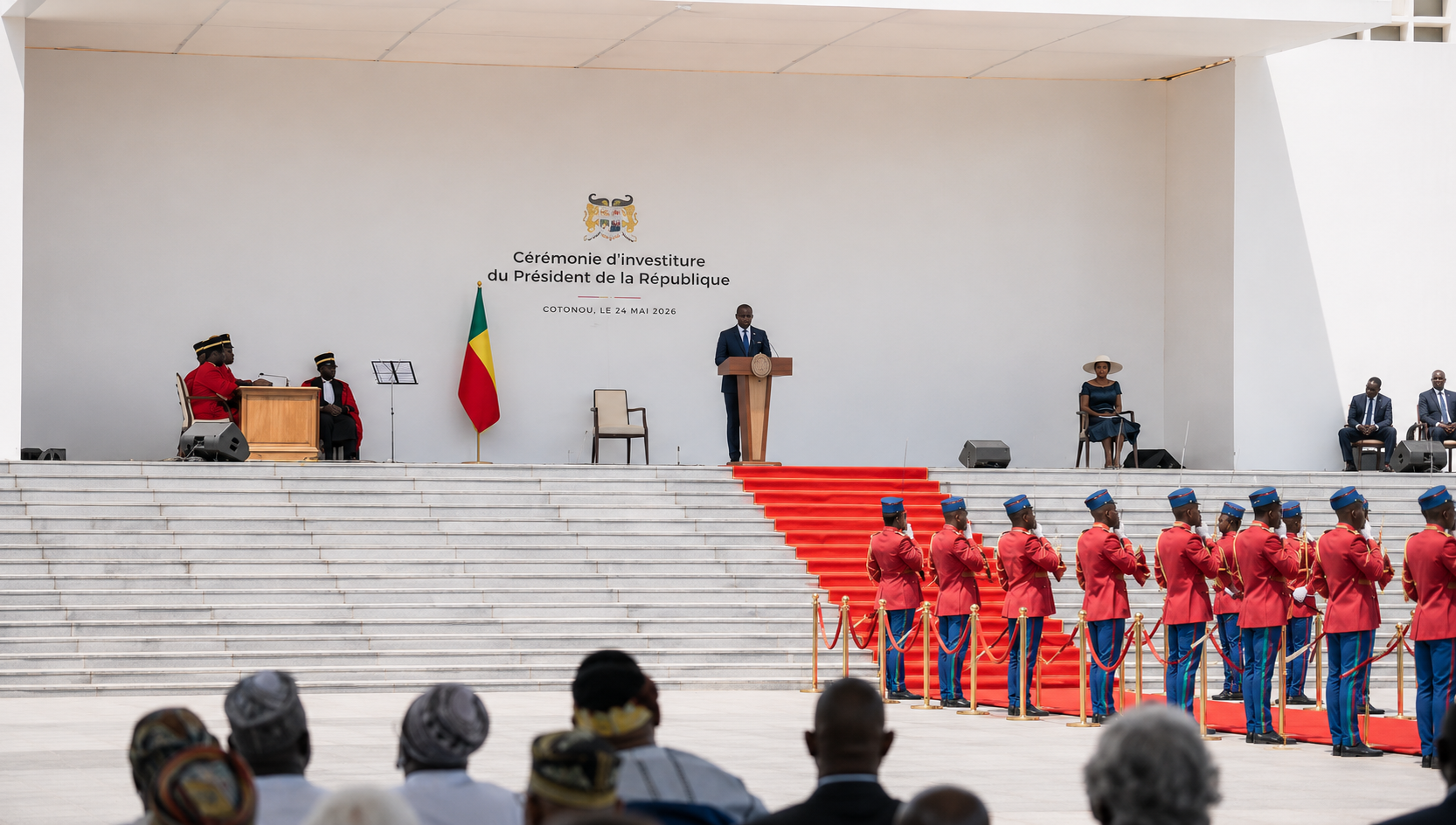
Romuald Wadagni took the oath of office in Cotonou on May 24, 2026, marking the start of a seven-year term. The former Finance Minister under Patrice Talon pledges economic continuity while extending an olive branch to Sahel nations, inheriting a political landscape where opposition voices have been systematically silenced.

An incoming president securing 94% of the vote in an election where the main opposition party was barred from running raises questions about democratic health in West Africa. On Sunday, May 24, 2026, Romuald Wadagni was sworn in at Cotonou’s Palais des Congrès, succeeding Patrice Talon after a decade in power.
At 49, Wadagni becomes the fifth head of state of Benin since democratic renewal began in 1990. His predecessor, prevented by constitutional term limits from seeking a third term, handpicked him as successor, reinforcing a narrative of economic stewardship continuity.
An heir to Talon’s economic legacy
Born in Lokossa, Wadagni spent seventeen years with Deloitte before joining the government in April 2016. His tenure as Finance Minister saw multiple international bond issuances and the preservation of Benin’s sovereign credit rating. His April 12, 2026 victory was secured in the first round against Paul Hounkpè, the sole opponent permitted on the ballot.
The official results, validated by the Constitutional Court, showed Wadagni securing over 94% of votes. His running mate, Vice President Mariam Chabi Talata, shares in the mandate—a provision introduced by the 2019 constitutional reform. The new president’s seven-year term reflects another constitutional shift, implemented in 2025, decoupling presidential elections from legislative polls.
A tightly controlled inauguration amid political narrowing
The ceremony unfolded with military precision from 9:30 AM to noon. Patrice Talon formally transferred presidential insignia to Wadagni following a brief meeting at the Marina Palace. At 11:10 AM, the Constitutional Court convened a solemn hearing for the oath, followed by the presentation of the Grand Collar of the National Order and the command flag to the chief of staff. Over 6,000 guests attended, including former presidents Nicéphore Soglo and Thomas Boni Yayi, who were individually acknowledged by the new leader.
Observers noted the flawless logistics, yet the event unfolded against a backdrop of severely restricted political space. The main opposition party, Les Démocrates, was barred from participating after its candidate list was invalidated in October 2025 for failing to secure the required 28 parliamentary endorsements—only 27 were obtained before one deputy withdrew support. The Constitutional Court upheld the disqualification on October 27.
Election devoid of meaningful opposition
The opposition’s exclusion extends beyond ballot access. High registration fees, stringent certification requirements, and a 2025 threshold mandating parties to secure at least 20% of votes per constituency to retain seats have systematically reduced parliamentary representation. In the January 2026 legislative elections, Les Démocrates failed to win any seats.
Political repression has intensified in recent years. Figures such as Reckya Madougou, sentenced to twenty years in 2021 on terrorism charges, and academic Joël Aïvo, handed a ten-year prison term for conspiracy, remain incarcerated. Several opposition figures have fled into exile. The Economic and Terrorism Repression Court, established in 2016, has been repeatedly criticized by NGOs for its perceived misuse in targeting political opponents.
A regional security overture in the inaugural address
Wadagni’s speech outlined two core priorities: translating economic growth into tangible benefits for Beninese families, with a focus on youth, women, rural communities, and the middle class, and adopting a firm stance against armed groups active in northern Benin since 2022. However, the most striking moment came when he extended an unexpected hand to Sahel neighbors.
Sixteen foreign delegations attended the ceremony—a rare occurrence for Benin, which traditionally excludes heads of state from inaugural events. France was represented by a junior minister, while Mali’s Foreign Minister Abdoulaye Diop, Burkina Faso’s Karamoko Jean-Marie Traoré, and Niger’s Prime Minister Ali Mahaman Lamine Zeine represented the Alliance of Sahel States. Nigeria’s vice president also attended as Bola Tinubu’s special envoy. The prolonged applause when Niger’s prime minister was named signaled a diplomatic thaw, contrasting sharply with the strained relations following the coup in Niamey in July 2023.
Relations between Cotonou and Niamey have been tense since the coup, with the shared border—critical for Niger’s oil transit via the Beninese pipeline—subject to repeated closures. Wadagni’s conciliatory tone marks a departure from Benin’s previously uncompromising stance toward military-led governments in the Sahel.
The speech’s rhetorical structure centered on repeated phrases—“to you, I say”—addressing youth, women, rural populations, the middle class, the diaspora, and descendants of the transatlantic slave trade, whom he described as returning to “the house of Benin.” A strong emphasis on women’s representation was evident, aligning with the vice presidency held by Mariam Chabi Talata. After the ceremony, Wadagni took time to greet his staff.
Key milestones to watch in the coming weeks
Several developments will reveal the new president’s room for maneuver. The composition of the incoming government, expected within days, will indicate whether Wadagni broadens the executive beyond Talon’s inner circle. The fate of imprisoned opposition figures will also be closely monitored; any amnesty legislation, already demanded by Les Démocrates, could send a powerful political signal. Equally critical will be the tangible steps toward rapprochement with the Alliance of Sahel States, potentially beginning with an official visit to Niamey, Bamako, or Ouagadougou.
Benin enters a seven-year term under institutional arrangements heavily reshaped by its outgoing administration. The true question posed by this inauguration is not one of stability, but of pluralism: an economy widely praised by international partners, yet a political system that leaves little room for dissent.