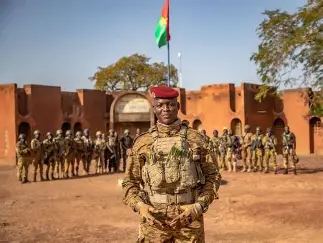
In Burkina Faso, Captain Ibrahim Traoré’s latest statements have intensified discussions about the nature of his leadership and the country’s political direction since the September 2022 coup. His unequivocal declarations now clearly signal an intent to openly embrace a seizure of power outside constitutional frameworks, reframing this breach as an acceptable political precedent.
The facts are indisputable. Ibrahim Traoré did not ascend to the presidency through electoral means. His rise followed a military takeover that ousted Lieutenant-Colonel Paul-Henri Sandaogo Damiba, who himself had come to power in a prior coup against President Roch Marc Christian Kaboré. This pattern of successive military overthrows underscores a fundamental departure from democratic principles that traditionally underpin a head of state’s legitimacy.
Critics argue that the issue extends beyond the circumstances of his accession. The most pressing concern lies in the discourse framing this power grab as a legitimate source of authority in itself. By publicly justifying this constitutional rupture, Traoré, according to analysts, normalizes the notion that force—provided it garners fleeting public support—could become an acceptable pathway to power.
This rationale carries grave implications. If political legitimacy no longer derives from institutions, elections, or the rule of law but instead from the ability of armed factions to impose their will, future grievances could similarly justify fresh military interventions. Such a cycle would erode state institutions and entrench chronic instability, where the barrel of a gun supersedes the ballot box.
Pro-government voices often highlight restored sovereignty, a break from foreign influences, and a resurgence of national pride as key achievements. While these narratives resonate with segments of the population, they cannot substitute for tangible governance outcomes. History demonstrates that patriotic slogans, no matter how stirring, do not compensate for economic stagnation, security failures, or institutional dysfunction.
Observers note a growing imbalance, with political messaging dominating governance. Patriotic imagery saturates public discourse, social media amplifies staged displays of support, and official communications prioritize symbolic gestures. Yet, fundamental questions linger over progress in critical areas that initially justified the coup: counterterrorism efforts, territorial restoration, and living conditions for ordinary Burkinabè.
Security remains the overriding benchmark for public approval. Despite announced military restructuring and counterinsurgency initiatives, lethal attacks persist in numerous regions, displacing thousands and deepening a humanitarian crisis that affects hundreds of thousands. In several localities, civilians continue to live under the shadow of armed groups, while access to healthcare, education, and basic services remains severely constrained.
The economic landscape presents equally daunting challenges. Persistent insecurity has crippled agricultural output, stifled domestic trade, and deterred investment. Citizens primarily seek tangible improvements: steady employment, higher purchasing power, reliable essential services, and stability to rebuild livelihoods. So far, these expectations have yet to be met with meaningful progress since 2022.
Analysts also highlight a troubling centralization of authority. Dissenting voices—journalists, civil society leaders, and opposition figures—face increasing constraints, with criticism often equated to treason. This conflation of national loyalty with unconditional regime support represents a dangerous deviation from democratic norms. In a functional democracy, loving one’s country does not require blind allegiance to its leaders.
The adage ‘Jupiter drives mad those he intends to destroy’ resonates here—not as a personal indictment, but as a reflection on power’s corrupting influence. Political history abounds with leaders who, convinced of their indispensability, silenced dissent, marginalized opponents, and conflated their personal survival with national salvation. Such hubris typically leads to isolation from the very realities their populations endure.
The danger, observers warn, lies in mistaking orchestrated applause, polished rhetoric, and curated loyalty for genuine progress. No amount of propaganda can replace measurable results on the ground. A leader’s true legitimacy is forged not through force, slogans, or defiance, but through institutional integrity, citizen protection, respect for freedoms, and sustainable improvements in living standards. It is against these benchmarks that Ibrahim Traoré’s tenure will ultimately be judged—and until decisive action addresses the security, economic, and social crises, debates over his authority will persist.