From erratic rains to devastating floods, Benin’s rural communities are on the frontline of climate change, facing mounting economic losses that threaten livelihoods and food security. With over 31,000 lives on the line, the government has rolled out a five-year plan worth $15.5 million to transform nine of the most climate-vulnerable districts into models of resilience. But what does this mean for farmers, local economies, and the nation’s food supply?
The stakes behind Benin’s climate adaptation fund
The Integrated Project for Strengthening Climate Resilience in Vulnerable and Border Communities (PIRRCF) isn’t just about building dams or planting drought-resistant crops. It’s a calculated move to safeguard Benin’s agricultural backbone—the backbone of its rural economy. With agriculture employing over 70% of the workforce and contributing nearly 40% to the national GDP, the stakes couldn’t be higher.
The project targets nine districts severely impacted by climate variability: Sèmè-Kpodji, Sakété, Kétou, Savalou, Dassa-Zoumè, Djougou, Copargo, Ouaké, and Malanville. These regions are not just agricultural hubs; they’re economic lifelines for thousands of farming families. Yet, their vulnerability to climate shocks is eroding their ability to feed the nation and sustain local industries. The PIRRCF aims to reverse this trend by addressing the root causes of climate-induced economic instability.
Climate change’s hidden economic toll on Benin’s heartland
Every delayed rainy season or flash flood doesn’t just mean lost crops—it means empty markets, higher food prices, and a ripple effect on national revenue. The minister of agriculture, Adin Yéton Bloukounon Goubalan, highlighted the stark reality during the project’s launch: farmers in these districts have seen entire maize and groundnut fields wiped out by erratic weather, pushing households further into poverty. This isn’t just a farming crisis; it’s an economic one.
The PIRRCF tackles this by integrating climate-smart agriculture with local economic development. By reducing dependency on unpredictable rainfall and lowering energy costs through renewable technologies, the project aims to break the cycle of vulnerability that keeps these communities trapped in poverty.
Water security and renewable energy: twin pillars of climate-proofing
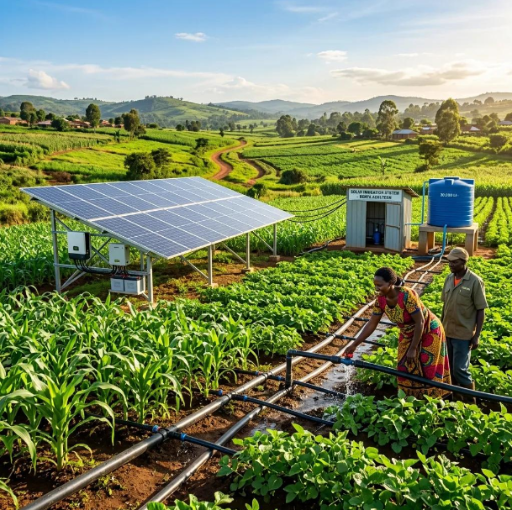
Agriculture in Benin remains heavily rain-dependent, and erratic weather patterns are turning a once-predictable cycle into a gamble for farmers. The PIRRCF is betting on water infrastructure and renewable energy as the twin engines of change. The project’s water strategy includes:
- Three multipurpose water reservoirs to store water for dry seasons and irrigation.
- Two valley bottoms developed to capture and store excess rainwater, reducing flood risks.
- Five drip irrigation systems to maximize water efficiency in crop fields.
- Twelve pastoral boreholes to secure water access for livestock, a critical asset for many rural households.
Complementing these are solar-powered water pumps and solar mini-grids, cutting energy costs for farmers and reducing reliance on costly diesel generators. With solar irrigation, smallholder farmers can extend growing seasons, diversify crops, and stabilize incomes—even in the face of climate unpredictability.
Local materials: building resilience into Benin’s infrastructure
The project isn’t stopping at water and energy. It’s also reshaping how Benin builds its future. By promoting locally made construction materials like compressed earth bricks and stabilized soil blocks, the PIRRCF supports sustainable building while boosting local industries. This approach has two key benefits:
- It lowers construction costs by reducing reliance on expensive imported materials.
- It creates jobs for women and youth in artisan cooperatives and small enterprises.
The Swiss cooperation sees this as a win-win: economic growth that doesn’t come at the expense of the environment. For rural communities, this means more stable housing, workshops, and markets—infrastructure that can withstand climate shocks rather than crumble under them.
Measurable outcomes: what success looks like by 2031
The PIRRCF’s ambitions are bold but clear:
- Train 20,000 farmers and community leaders in climate adaptation strategies.
- Boost agricultural productivity by 20% to meet growing food demand.
- Increase household incomes by 30% in 10,000 beneficiary households.
- Create 5,000 direct jobs and an additional 15,000 indirect jobs in climate-resilient sectors.
The impact will trickle beyond these numbers. Indirect beneficiaries could reach 1.5 million people, as improved food security strengthens local markets and reduces national reliance on imports.
The role of local governance in turning plans into progress
But money and plans won’t mean much without execution. The success of the PIRRCF hinges on strong local ownership. District authorities must take the lead in:
- Prioritizing infrastructure deployment to areas of greatest need.
- Ensuring community participation in project design and monitoring.
- Maintaining transparency in fund management and resource allocation.
Without this, even the best-laid plans risk becoming abandoned infrastructure or mismanaged resources. The government’s challenge is not just to fund resilience—but to build a system where resilience is sustained by the communities it serves.
The clock is ticking: why Benin can’t wait on climate action
The PIRRCF is a long-term investment, but its effects must be felt immediately. Farmers can’t afford to wait until 2031 to see if the project works. Their lives, their incomes, and Benin’s food security depend on swift, effective implementation.
This isn’t just about saving crops—it’s about preserving a way of life. For the 31,687 direct beneficiaries, including over 12,300 women, the project represents a lifeline. For Benin, it’s a test of whether the nation can turn climate vulnerability into a platform for sustainable growth.
As the sun rises over these nine districts, the question remains: will the rains come on time? With the PIRRCF’s tools and technologies, Benin is placing its bets not on luck—but on preparedness.