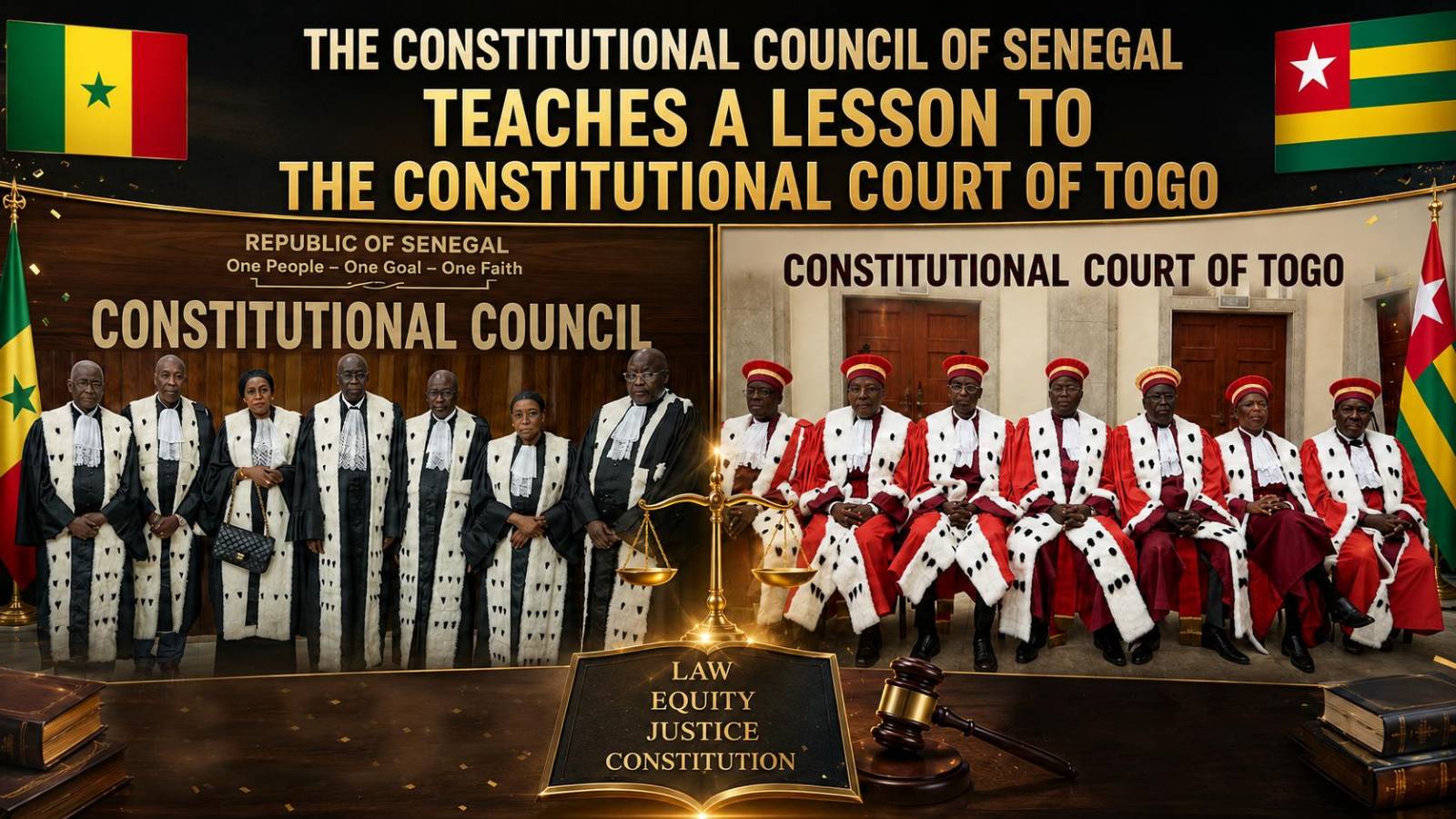
Two African capitals, two distinct interpretations of legal sovereignty
The capital cities of Sénégal and Togo are currently showcasing sharply contrasting philosophies regarding the enforcement of constitutional law. Recent landmark decisions by their highest judicial bodies have underscored two fundamentally different visions of institutional authority and its limits.
Dakar’s judicial guardianship upholds constitutional supremacy
In Sénégal, the Conseil constitutionnel took a decisive stance against an attempt to amend constitutional provisions backed by both the government of Prime Minister Ousmane Sonko and the parliamentary majority. The judicial body’s ruling sent a clear message: electoral victories do not grant unchecked authority. Under the rule of law, political legitimacy must always yield to constitutional primacy. The decision reinforced the notion that no institution—regardless of its democratic mandate—can override the foundational text that defines the state’s legal and political framework.
Lomé’s constitutional court validates sweeping reforms amid controversy
Across the border in Togo, the Cour constitutionnelle has taken a markedly different path. It approved a comprehensive constitutional overhaul despite widespread objections from political opposition groups, civil society organizations, and legal experts. Critics argue that the reform process lacked genuine national consultation and was driven more by political expediency than by a collective search for consensus. A constitution, they contend, should represent a social contract built on broad agreement—not a legislative instrument tailored to serve the immediate interests of those in power.
The independence of judicial bodies as a cornerstone of democratic resilience
The contrasting rulings in Dakar and Lomé highlight a critical truth: the strength of a democracy is not determined solely by the wording of its constitution, but by the willingness of its institutions to enforce that constitution with integrity and independence. When constitutional courts act as impartial arbiters, they protect both the legal framework and the stability of the state. They prevent political disputes from escalating into institutional crises or legitimacy deficits.
In Sénégal, the Conseil constitutionnel’s refusal to endorse a government-backed constitutional revision has strengthened public trust in the judiciary. Citizens see a court that can challenge executive decisions without succumbing to political pressure—a signal that the rules of democracy apply universally. Such legal predictability fosters political stability, bolsters investor confidence, and enhances the country’s international standing.
By contrast, when a constitutional court is perceived as merely rubber-stamping executive decisions, it risks eroding its moral authority. Citizens may conclude that domestic legal recourse is ineffective, pushing them to seek justice through regional or international tribunals. This appears to be the case in Togo, where the ECOWAS Court of Justice has increasingly intervened in matters concerning fundamental rights and freedoms—an indication of systemic weaknesses in the national legal protection framework.
Constitutional reform: substance over symbolism
The method by which a constitution is amended carries long-term implications for democratic health. In mature democracies, constitutional changes are typically preceded by extensive national dialogue, robust debate, and efforts to build consensus. This caution stems from the fact that a constitution does not govern only the present; it sets the rules for future power transitions.
When constitutional revisions are seen as serving short-term political objectives, they create dangerous precedents. Successive governments may be tempted to reshape institutional arrangements to their advantage, fostering chronic instability and concentrating power in the hands of a few. The risk is not merely legal but deeply political: a constitution that no longer unites the nation becomes a perpetual source of conflict, turning institutions meant to arbitrate disputes into objects of contention themselves.
Learning from comparative governance: beyond imitation
In its quest to transition toward a parliamentary system, Togo has sent delegations abroad—including to India—to study alternative models of governance. While comparative analysis can offer valuable insights, it cannot replace an honest assessment of African experiences shaped by similar historical, social, and political realities. The continent offers numerous examples where democratic consolidation has succeeded not through imported models, but through the rigorous application of constitutional principles.
Sénégal, with its Conseil constitutionnel, exemplifies how institutions earn credibility not through rhetoric, but through decisive action—even when such action challenges the ruling establishment. This difference is not merely symbolic. It influences governance quality, citizen trust, international image, and economic attractiveness. Countries with stable and respected legal frameworks attract more investment and cooperation than those where institutions appear to bend to political winds.
The essence of the divide: law as limit or law as tool
At its core, the divergence between Dakar and Lomé reflects differing philosophies of constitutionalism. In Sénégal, the constitution is viewed as a constraint on power, a bulwark against executive overreach. In Togo, critics argue it has become a malleable instrument, adapted to serve the priorities of the moment. A resilient democracy is not measured by the frequency of constitutional amendments, but by the capacity of its institutions to protect citizens from all forms of power abuse—regardless of origin.