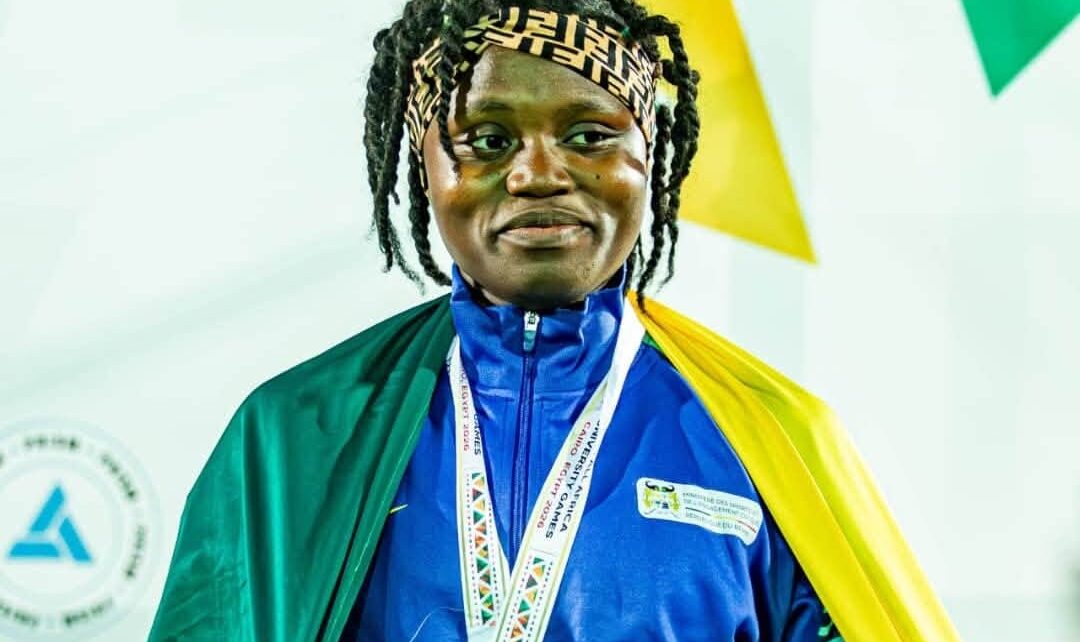
When Brigitte Tchede stepped onto the podium in Cairo, she did more than collect personal hardware. Her two medals at the 12th African University Games gave Benin its first real foothold in the competition — and handed the country a tangible return on the kind of investment that often goes unnoticed: student sport. The impact stretches beyond the track and field, touching national pride, athlete development, and the case for funding university athletics.
A double podium that reshapes Benin’s expectations
The Egyptian capital hosted the 12th edition of the African University Games from 8 to 16 September 2026, drawing student-athletes from across the continent. For Benin, the stakes went beyond participation. The event offered a chance to test emerging talent against continental opposition and to confirm that some of its athletes are ready for bigger stages.
Brigitte Tchede seized that opportunity. The Porto-Novo native secured Benin’s first two medals of the 2026 edition, taking silver in the discus throw and adding another podium finish in a second discipline. Her success quickly became one of the defining stories of Benin’s campaign.
Discus silver and a personal best that raises the bar
The first medal came on Sunday 13 September. Competing in the women’s discus, Tchede finished second with a throw of 47.08 metres. Beyond the silver, the mark represented a new personal best. She improved significantly on her previous record of 44.37 metres, set in May at the African Athletics Championships in Accra, Ghana.
The jump from 44.37m to 47.08m — a gain of 2.71 metres — is notable in a discipline where centimetres often separate competitors. It reflects months of consistent work and an ability to deliver under continental pressure. For Tchede, already known in Benin for her international performances, the Cairo result signals a step up in class.
Versatility on display with a second medal
Tchede’s contribution did not stop at the discus circle. She also reached the podium in a different event, giving Benin a second medal at the Games. Winning in two separate disciplines highlights her range and her capacity to perform across multiple fronts — a rare asset in university sport.
For the Beninese delegation, the double podium carries symbolic weight. In a competition featuring universities from across Africa, opening the medal tally with two awards from the same athlete sends an encouraging signal about the depth of talent available.
From Porto-Novo to Accra to Cairo: a trajectory on the rise
Tchede’s recent record tells a story of steady progression. Her previous best of 44.37 metres came just months before Cairo. In Egypt, she pushed that mark to 47.08 metres. The improvement should not be seen as an endpoint. With the Games still winding down, the Cairo performance looks more like a new platform than a final destination.
For Benin, the value lies in continuity. The gap between the African Championships and the University Games shows that regular competition and structured training can move Beninese athletes closer to the continent’s best. Each international outing adds experience and raises personal benchmarks.
Why the fallout matters beyond the medals table
With the Games scheduled to close on 16 September, Benin already has a notable haul thanks to Tchede. Her discus silver will remain tied to her new personal best, while her second medal confirms her central role in the delegation.
The consequences extend beyond the immediate celebrations. Two medals from a university competition strengthen the argument that student sport can serve as a launchpad for athletes who go on to represent the country at major international events. For young Beninese athletes, Tchede’s Cairo breakthrough offers a visible pathway — and a reminder that university games are not a side show but a serious stage.
As the Cairo edition concludes, Benin leaves with more than medals. It takes home a new national reference point of 47.08 metres, a proven multi-event performer, and a clearer sense of what sustained support for university athletics could deliver in the years ahead.