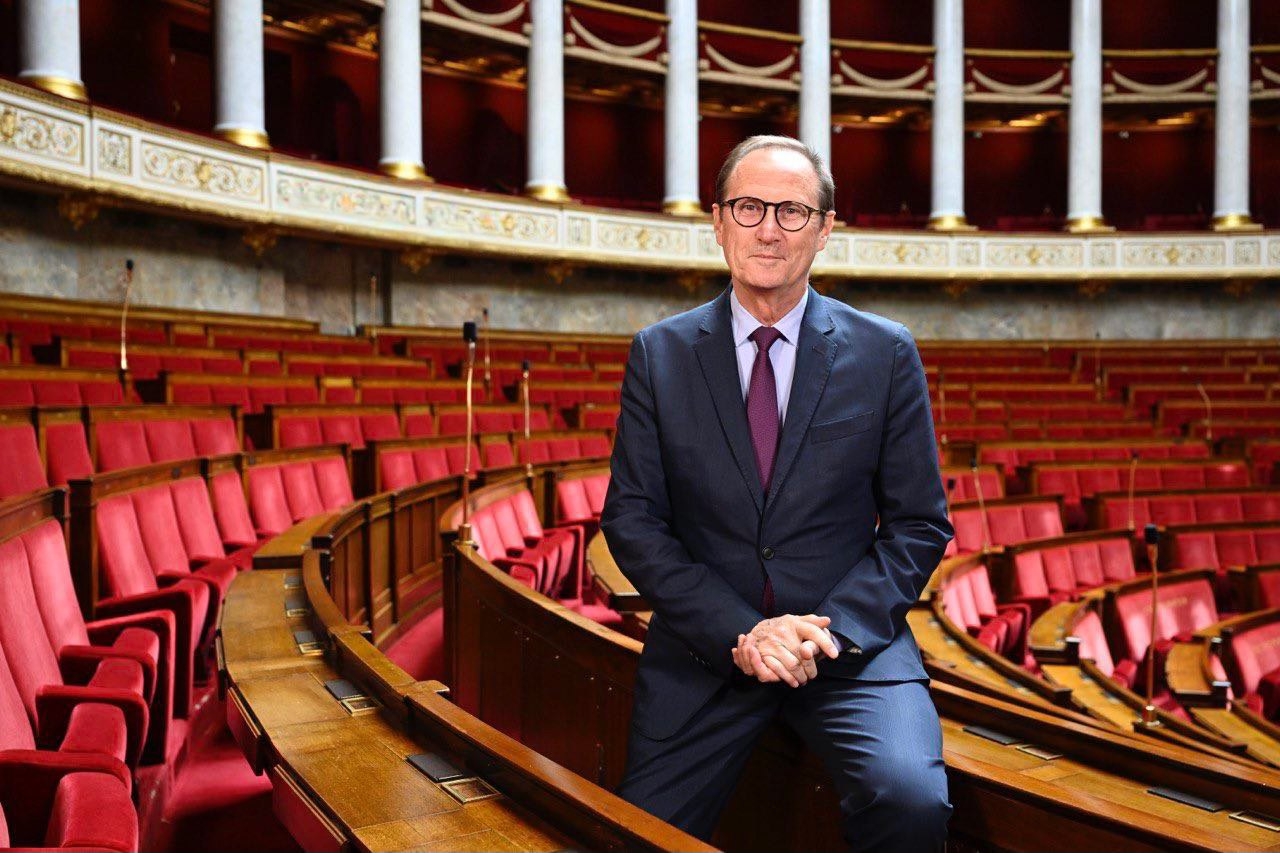
Bruno Fuchs’s bold vision for Mali: negotiating with JNIM
The evolving French position on Mali’s deep-seated crisis is now strikingly evident. Bruno Fuchs, a centrist (Modem) and President of the National Assembly’s Foreign Affairs Committee, a frequent companion on Emmanuel Macron’s international trips, articulated his views without reservation.
Beyond his optimistic assertions regarding France’s future on the continent — suggesting that “eliminating irritants like the CFA franc and visa issues” would restore France as a “desired power” — the interview reveals a fundamental internal conflict. It juxtaposes pledges to move past the colonial Françafrique relationship with an unwavering drive to reclaim influence ceded to Russia.
What proves most cynical and exasperating are the remarks concerning Mali. Bruno Fuchs, seemingly echoing certain French military and political strategists who reportedly welcomed the complex attack on April 25, presented a clear narrative: “The Russians are currently negotiating their withdrawal from Mali, and the governing junta in Bamako is set to collapse within a matter of weeks or months.”
When asked by the interviewer if France was pleased with the reported military setbacks faced by Russians in northern Mali, a question prompted by President Emmanuel Macron’s recent statement in Nairobi — that “the departure of French soldiers was undoubtedly not the best decision the putschists made for their country” — Bruno Fuchs provided a nuanced response.
“To have removed the French partner proved counterproductive”
Bruno Fuchs sidestepped the direct inquiry, instead rephrasing the President’s sentiment: “To have removed the French partner proved counterproductive.” The message was clear. The deputy then continued with his forecast: “The Malian junta, in my estimation, has only days or weeks remaining. Currently, it finds itself in a vulnerable position against the FLA and JNIM. Consequently, a change in Mali’s leadership is unavoidable within the next few weeks or months.”
The parliamentarian then ventured into particularly delicate territory, positing that Malians face a choice between “integrist jihadists” (which he described as a “curious concept,” and “not for all”—a “fascinating” distinction) and the FLA rebels, on one side, and “democratic life, public freedoms, and Mali’s former way of life,” on the other. He emphatically stated, “Life in Mali risks changing,” seemingly overlooking the fourteen years of conflict that have already ravaged the resilient population.
“How to integrate the JNIM?“
With unwavering confidence, Bruno Fuchs proceeded to outline Mali’s potential political future, presenting two distinct scenarios. In the first, Bamako agrees to negotiations. He stated, “Should the junta and President Assimi Goïta act reasonably, they would initiate negotiations. This would involve a transitional period of three to six months, led by a military figure from the current transition—though I won’t disclose names, it would not be Assimi Goïta—culminating in elections within that timeframe.” The proposed timeline appeared unrealistic. Such a transition, potentially influenced by JNIM, would, in his view, raise a critical question: “How does one integrate the JNIM into governance and collaborative efforts?” The phrasing demanded scrutiny: the JNIM is an al-Qaida affiliate, its leader Iyad Ag Ghali was once France’s primary adversary, and France sustained 57 casualties in the conflict against this group in the Sahel.
Bruno Fuchs seemingly possessed direct intelligence concerning the JNIM, perhaps even more than any Malian. This was presented as a significant revelation: “I believe the JNIM is prepared to disarm and halt armed conflict, on the condition of participating in the nation’s political life. Not to seize control of Mali, but to engage in its political processes.” The President of the Foreign Affairs Committee offered no explanation as to why the most dominant force on the ground would be content with mere participation without asserting its full authority. Perhaps, as is often said, participation itself is paramount. This then led to a difficult dilemma: “The question that will confront us, as Europeans or French, is what course of action do we take? Do we endorse this transition where the JNIM holds a political role, or do we not? I lack the definitive answer, but it presents a genuine moral and political challenge.” Indeed, this is a profound question, not solely for “us, Europeans or French,” but first and foremost for the Malian people.
“The worst: Afghanistan”
- Bruno Fuchs then produced a second scenario. “The junta is determined to resist, refuses dialogue, and eventually finds itself in a weakened state. The Russians are, despite their assertions, negotiating their exit (…) At that point, the junta will inevitably collapse. If a negotiated settlement isn’t reached, the outcome will undoubtedly be worse than if negotiations had occurred.” He did not specify for whom this “worse” outcome would be—Mali, the region, or France. Reverting to his initial scenario, the deputy expanded on the potential results of the anticipated negotiations.
“We might witness a Mauritanian-style arrangement, characterized by a religious government; or a Nigerian model, involving a federal state within Mali where certain states adhere to Sharia law (…) while others do not. Essentially, a federal state with diverse governance structures, ensuring the representation and role of each community in the nation’s political sphere, akin to Nigeria.” This particular scenario appeared to be Bruno Fuchs’s preference: a moderately Islamic Republic where the representation and roles of all communities are secured. He did not, however, elaborate on the “how.” It was a missed opportunity to advance the discussion, as Mali’s challenge lies precisely in communities sharing a common territory, not residing in segregated “bantustans.” The entire proposition remained indistinct, even hazy.
The second scenario, described as the “ultimate scheme,” was Afghanistan. While Fuchs seemed at ease with his preferred outcome, he explicitly stated he did “not wish for an Afghanistan in the very heart of the Sahel, as this would have repercussions across the entire region”—affecting not only the Sahel nations but also their “innocent” neighbors: Guinea, Senegal, Côte d’Ivoire, Bénin, and Togo. “Complicated,” he concluded, an understatement indeed.
“The Russians would be ready to return”
Slightly taken aback by these assertive pronouncements, Christophe Boisbouvier pressed further: “Do you possess evidence suggesting the Russians are preparing to depart Bamako?” Bruno Fuchs responded without flinching: “They are engaged in negotiations. They have adjusted their positions. Discussions are presently ongoing.” Regarding the uncertain outcome of these talks, he stated, “everything hinges on the JNIM, everything hinges on the junta.” Nevertheless, he remained convinced that the Russians “would be prepared to withdraw, subject to certain assurances concerning the assets they currently operate in Mali, such as gold mines, which they are keen not to lose, even if, in my estimation, their legitimacy to exploit these resources is rather dubious.”
Despite his stated desire to conclude the “unfortunate chapter of Françafrique” with its “colonial-era behavior,” its “unresolved history with Francophone Africa,” and its tendency to impose “our truths and perspectives” while resisting “any opposition,” Bruno Fuchs held firm opinions on the legitimacy of exploiting Mali’s resources. The underlying message was clear: France, and by extension “Europe, to avoid immodesty,” possesses greater legitimacy than Russia. His reasoning? France “is dependable in its commitments,” unlike the Americans and Russians “who are withdrawing from Mali because their endeavors there are not succeeding.” Contradicting himself somewhat, he then referenced the Central African Republic, where “we have normalized our relations, we have re-established normal ties with President Faustin Archange Touadéra,” even with the continued Russian presence. “We must learn to collaborate with everyone,” he declared. This “everyone,” however, seemingly excludes the disfavored leaders of the Alliance of Sahel States.