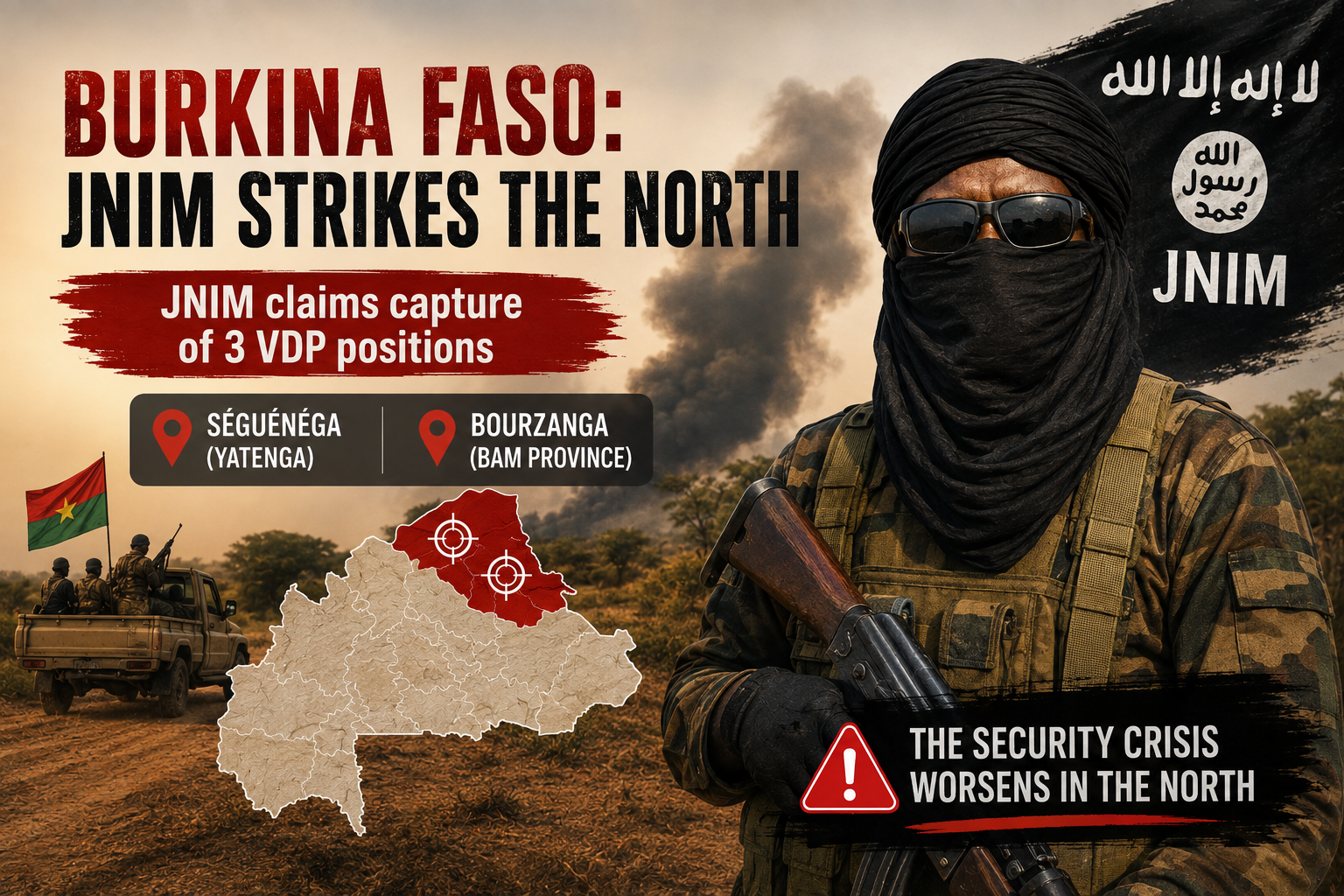
Despite persistent efforts to address the ongoing security crisis in Burkina Faso, the nation’s approach to communication and governance remains under intense scrutiny. On August 19, the Group for the Support of Islam and Muslims (JNIM) executed a series of coordinated assaults, seizing three strategic bases operated by the Volontaires pour la défense de la patrie (VDP) in the northern provinces. The targeted locations included Séguénéga in Yatenga province and Bourzanga in Bam province. These incursions underscore a troubling trend, as armed factions continue to expand their territorial reach with alarming ease.
Assessing the limitations of military reconquest efforts
The recurrent nature of these attacks raises serious doubts about the effectiveness of current military operations, particularly regarding their ability to secure and maintain control over recovered zones. The escalation of violence, the heightened vulnerability of civilian populations, and the recurrent loss of strategic positions collectively suggest that military action alone is insufficient to address the crisis. To achieve sustainable stability, additional measures must be implemented, including sustained state presence, enhanced intelligence operations, improved logistical frameworks, and, most critically, unwavering protection for civilian communities.
Of particular concern is the central role of the VDP within Burkina Faso’s security framework. These auxiliary forces, often deployed to the frontlines, face well-armed and highly mobile adversaries capable of rapid, disruptive maneuvers. Consequently, the loss of any VDP position not only signifies a tactical defeat but also undermines public confidence, accelerates civilian displacement, and complicates humanitarian access in affected regions.
The inadequacy of political responses to escalating threats
Rather than confronting the root causes of the security dilemma, Captain Ibrahim Traoré’s administration appears to rely on disjointed rhetoric and populist messaging as a means of deflecting criticism. Public statements, often lacking clear policy direction and substantive solutions, seem designed to placate a population increasingly frustrated by the daily erosion of safety and stability. However, such tactics do little to address the urgent challenges at hand protecting rural communities, securing critical infrastructure, and safeguarding civilian lives. Citizens, in turn, demand tangible and verifiable progress rather than rhetorical assurances.
The crux of the issue extends beyond mere political discourse. It hinges on whether government actions genuinely enhance the security and well-being of the Burkinabè people. Repeated setbacks, whether in the form of fallen positions, abandoned villages, or persistent attacks despite resource mobilization, reveal fundamental deficiencies in strategy execution and state accountability.
The suppression of critical discourse: implications for national resilience
The Burkinabè media landscape, once dynamic and investigative, now operates under severe constraints. Journalists and commentators who seek to report on ground realities or challenge official narratives face severe repression, including arrests, forced disappearances into alleged re-education centers, or coercion into frontline service under the pretext of patriotism. This systematic suppression of dissent not only erodes democratic freedoms but also deprives the nation of essential perspectives needed to evaluate the effectiveness of security policies.
Independent reporting serves as a vital mechanism for identifying vulnerabilities, tracking progress, and holding authorities accountable. Silencing those tasked with documenting the crisis does not eliminate the underlying problems; rather, it fosters a dangerous disconnect between official narratives and lived realities. The more the government restricts open dialogue, the greater the risk of misaligned priorities, unaddressed failures, and prolonged suffering among affected populations.
The necessity of transparency in counter-terrorism efforts
The paradox facing Burkina Faso today is stark: as the security situation deteriorates, the space for critical analysis and public debate narrows. A robust security strategy requires not only resolve but also the humility to acknowledge setbacks, analyze their origins, and adapt accordingly. While avoiding scrutiny may offer short-term political advantages, it ultimately deprives leaders of the insights necessary to refine their approach.
By restricting access to independent information, the government risks entrenching itself in a cycle of denial one that fails to address the gravity of the crisis. Combating terrorism demands more than firm action; it requires transparency, responsibility, and a willingness to confront uncomfortable truths. In the final analysis, the true measure of success lies not in the strength of official statements but in the safety and security of Burkina Faso’s citizens. As long as armed groups continue to gain ground and inflict harm, the onus remains on authorities to demonstrate meaningful results rather than rely on hollow rhetoric.