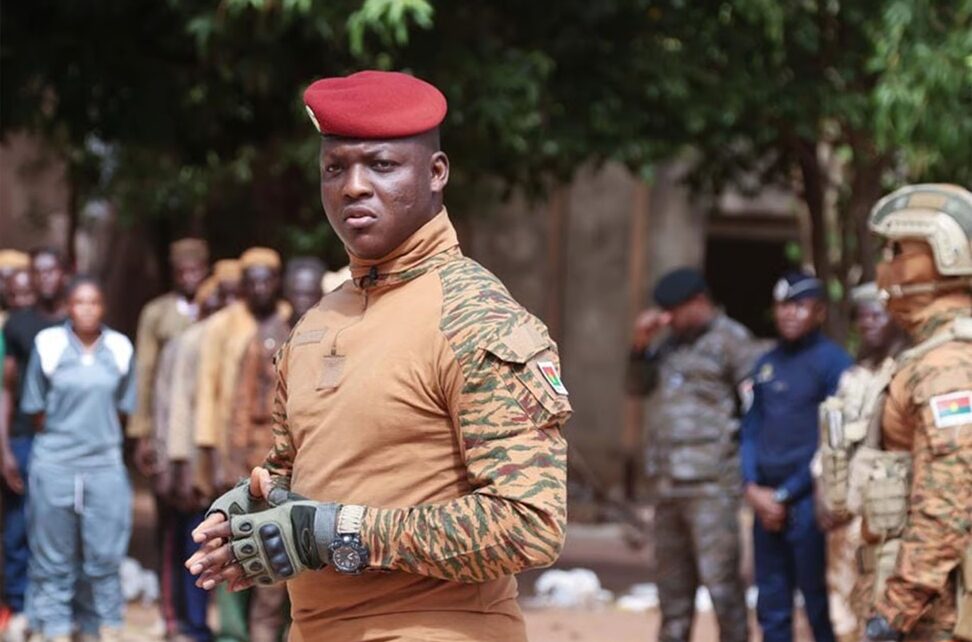
Forty-four Burkinabè journalists recently completed a six-day military training program in Pabré, just outside Ouagadougou, marking an unprecedented move by Burkina Faso’s military-led government. Organized by the Ministry of Security at the Police Academy, this compulsory session is framed as a patriotic immersion within the broader counterterrorism campaign declared by the junta under Captain Ibrahim Traoré to combat Al-Qaeda and Islamic State-affiliated groups active in the region for over a decade.
A video shared by the state broadcaster RTB captured the journalists—men and women in military fatigues, rifles in hand—standing at attention during the closing ceremony. Government spokesperson and Minister of Communication Pingdwendé Gilbert Ouédraogo addressed the group, asking, « Will you be patriotic and professional journalists? » To which the journalists responded in unison, « Affirmative. »
« A professional journalist who lacks patriotism poses a threat to their nation, » Ouédraogo warned. « A professional and patriotic journalist who remains unengaged is merely a passive observer in the defining moments of their country’s history. » Lassina Traoré, Director General of the Police Academy, later explained that the training aims to « instill operational realities and values guiding the daily actions of defense and security forces » in the participants.
The initiative has drawn sharp criticism from press freedom advocates. Sadibou Marong, Director of Reporters Without Borders’ Sub-Saharan Africa bureau, condemned the program as « a disturbing new precedent for press freedom. » He emphasized, « Journalists are not soldiers, nor should they be conscripted as propaganda tools, dressed in military uniforms and bearing arms. »
This mandatory military immersion aligns with a wider political agenda under Captain Traoré, who seized power in a 2022 coup, positioning himself as a champion of national sovereignty. Notably, a similar military training requirement was imposed last year on secondary school students sitting for their final exams.
The forced integration of journalists into this military framework occurs against a backdrop of intensifying pressure on domestic and international media outlets. Several outlets have faced abrupt suspensions by transitional authorities, while human rights groups report that dissenting journalists have been forcibly conscripted and sent to frontline areas. The case of journalist Serge Oulon, who remains detained two years after his abduction in Ouagadougou, underscores the escalating tensions.