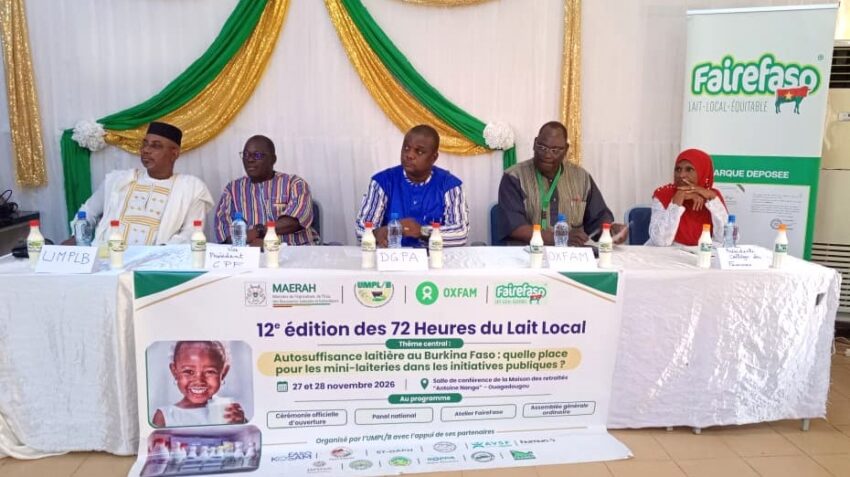
Public scrutiny grows over Burkina Faso’s dairy policy as small-scale plants demand greater inclusion
Ouagadougou’s 12th edition of the local milk festival opened this Friday with a sharp focus: how to turn Burkina Faso’s network of small-scale milk processing plants into full-fledged partners in national dairy policy. For years, these mini-dairies have boosted local job creation and food security, yet public recognition and integration remain uneven, sparking a growing national debate over their future role.
The festival’s mandate: from dialogue to action
The three-day forum, convened annually since 2015 by the National Union of Mini-Dairies and Milk Producers (UMPLB), gathers producers, policymakers, and development partners to address systemic challenges. This year’s theme—“Local dairy self-sufficiency: what place for mini-dairies in public initiatives?”—reflects mounting public pressure to move from rhetoric to concrete inclusion of local processors in state-led dairy programs.
From challenge to milestone: what the mini-dairy network has achieved
The UMPLB network has grown from 101 mini-dairies and 94 producer organizations in 2024—encompassing roughly 4,000 members, 80% of them women and 35% young people—to become a proven engine of rural employment and market integration. In 2025 alone, the network:
- Collected 1.84 million liters of fresh local milk, a 15% increase over the previous year;
- Generated over 1.3 billion West African CFA francs in revenue;
- Sustained an estimated 612 jobs, with 250 direct and 362 indirect positions across the value chain.
The network has also led professionalization efforts, training over 1,200 actors in seven dairy trades through certified vocational programs and green-skills initiatives since 2021. It has launched nine “lait-resto” outlets and established a registered, collective brand—“FasoFresh: Fair, Local, Certified”—with protection under the African Intellectual Property Organization (OAPI).
Policy integration: the missing link in Burkina Faso’s dairy revolution
Despite these strides, the sector’s potential remains constrained by weak public integration. Speaking on behalf of development partners, Adama Zim emphasized that “dairy self-sufficiency is not merely a production target—it is a commitment to economic justice and social transformation.” The consensus emerging from the festival is clear: mini-dairies must transition from peripheral actors to central pillars of national dairy policy.
Specific demands aired during the event include:
- Full inclusion in public collection and processing schemes, with transparent quotas and fair pricing;
- Operational partnerships with Faso Kosam and Faso Guulgo to expand cold-chain logistics and market access;
- Equitable access to finance, refrigeration units, renewable energy, inputs, and extension services;
- Priority access to institutional markets—especially school canteens and public catering—provided local dairy products meet national quality standards.
What’s next? A roadmap under scrutiny
Addressing the forum via video message, General Director of Animal Production Yisso Ulrich Bakoné set clear expectations: “This panel must deliver a realistic roadmap—one that identifies priority basins and services, clarifies complementarities with public initiatives, and sets responsibilities, deadlines, and monitoring mechanisms.”
The stakes are high. With rural youth migration and food import bills rising, Burkina Faso’s dairy policy is at a crossroads. The outcome of this debate will determine whether mini-dairies remain a symbol of promise or become an institutionalized engine of inclusive growth.
Signs of progress, but the clock is ticking
UMPLB President El Hadj Ibrahim Adama Diallo acknowledged partial progress but warned that “time is not on our side.” He called on the government to accelerate the integration of mini-dairies into national programs, stressing that their growth is vital for both food sovereignty and social equity. As the festival concluded, participants left with a shared resolve: the next 12 months will be decisive in shaping Burkina Faso’s dairy future.