Burkina Faso’s public debt has now crossed the 8,700 billion FCFA mark, and its consequences are no longer confined to budget annexes. They reach into the resources the state can devote to public services, the conditions under which local banks and businesses obtain financing, the weight of interest payments absorbed before any other expenditure, and the fiscal margin the country will have for years to come.
Ibrahim Traoré regularly repeats that Burkina Faso must rely on its own strength and has no need to borrow in order to build its development. The message is presented as a break with past practice: less external dependence, greater economic sovereignty, and development financed from national resources.
The public debt figures, however, call for a more measured reading of that assertion.
A debt trajectory that narrows the state’s room for manoeuvre
Behind the political narrative lies an accounting reality: Burkinabè public debt has risen sharply in recent years, at a pace that increasingly constrains public decision-making.
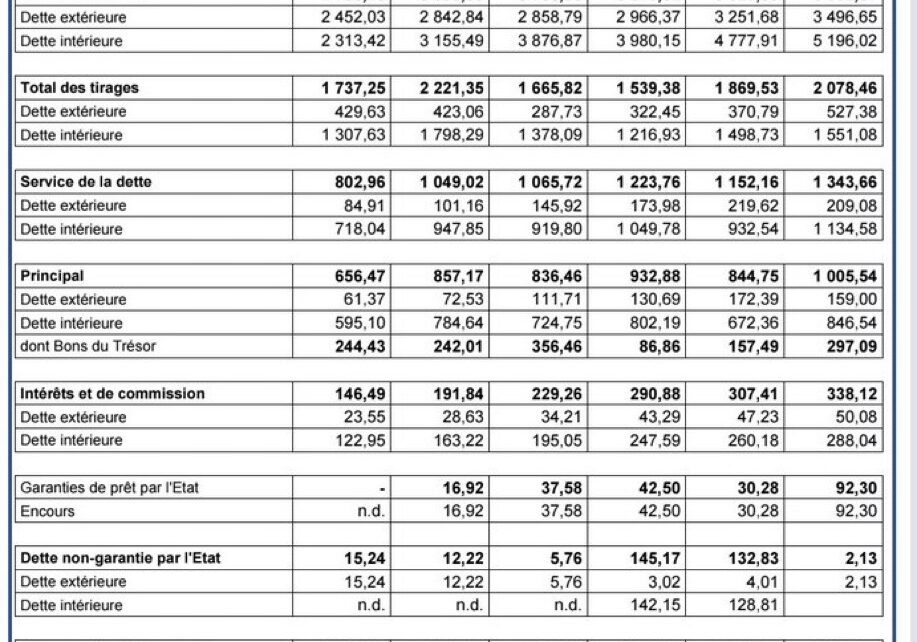
At the end of December 2020, the outstanding debt of central government amounted to 4,765.45 billion FCFA. By the end of 2021, it had already reached approximately 6,107 billion FCFA, as recorded in Ministry of Economy and Finance documents.
The upward movement has continued since. The most recent available statistical bulletin of the Burkinabè Treasury places central government debt at 8,692.67 billion FCFA at the end of December 2025, then at 8,731.5 billion FCFA at the end of March 2026.
In practical terms, within a few years the country moved from an indebtedness level below 5,000 billion FCFA to more than 8,700 billion.
The decisive question is not whether a state borrows
Public indebtedness is not automatically synonymous with poor management. A state may legitimately borrow to finance infrastructure, support investment, respond to a security crisis, or sustain public spending when its own revenue falls short.
The essential question is therefore a different one: what do the new loans finance, at what cost are they contracted, and what future repayment capacity do they generate?
Domestic debt now dominates the portfolio
The very structure of Burkinabè debt deserves close attention. At the end of 2025, nearly 60% of central government debt consisted of domestic debt, largely in the form of Treasury bills and Treasury bonds. Domestic debt alone stood at roughly 5,196 billion FCFA.
This shift matters all the more because domestic financing is not free of charge. The principal must be repaid, and interest paid on top of it. By the first quarter of 2026, debt service had already reached 407.1 billion FCFA, an increase of 31.5% over one year.
What the interest bill takes away from everything else
Every franc absorbed by debt service is a franc that cannot be allocated to schools, health centres, roads or security operations in the same budget year. As domestic borrowing grows, that absorption becomes more pronounced, and the cost of refinancing existing securities becomes a structural constraint rather than a one-off event.
For businesses, the effects are indirect but tangible: heavy recourse by the state to domestic markets influences the terms on which credit circulates in the wider economy, and therefore the investment capacity of private actors.
Economic sovereignty also carries a price tag
Ibrahim Traoré can legitimately defend a policy of economic sovereignty. Yet sovereignty is not measured solely by the refusal of certain partnerships or by declarations of financial independence.
It is also measured by a state’s capacity to raise its revenue sustainably, control its expenditure, finance its investments, and contain the weight of debt service.
Burkina Faso possesses significant mining resources, gold in particular. The existence of those resources does not, however, automatically mean that the state holds sufficient liquidity to finance all of its ambitions without resorting to borrowing.
This is precisely where the debate ought to shift: the real issue is not to proclaim that Burkina Faso will not borrow, but to demonstrate that every franc borrowed generates enough value to justify its cost.
How international assessors weigh the risk
The International Monetary Fund, in its 2026 analysis, classifies Burkina Faso as facing a moderate risk of debt distress while considering the debt sustainable over the medium term. The institution nonetheless highlights several vulnerabilities, among them the refinancing risk attached to domestic debt, dependence on gold export receipts, and the security situation.
It would therefore be excessive to present this increase mechanically as proof that Burkina Faso is insolvent. The available data do not support such a conclusion.
But it would be equally difficult to argue that the country has developed in recent years without significant recourse to borrowing. The figures tell a different story.
The explanations the authorities will have to provide
Between the end of 2020 and the first quarter of 2026, central government debt rose by close to 4,000 billion FCFA. The government may point to its investments, its military effort, its infrastructure or its social policies, but those expenditures must be set against the evolution of the debt.
The questions that now remain are simple, yet politically and economically decisive:
- How much has been borrowed during this period?
- From which creditors, and at what interest rates?
- Which projects were financed with those funds?
- What measurable results have been delivered for the population?
If Burkina Faso does not need to borrow in order to build itself, how is the increase of several thousand billion FCFA in public debt to be explained?
A contradiction whose consequences will shape the next budget
It is on this apparent contradiction between the discourse of financial sovereignty and the evolution of public accounts that the government of Ibrahim Traoré will have to supply precise answers. The matter is not merely rhetorical: repayment schedules, interest charges and refinancing calendars will determine what remains available for citizens and for the economy in the years ahead.
In public finance, slogans may persuade. The numbers, for their part, remain to be explained.